From King's Bounty to Erathia: Who Made the Third Heroes
To understand the longevity of Heroes of Might and Magic III: The Restoration of Erathia, it helps to start with how the game is built. It brings together three different scales of decision-making. On the map, you look for roads, resources, and ways around the enemy; in town, you plan your economy for the start of the next week; in battle, you calculate the strength of small armies. Each scale is easy to grasp after a few turns, but together they create an almost inexhaustible range of situations. And hot-seat mode lets you experience them not only alone, but with someone sitting right beside you.
The formula's roots go back to King's Bounty, a game created by New World Computing in 1990. It already featured a hero, map-based exploration, army recruitment, and turn-based battles. Later, this collection of ideas grew into Heroes of Might and Magic. At the same time, the series remained connected to the broader Might and Magic role-playing universe, which Jon Van Caneghem had been developing since the 1980s. It's important to distinguish the role of a studio founder from the direct leadership of a particular production: Van Caneghem founded New World Computing and defined the franchise's direction, but the third game was made by a team, not one person.
In his own recollections, producer and development lead David Mullich described assembling the group for Heroes III. One of its key members was lead designer Greg Fulton. This is a useful corrective to the familiar legend that every decision in the game belonged to Van Caneghem. Different specialists worked on maps, rules, the interface, art, music, and testing. Their task was not to abandon the second game, but to make its familiar formula broader and clearer.
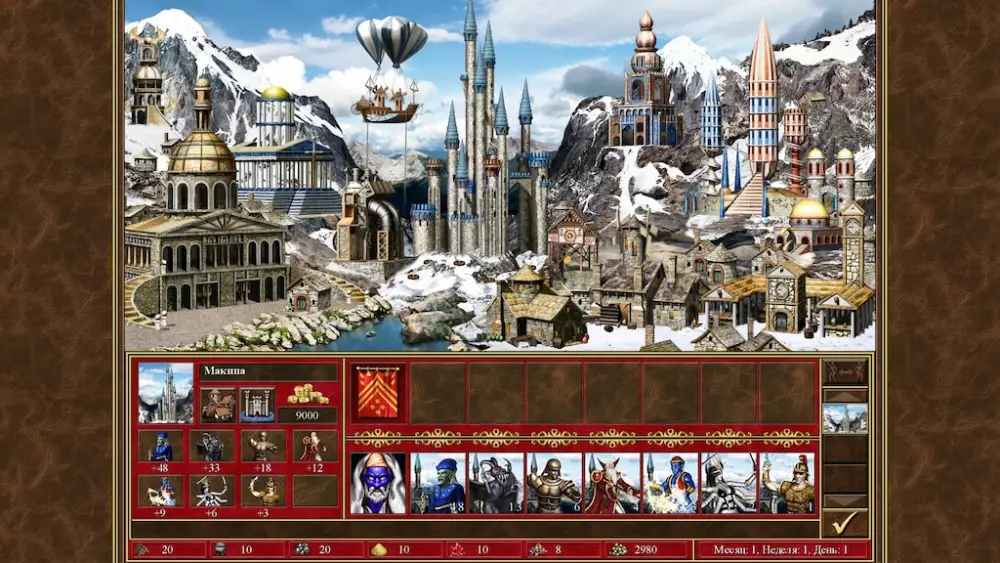
The Restoration of Erathia went on sale on February 28, 1999. Behind the grand title was more than a new story about the kingdom of Erathia. The third game reshaped the series' visual language and added details that made each turn feel like a small journey. The clever touch is not simply the number of creatures, but how they are woven into planning. You can lose a battle through a tactical mistake, but defeat often begins earlier, when you fail to buy troops in time or spend your wood on the wrong building.
Seven Days, One Castle, and Too Many Decisions
A week in Heroes III consists of seven in-game days. At the start of each new week, creature-producing buildings replenish the available recruitment pool. This simple rule acts as a timer for a whole set of decisions. Should you bring your main hero home for reinforcements? Can a secondary character capture a mine by Monday? Will you have enough gold for new troops if you build an expensive citadel today? The game rarely demands an immediate answer, but it almost always makes you feel the cost of delay.
Resources are not an abstract shared balance; each represents a different kind of scarcity. Gold is needed to sustain the economic cycle and recruit creatures; wood and ore often determine what you can build early on; rare materials become necessary for certain buildings and powerful armies. In some games, you long for one more chest of gold; in others, for a single crystal. The map and starting conditions change the value of the very same items every time.
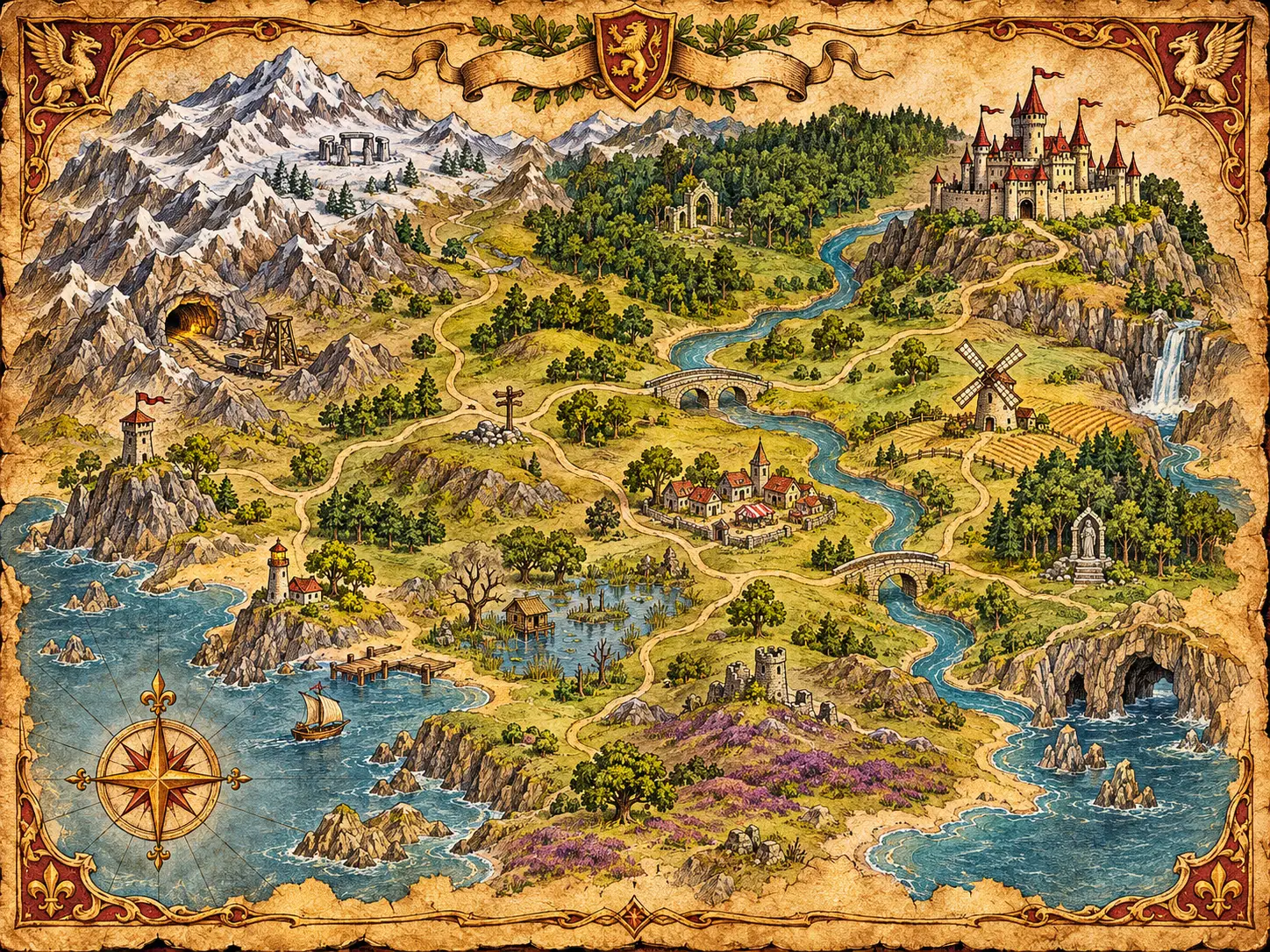
That is why geography matters so much. A narrow pass turns a neutral army into a border guard. A distant windmill might offer a small reward, but reaching it costs precious movement points. An object that seems trivial at the start of the game becomes decisive if there is only one day left until the next week. The Heroes III map is not just a backdrop: it constantly asks you to trade time for resources, knowledge, and safety.
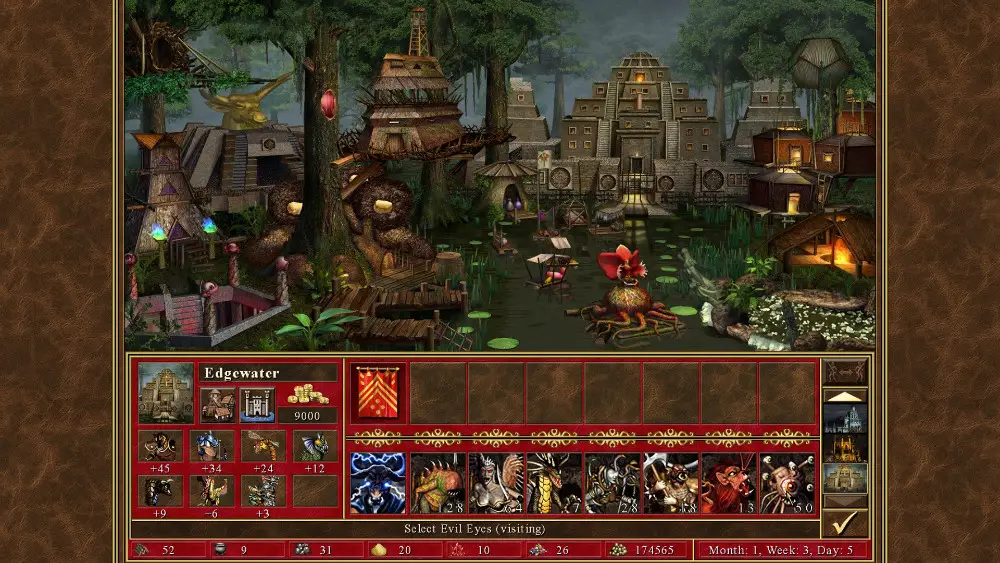
The differences between towns strengthen this system. Castle, Rampart, Tower, Inferno, Necropolis, Dungeon, and Stronghold, Fortress are not just alternative looks. Each has its own creature roster, development pace, and strengths. Some armies benefit most from getting ranged units; others need to move quickly into mobile troops or protect expensive fighters. Heroes and schools of magic create even more combinations. You learn not one optimal sequence of actions, but how to read the game you're playing.
Turn-based combat moves the strategy to a grid-based battlefield. Each army occupies space, acts according to its speed, and can threaten several adjacent positions. Even if one army is stronger on paper, the placement of ranged units, obstacles, turn order, and spells can change the outcome. Crucially, battle is not separate from the rest of the world: lost creatures are not restored for free after victory. This connects the satisfying local tactics to the harsh economy of the entire campaign.
At lower difficulty levels, the game encourages experimentation; at higher ones, it makes you calculate almost everything. As a result, Heroes III works both as a welcoming fantasy journey and as a demanding tabletop puzzle. Some fans spend years studying optimal routes, while others simply admire the maps and build their favorite towns. Both audiences enjoy the same underlying system—a rare achievement for a strategy game with such staying power.
How 3D Models Became a 2D Classic
Today, Heroes III is often remembered for its two-dimensional graphics, and it's easy to assume that everything was hand-drawn pixel by pixel. That's not quite right. Lead designer Greg Fulton later explained that the town scenes were created using 3D graphics—including 3D Studio Max—and then converted into two-dimensional interface elements. More broadly, the game's visual style relied on pre-rendered 2D frames from 3D scenes. The specific methods used to create each individual animation, however, should not be reduced to a single tool.
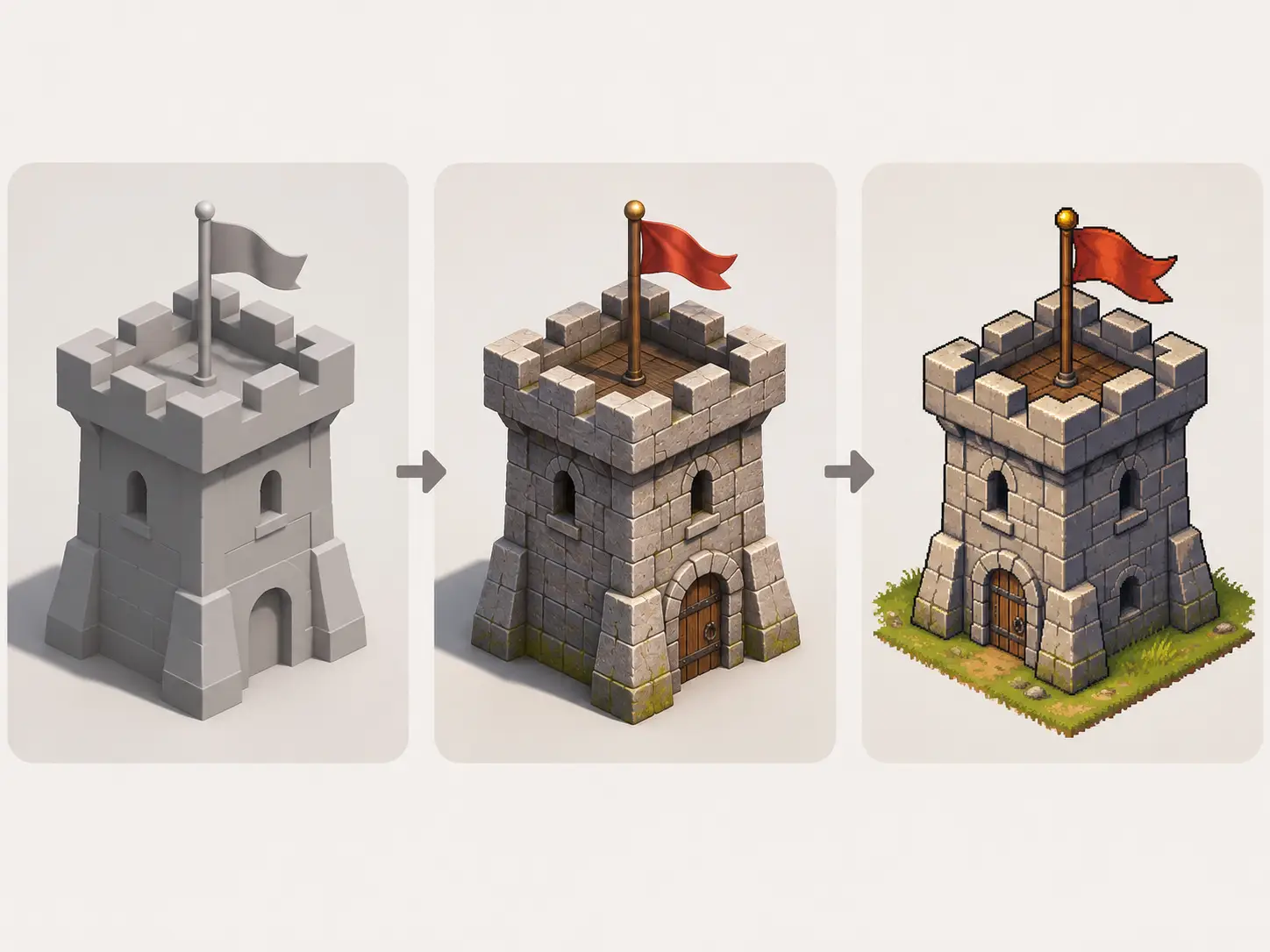
This approach made it possible to give towers, buildings, and fantastic creatures consistent lighting and depth without requiring a 1999 computer to render complex 3D scenes in real time. During play, the computer displayed finished images. That kept the interface legible and allowed the game to run at 800 × 600 resolution, which seemed like a practical choice for home PCs at the time. The combination of 3D scenes at the source and 2D presentation in the game created an aesthetic that remains instantly recognizable today.
The thought behind the visual language is especially clear in the towns. The palace, marketplace, mage guild, and fortifications do not look like neutral menu buttons: they seem to grow out of a fantasy landscape. You don't just buy a building from a list; you watch the settlement become more complex and prosperous. The system makes economic progress visible. It's a small psychological trick: another upgrade feels good not only because of the numbers, but also because the town changes its appearance.
On the world map, every structure needs to be recognizable at a moderate zoom level. The developers used contrasting silhouettes and familiar visual shorthand: a mine looks like a mine, a forest path guides your eye to the next object, and a monster guards a specific location. This clarity should not be confused with simplicity. It reflects a great deal of editorial work by artists and designers, who learned how to make an information-rich map legible even without constant tooltips.
Music That Makes Every Town Feel Like Home
The contribution of composers Paul Anthony Romero, Rob King, and Steve Baca to the identity of Heroes III is as noticeable as the creature designs. Each town has its own musical theme, and each gives the same action a different emotional color: recruiting troops in Castle feels different from visiting Necropolis or Inferno. The music doesn't tell you what to think about the economy, but it gives each place an emotional address. You're not visiting an abstract shopping screen, but a familiar town with its own character.
The melodies combine elements of classical music, theatrical grandeur, dark tones, and memorable motifs. Their strength is that they don't need to play only during climactic moments. Most of the time, the player is studying building stats, rearranging army slots, and planning a route. The soundtrack sustains the atmosphere in the background during routine tasks and never lets them feel entirely mechanical. This matters especially in a game where a single session can last many hours.
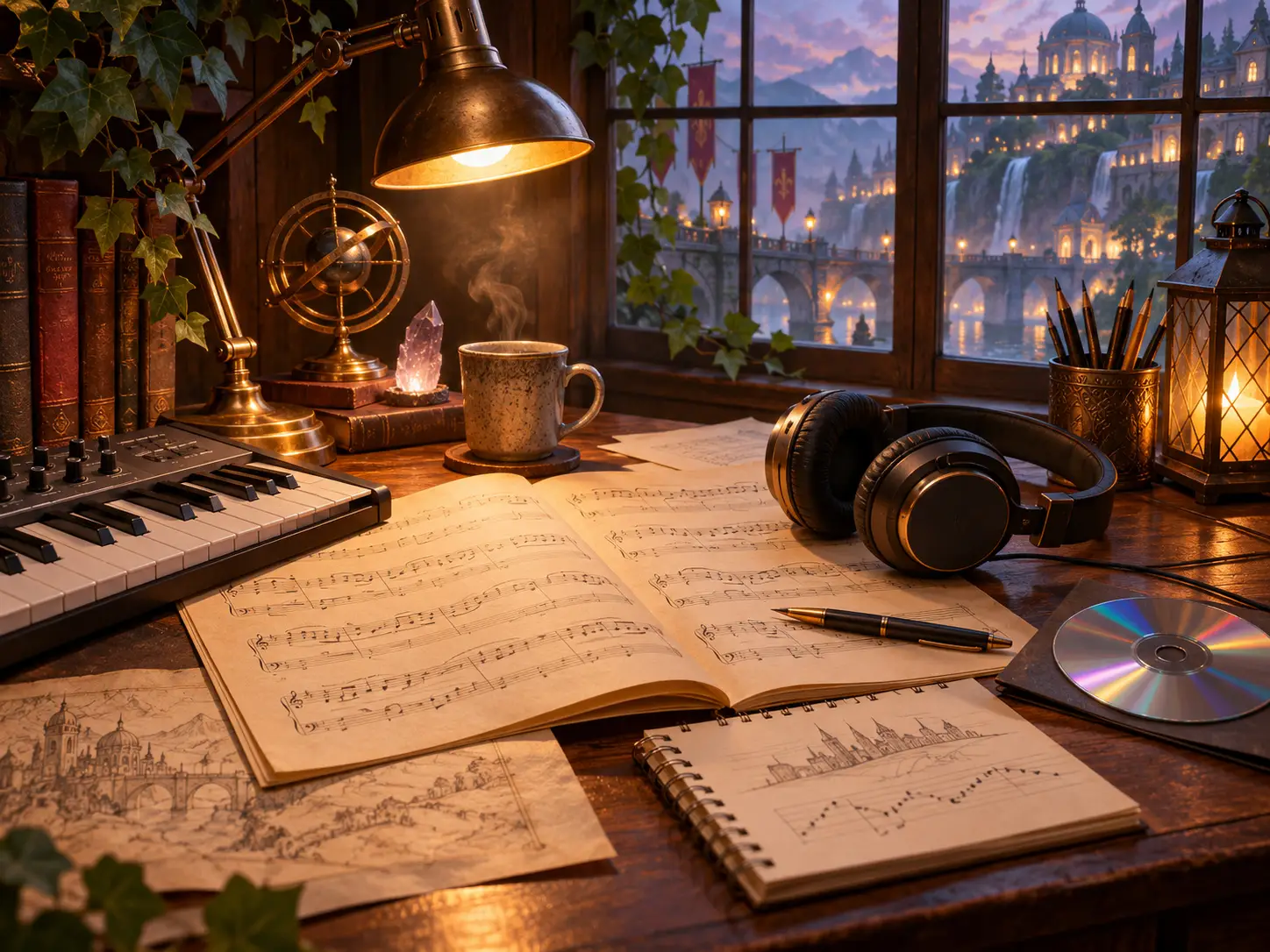
Nostalgia certainly amplifies the effect over the years. But it would be wrong to treat musical memories as the only reason for the game's popularity. A new player with no connection to 1999 also quickly learns to associate a town's visual style with its theme. In this way, the sound helps you navigate a large game. It doesn't replace the mechanics; it makes them emotionally recognizable—a rare combination for a strategy game packed with interface elements.
Hot-Seat, the Map Editor, and the Community After New World Computing
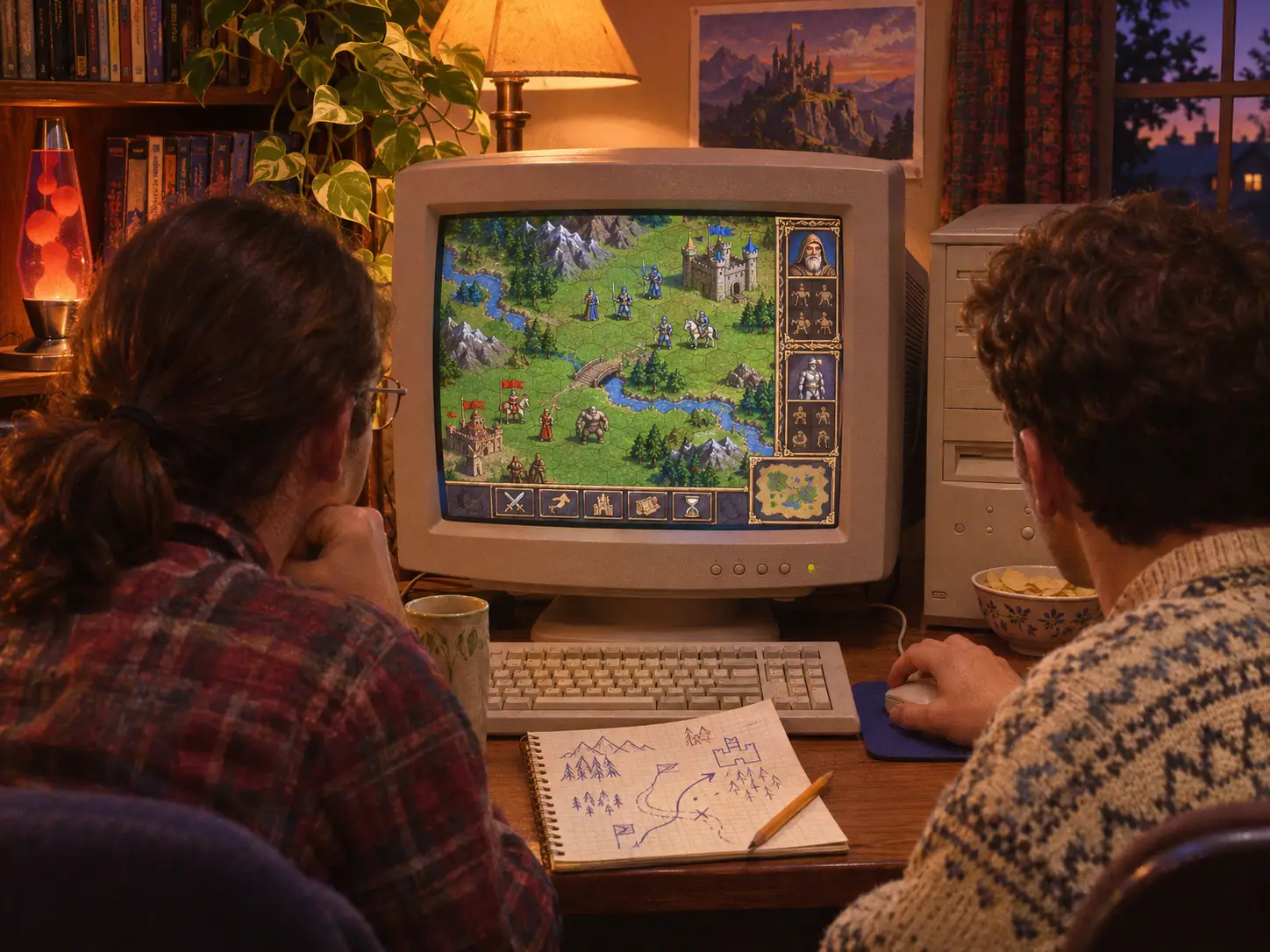
Hot-seat literally means taking turns playing on one computer. One person takes a turn, then gives way to the next; each sees their own map, makes decisions, and takes part in battles. This made Heroes III a social game for the home, one that did not require two computers, a local network, or a shared server schedule. Players could argue over deals, peek at a neighbor's map, and agree on the rules before the game even began.
This kind of multiplayer changes the pace of play. While an opponent thinks, the other player can analyze possible threats or simply comment on their good fortune. One screen becomes a miniature tabletop game, where negotiations and grudges matter as much as army numbers. This helps explain why people often associate their introduction to Heroes III not with an advertisement or a box cover, but with specific evenings at a friend's house.
The map editor gave the community a second way to extend the game's life. Fans could build scenarios with narrow passages, objectives, elaborate underground areas, and unusual victory conditions. The first expansion, Armageddon's Blade, expanded the tools and added a random map generator; The Shadow of Death continued to develop the content. This meant that the world did not end after the official campaigns were completed. Any sufficiently patient creator could offer a new challenge.
The studio's own fate was less fortunate. The 3DO Company and its New World Computing division ceased to exist in 2003. But the game, already surrounded by guides, maps, discussions, and local communities, did not depend entirely on the publisher's future plans. Fan-made compatibility and interface improvements appeared later, and the Horn of the Abyss project added new content while trying to preserve the original's recognizable logic.
The Russian-speaking audience is one more measure of the game's staying power: for decades, Heroes III has remained a shared cultural language there. Players discuss town development, random map templates, tournament rules, and beginners' mistakes. Still, it would be an oversimplification to declare modifications the reason for the game's immortality. A robust system of rules came first; only then did people want to expand it. If the basic formula had not stood up to repeated play, no additional scenarios could have kept interest alive.
That's how “one more turn” works. It's impossible to predict exactly which decision will be the last one of the evening: capturing a mine, building something new, scouting a road, or fighting over an artifact. Each task is small and understandable, but another one opens up behind it. This structure—not some abstract magic of nostalgia—is what has kept Heroes of Might and Magic III in active play decades later.
At a Glance
• Heroes of Might and Magic III: The Restoration of Erathia was released on February 28, 1999.
• Developer: New World Computing; original publisher: The 3DO Company.
• David Mullich led development, and Greg Fulton was the team's lead designer.
• The game's original display resolution was 800 × 600 pixels.
• The soundtrack is associated with Paul Anthony Romero, Rob King, and Steve Baca.
• The random map generator was introduced in the Armageddon's Blade expansion, not in the original Restoration of Erathia.