Valves, Corridors, and Silence: How Gabe Newell and Valve Rewrote the Rules of the Story-Driven Shooter in Half-Life (1998)
They left Microsoft, licensed the Quake engine, scrapped an almost-finished plan, and created a shooter that tells a story without taking control away from the player. Here’s how Valve’s first game changed our idea of what a virtual world could be.
CHECKPOINT RETRO • THE STORY OF HALF-LIFE (1998)
THE GAME AT A GLANCE
| РазработчикValve Software | ДвижокGoldSrc — глубоко модифицированная технология на основе Quake |
| Разработка1996–1998, приблизительно два с лишним года | Релиз19 ноября 1998 года (Северная Америка) |
| Продажи9,3 млн розничных копий по отчётности, опубликованной в 2008 году; без цифровых продаж Steam | ИздательSierra On-Line |
Leaving Redmond: Two Microsoft veterans and one risky idea
In 1996, Gabe Newell and Mike Harrington left Microsoft and founded Valve in Kirkland, Washington. Both came from the software world, not the traditional games industry. They had money, technical experience, and a rare opportunity for a young studio: the freedom to risk their own time. But they lacked the most important thing—a released game that could prove their ideas worked.
Their concept sounded simple: take the momentum of contemporary shooters and combine it with a world where events have causes and consequences. Against the backdrop of Doom and Quake, where the greatest pleasures were speed, combat, and exploration, Valve wanted action to be part of one continuous story. Players shouldn’t move from level to level as if flipping through disconnected backdrops. They should feel that they were in one enormous research complex where something had gone terribly wrong.
The project’s earliest materials looked much more like the action games and horror titles of the era. Early concepts were full of monsters, a dark atmosphere, and an emphasis on technology. But gradually, the focus shifted away from isolated effects and toward the everyday life of a research facility: access cards, elevators, staff rooms, public-address announcements, and colleagues who don’t know that catastrophe is only minutes away.
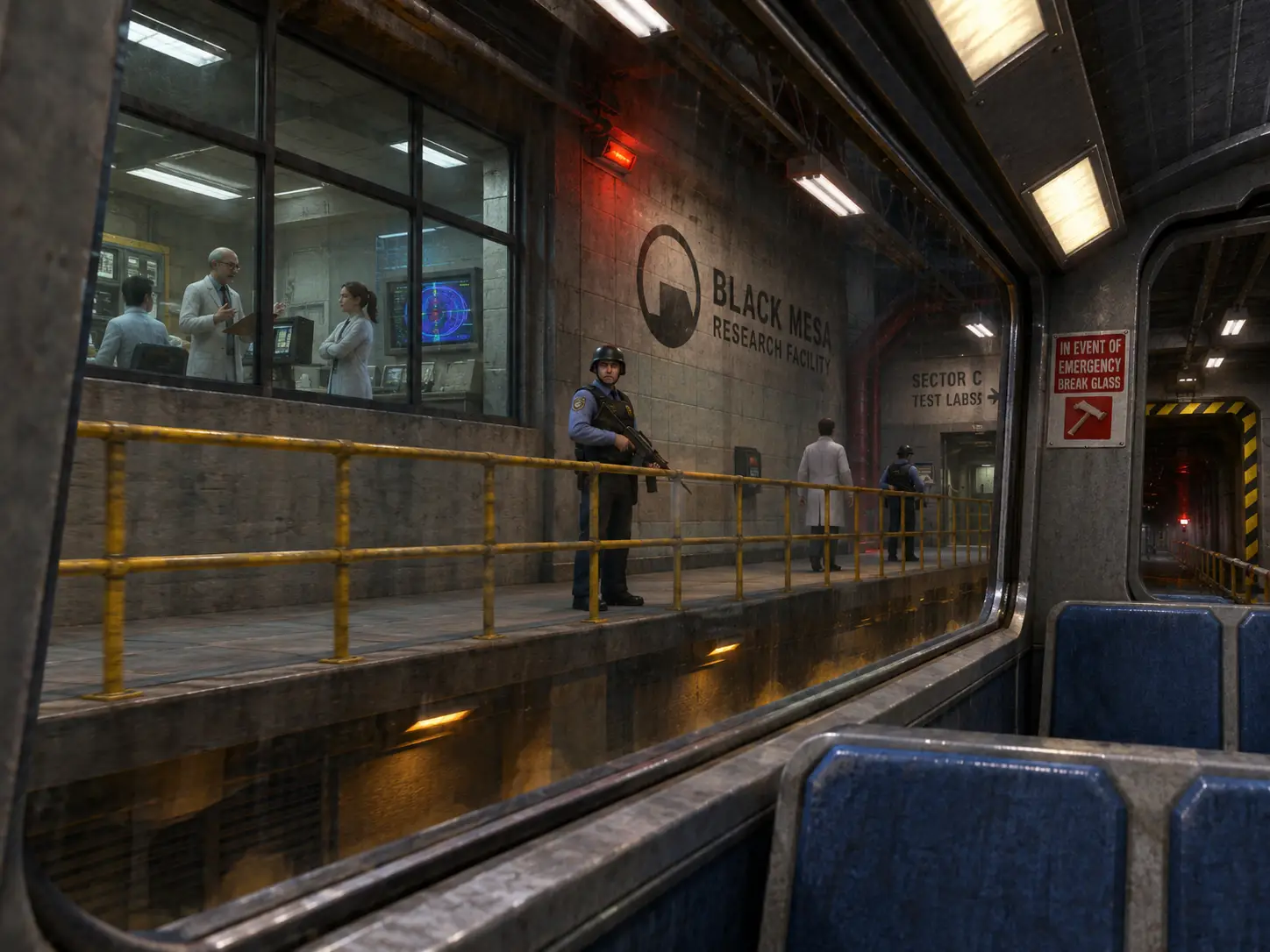
This was the crucial shift. The studio envisioned a shooter not as a series of “arenas full of enemies,” but as a journey through a place that seems to exist independently of the player. The famous opening ride on the Black Mesa monorail was the result of this logic. From the very first shot, Half-Life invites players to look around, read the signs, and notice an infrastructure that operates according to its own rules.
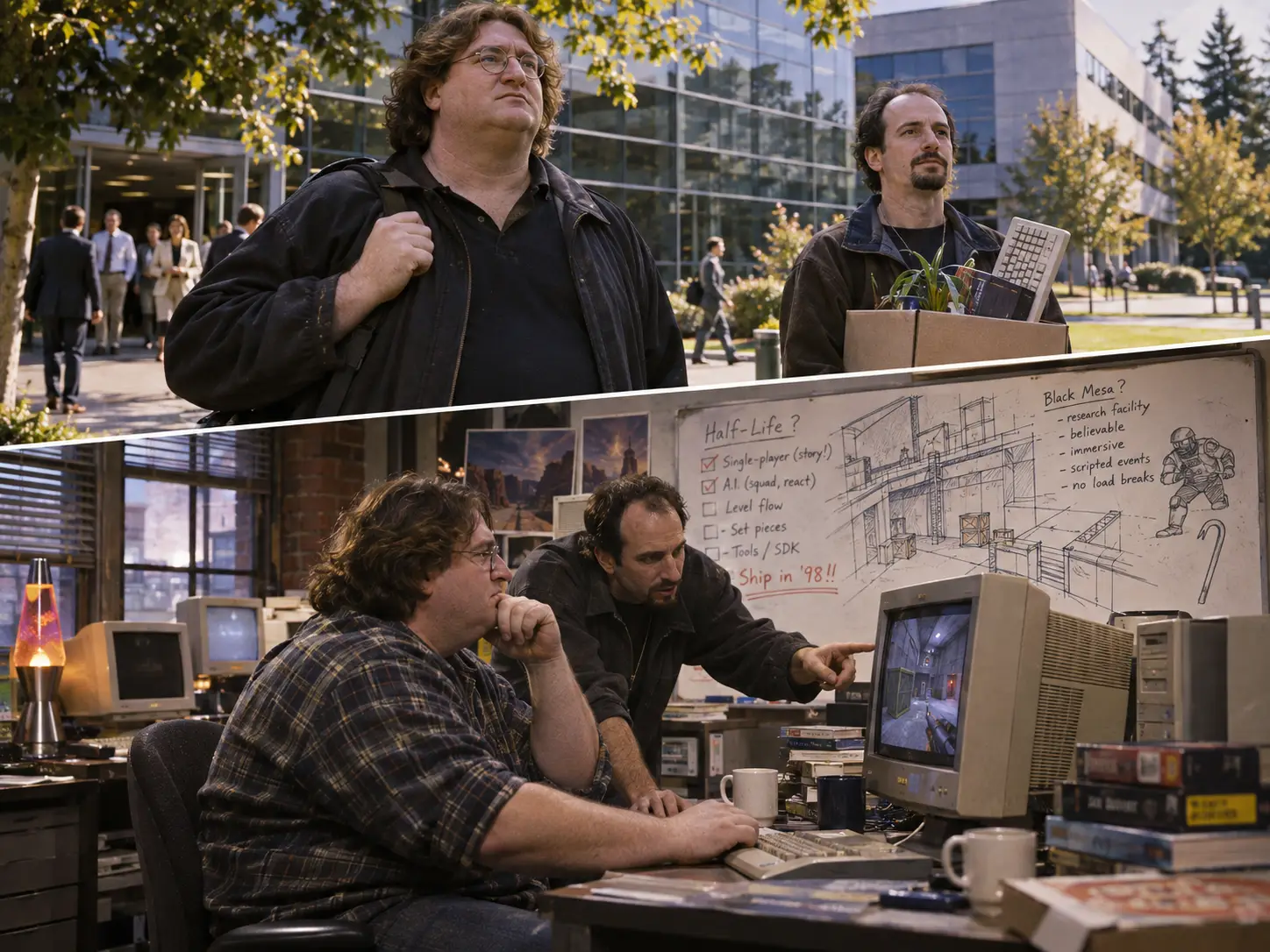
From Quake to GoldSrc: Technology that learned to play a role
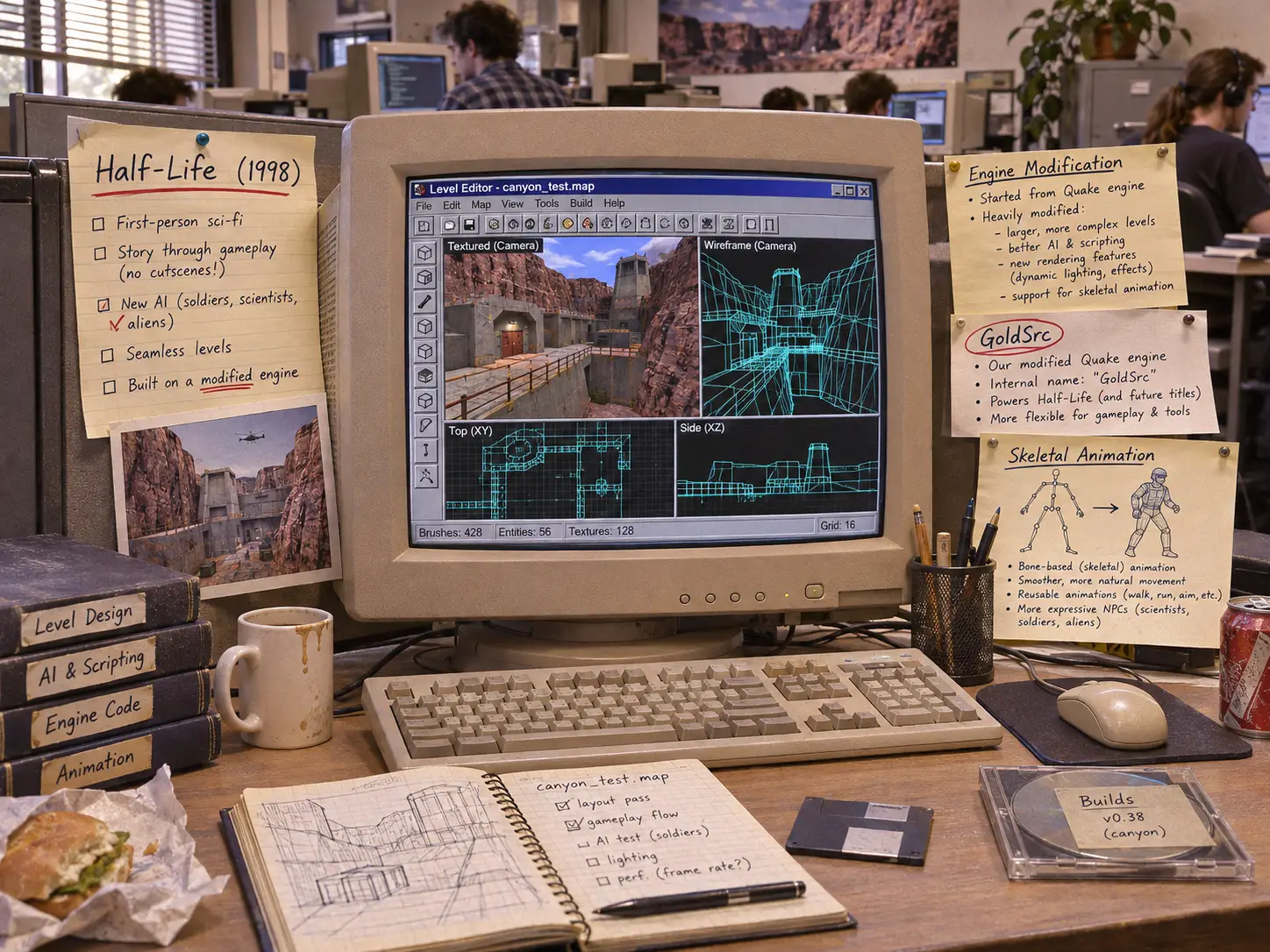
Valve didn’t start with a blank screen: the company licensed the Quake engine from id Software. For a small studio, it was a pragmatic choice. The underlying technology could already create complex three-dimensional spaces, and modders were familiar with its tools and level-design principles. But Half-Life’s story required things standard Quake didn’t provide out of the box: convincing characters, scripted scenes, richer sound, and new ways to express the world.
The technology was later reworked and named GoldSrc. It was neither “the Quake engine with a different logo” nor a completely independent development from scratch. Valve expanded and replaced substantial parts of the original system: graphics capabilities, character behavior, scripted events, and audio. In his account of the development process, Ken Birdwell specifically noted that skeletal animation was initially adopted for practical reasons—it was more compact to store many movements than frame-by-frame vertex animation.
But its benefits went well beyond saving memory. A skeleton made it possible to move limbs more naturally and link in-game actions to animations. When the team combined animation capabilities with the sound system and character faces, scenes emerged in which a scientist could open his mouth in time with speech. These elements became the foundation not of a cinematic set piece, but of a living spectacle unfolding right in the game world.
The Worldcraft editor—the forerunner of Hammer—helped creators build spaces from geometric “brushes,” textures, light sources, and game entities. Its distinctive four-pane layout, with one perspective view and three orthographic views, was the designers’ working language. This was where stairs, airlocks, shafts, and service corridors became a route that felt like a single, unified organism.
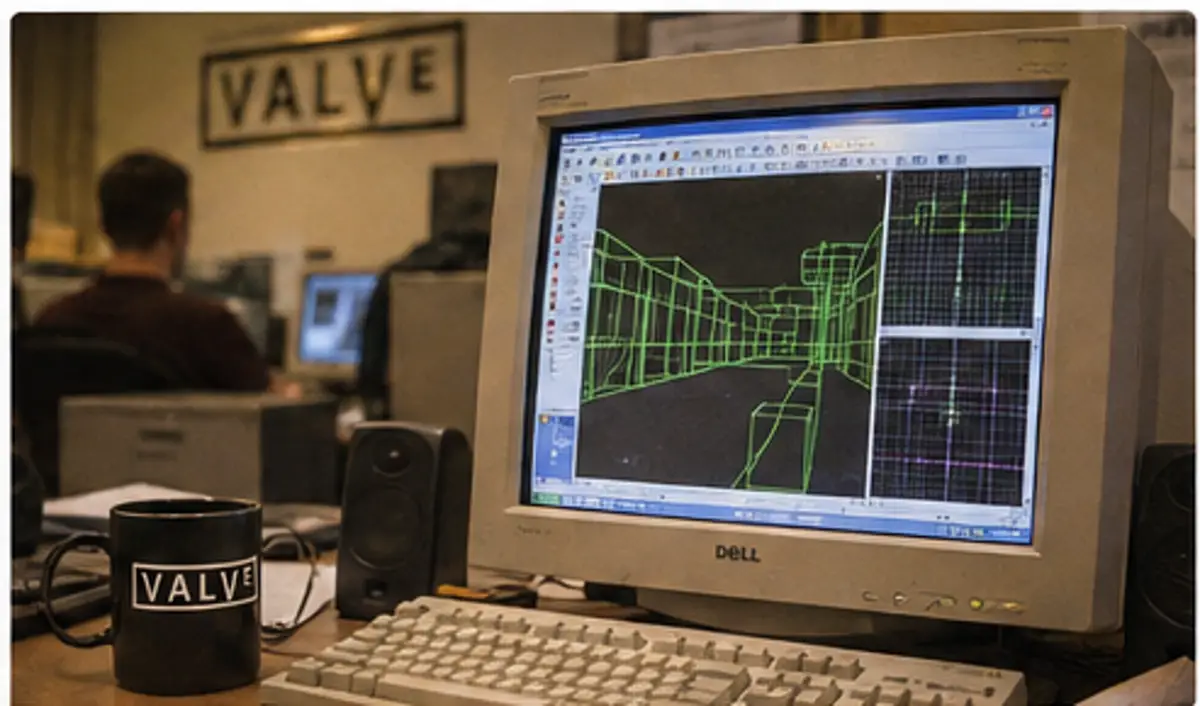
The other side of these achievements was compromise. Some events had to be assembled manually from triggers, while “intelligent” enemy behavior relied on a combination of programmed rules and carefully designed environments. But what mattered to the player was the result: marines tried to flank them and threw grenades, scientists reacted to danger, and the world around them responded to their actions instead of simply waiting for the next transition.
The 1997 reboot: Why Valve decided to remake the game
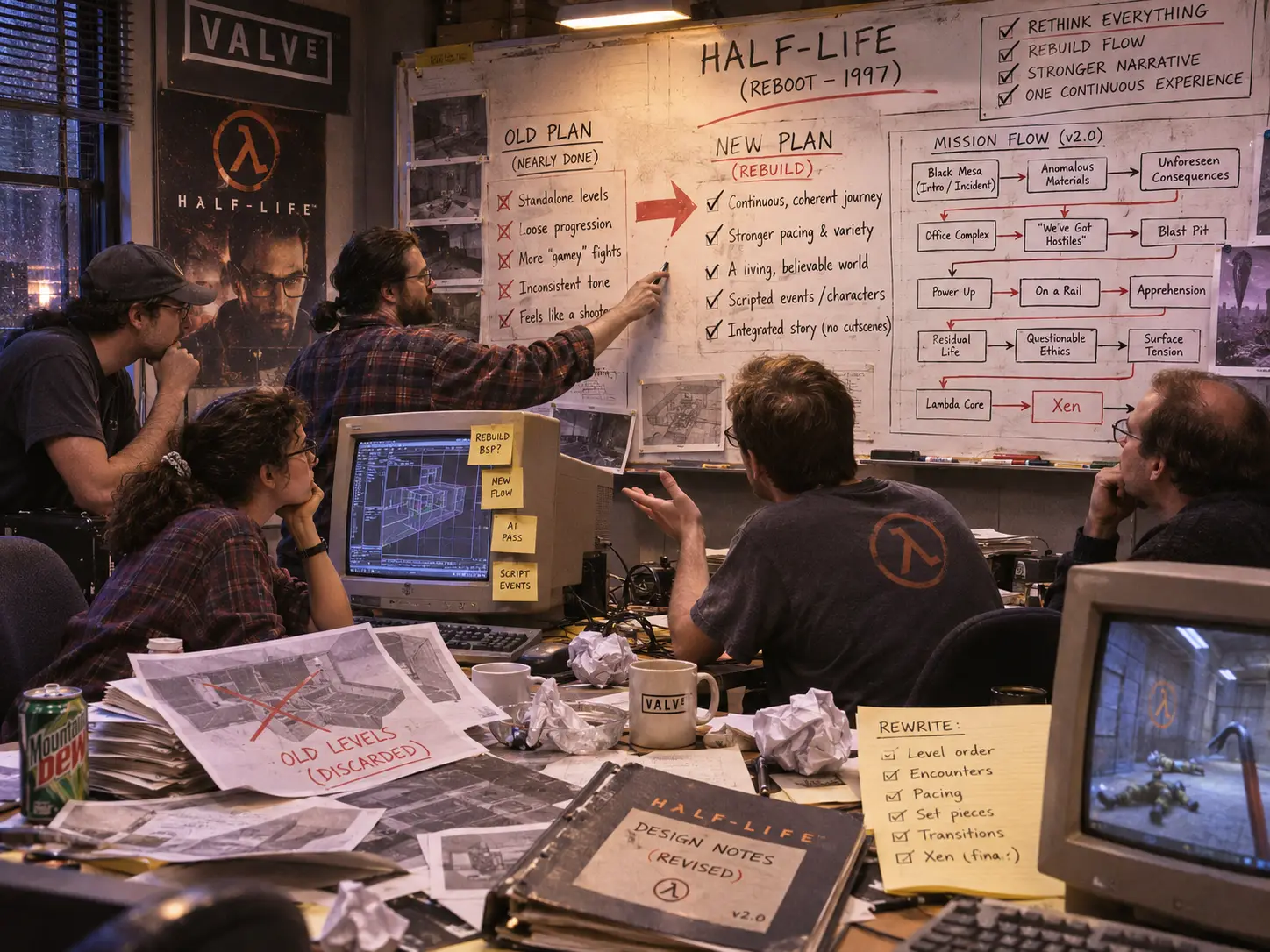
Half-Life had an initial release date—November 1997. By autumn, the project had assembled impressive fragments: monsters, weapons, technology, and levels. They worked in demonstrations. But when the fragments were put together as a game, a problem became clear: individual successful ideas did not form a cohesive adventure. That was how Ken Birdwell described the project in a 1999 article about Valve’s internal process.
The situation was dangerous for a newcomer. Sierra was already on board as publisher, the team had invested months of work, and the shooter market was moving at a dizzying pace. The obvious solution would have been to fix a few problems and make the next season. Valve chose the opposite: abandon the existing structure and rebuild the game around clear dramatic structure and a testable player experience.
It’s important not to romanticize this story. The developers didn’t literally destroy all their work and write Half-Life from scratch. They kept valuable elements but rethought the sequence of events, the interaction of systems, and the coherence of the levels. To do this, the team formed an interdisciplinary group, later known as the “Cabal,” where designers, programmers, and artists worked together to figure out what the player should experience and how to make it happen.
This is where Half-Life’s central rule was born: a good scene doesn’t exist just to show off technology. It works when the player has a reason to look, move, fear, or wonder. Not every corridor has to end in a shootout; sometimes all it takes is a deafening noise behind a wall, a door that suddenly closes, or a conversation between two employees that becomes an ominous prelude to catastrophe a minute later.
The remake extended development by about a year, but it made something possible that the first version lacked: a cohesive journey with its own rhythm. Later, this choice would become part of Valve’s legend—not because the studio allowed itself a delay, but because the team seriously asked: “Is this fun to play from beginning to end?”
No cutscenes, no grand speeches: How Half-Life made the world speak for itself
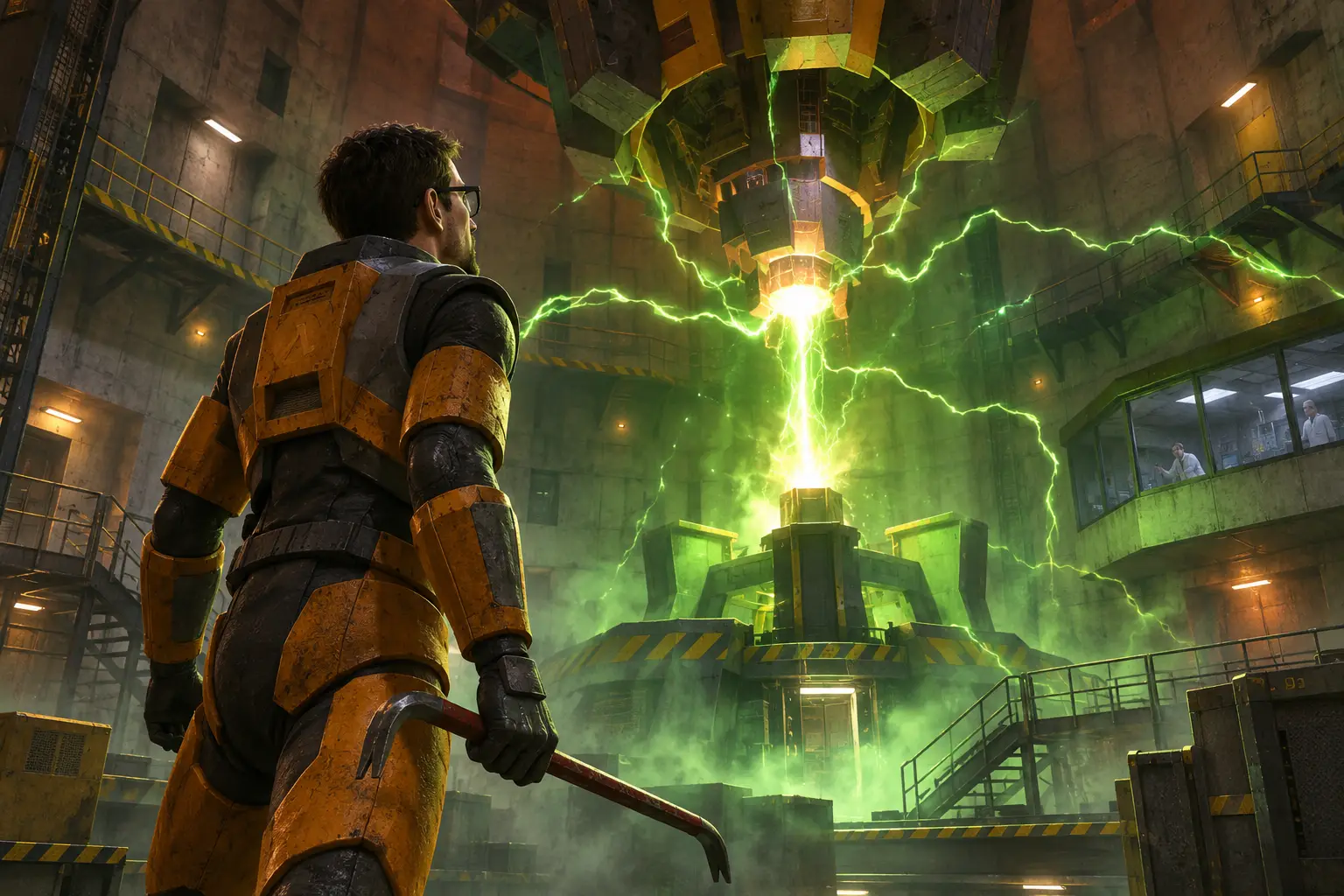
In Half-Life, the player is almost always Gordon Freeman. The camera doesn’t pull back to show the hero from the outside; an invisible director doesn’t switch angles at key moments. Freeman remains silent, and that silence works more powerfully than many lines of dialogue: he becomes a point of observation, not a conversation partner whose thoughts and feelings have already been spelled out by a screenwriter.
The opening monorail scene is a masterclass in setting expectations. Laboratories, storage areas, walkways, and guard posts pass behind the glass. An automated voice delivers workplace information as if this were an ordinary shift at a secure facility. The absence of a cutscene isn’t a pause before “the real game”; it is part of the game. It gives players a chance to form their own picture of Black Mesa before the familiar order collapses.
When the resonance cascade begins, the world responds to the catastrophe through a multitude of small events. Shattered glass, wounded employees, alien creatures, anxious radio exchanges, and botched rescue attempts—players piece together the causes and consequences for themselves. Instead of watching a long video about the disaster, they experience it on the scale of doorways, broken elevators, and familiar rooms that suddenly stop being safe.
The game isn’t entirely without staging: characters may stop the player, talk to them, and perform pre-scripted actions; transitions between maps are also a technical necessity. So it’s more accurate to say not “there is no direction at all,” but “the narrative doesn’t regularly take control away from the player.” Half-Life kept the familiar language of the shooter but learned to tell a story with its own tools.
Architecture plays a special role here. Repeated logos, room labels, ventilation shafts, service tunnels, and sounds coming from behind opaque walls create a sense of scale. At times, the game shows the consequences of a struggle before explaining its causes. Those unanswered questions are what make players press on. Gordon doesn’t tell us how he feels; Black Mesa speaks for him.
AFTER THE CASCADE
Half-Life’s success can’t be reduced to one piece of technology or one technique. Valve brought existing elements together—shooter mechanics, scripts, animation, sound design, and level design—and made them serve a single purpose. The world became not a backdrop for shooting, but the story’s central participant.
A quarter of a century later, it’s still easy to remember not just the guns and enemies, but the first announcement on the platform, the ominous sounds behind a door, and the scientist’s expression before the experiment. That is the measure of Half-Life’s influence: it proved that a story in an action game can happen not between levels, but every second the player remains in control.
EDITORIAL NOTES AND SOURCES
Historical caveats: The figure “28 months” appears in retellings, but it is safer not to claim an exact duration without a month-by-month start date. This article gives the interval 1996–1998. The figure of 9.3 million refers to retail sales reported in 2008, not exclusively to copies sold “before the arrival of Steam.”
Valve — official Half-Life 25th anniversary page — https://www.half-life.com/en/halflife/25th
Valve — official corporate handbook, timeline for 1996–1998 — https://media.steampowered.com/apps/valve/Valve_Handbook_LowRes.pdf
Ken Birdwell — The Cabal: Valve’s Design Process For Creating Half-Life (1999) — https://www.gamedeveloper.com/design/the-cabal-valve-s-design-process-for-creating-i-half-life-i-
Shacknews — published retail sales figures (2008) — https://www.shacknews.com/article/56193/valve-reveals-lifetime-retail-sales
Valve Archive — archival Worldcraft screenshot, E3 1998 press kit — https://valvearchive.com/Games/Half-Life/Screenshots/Worldcraft%20%28Level%20Editor%29/E3%201998%20Press%20Kit/worldcraft-fullsize2.bmp
Half-Life 25th Anniversary Documentary — developer team interview — https://www.half-life.com/en/halflife/25th
Use of graphics: All illustrations embedded in this article are artistic reconstructions created specifically for the article’s editorial design. The archival Worldcraft material is not embedded as an original and is instead listed as a separate link in the sources; for web publication, reconstructions should be identified as editorial illustrations.