Dual SH-2 Processors: The Coder's Dilemma
In late 1993, stunned by secret briefings on Sony PlayStation's immense 3D floating-point power, Sega rushed to modify Saturn by adding a secondary Hitachi SH-2 RISC CPU. Multi-core programming without modern OS abstractions or cache coherence was uncharted territory.
Western third-party studios struggled mightily. If both CPUs contended for the shared bus simultaneously, the system stalled. Many developers simply left the second SH-2 idle, resulting in compromised multiplatform ports that lagged behind Sony's console.
'Developing on Saturn was like trying to assemble a luxury watch while wearing boxing gloves. Yet once mastered, it sang.' (— Yu Suzuki, Head of Sega AM2)
Quadrilaterals vs. Polygons
While PlayStation standardized on triangle primitives, Saturn's VDP1 rasterizer mapped quadrilateral sprites with four vertices. Creating 3D geometry meant degenerating quads, causing texture distortion if vertices became non-planar.
However, the companion VDP2 background processor was pure wizardry. It natively rendered multiple rotating, scaling planes with infinite draw distances without taxing the main CPUs, creating the breathtaking rolling skies of Panzer Dragoon.
The 2D Arcade Goldmine
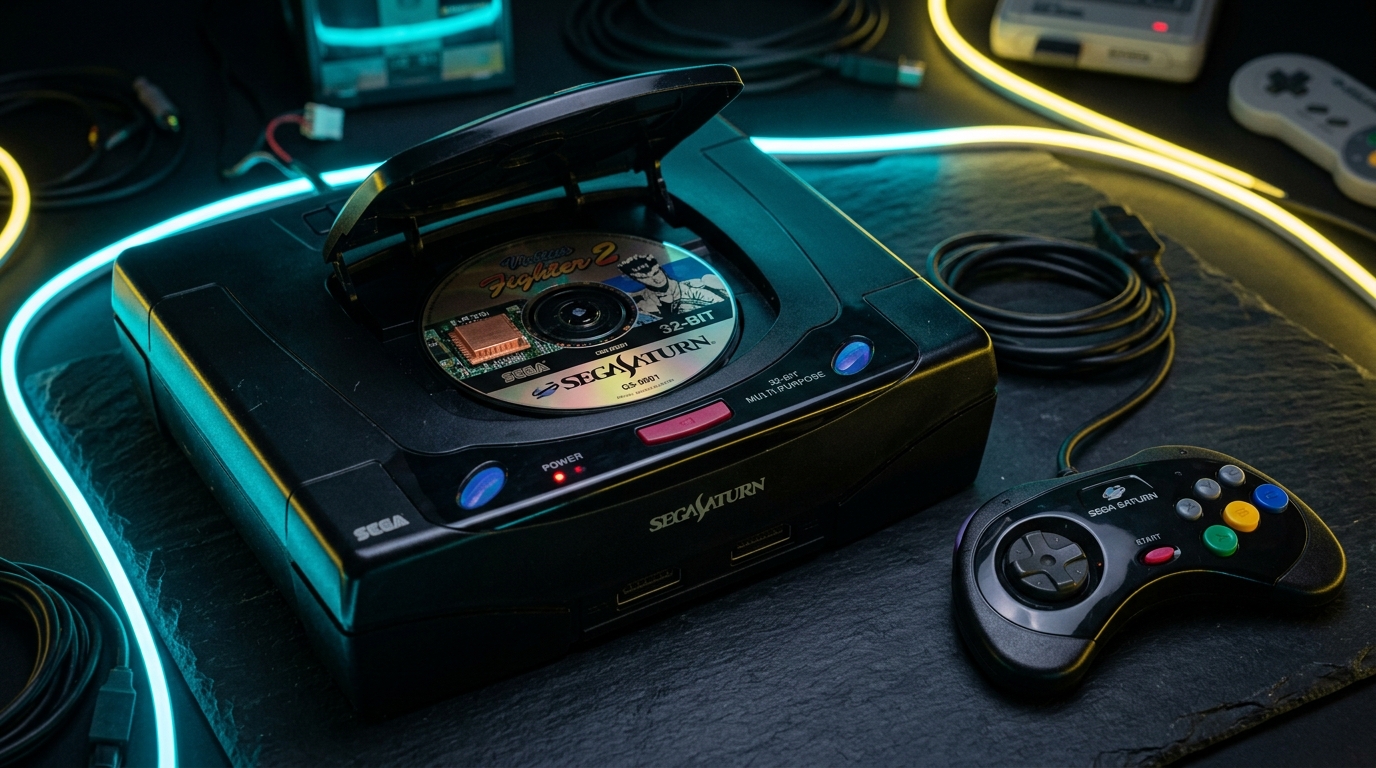
Though it faltered commercially in the West, Saturn became a revered arcade sanctuary in Japan. Utilizing official 1MB and 4MB RAM expansion cartridges, it was the only console capable of running arcade-perfect ports of Capcom and SNK fighting games with zero frame cuts.
Timeless classics like Nights into Dreams, Treasure's Radiant Silvergun, and the legendary 4-disc RPG masterpiece Panzer Dragoon Saga cemented Saturn's legacy as an artist's console.