Carmack's Binary Space Partitioning
In 1993, 3D computer graphics on home hardware were notoriously slow and untextured. To force standard Intel 486 computers to render fluid 3D worlds at a rock-solid 35 frames per second, programming visionary John Carmack weaponized Binary Space Partitioning (BSP) trees.
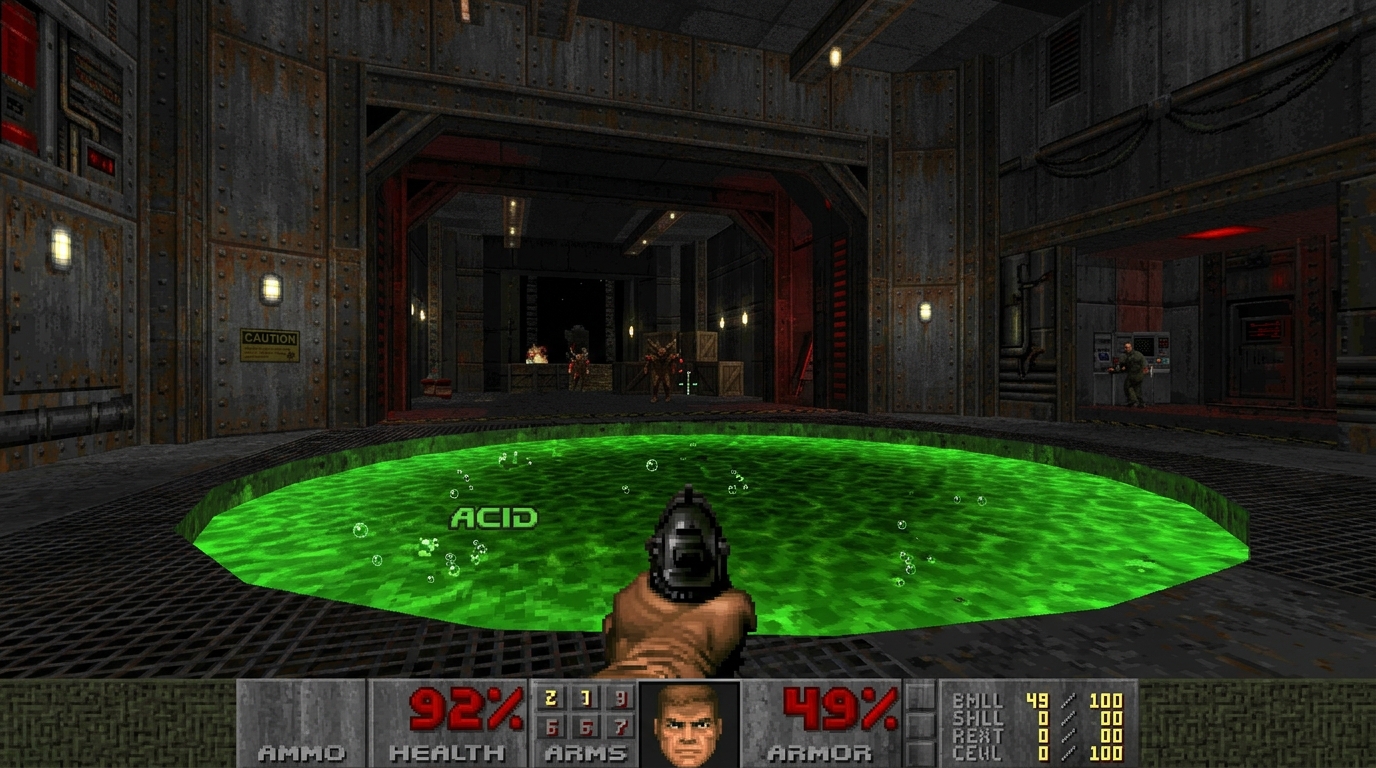
Unlike the rigid orthogonal maze of Wolfenstein 3D, Carmack's engine allowed walls angled in any direction, dynamic sector lighting, height-differentiated platforms, stairs, and skyboxes. Pixel rendering was calculated purely on the CPU, years before dedicated 3D accelerator cards existed.
'In physics, there are no unsolvable bottlenecks, only shortcomings in mathematical elegance. DOOM demonstrated what raw software ingenuity could extract from consumer PC silicon.' (— John Carmack, Lead Programmer)
Romero's Visceral Level Flow
While Carmack provided the technological foundation, John Romero infused it with raw rock-and-roll swagger. The shareware episode 'Knee-Deep in the Dead', spearheaded by E1M1: Hangar, created an immortal blueprint for pacing, mixing keycard exploration with furious shotgun ambushes.
Darkened rooms triggering monster closets, noxious radioactive waste pools, and Bobby Prince's pulse-pounding MIDI riffs — heavily influenced by Pantera and Metallica — forged an incomparable mood of industrial sci-fi horror.
The Genesis of Deathmatch
It was John Romero who coined the term 'Deathmatch'. When local-area network code first went live over IPX inside id Software's Mesquite office, development halted for weeks as the four partners engaged in relentless multiplayer bloodbaths.
Released on December 10, 1993 as a shareware download, DOOM clogged university networks and corporate servers worldwide. It birthed modern esports, popularized online modding via WAD archives, and permanently crowned the PC as the preeminent gaming platform.