NEC and Hudson Soft join forces: engineering meets gaming instinct
How did they fit a serious gaming system into a case that looked more like a small network device? The answer lies in dividing up the work. NEC handled manufacturing, electronics, and access to the mass market, while Hudson Soft brought game-development experience and an understanding of what capabilities studios would really need. Inside PC Engine, separate specialized chips handled computing, image preparation, and color output. On the outside, users got the compact HuCard format and, later, an optical disc for music, voice, and larger amounts of data.
Japan in the mid-1980s looked like Nintendo territory. The Famicom had already become a cultural phenomenon, and publishers were learning to turn hit arcade mechanics into home adventures. But the market was still looking for brighter visuals, faster response, and new formats. NEC, known for computers and electronic components, could build the system; Hudson Soft, a game publisher with experience on the Famicom, could explain why it was needed. Thus began an unusual partnership for its time, between hardware makers and software developers.
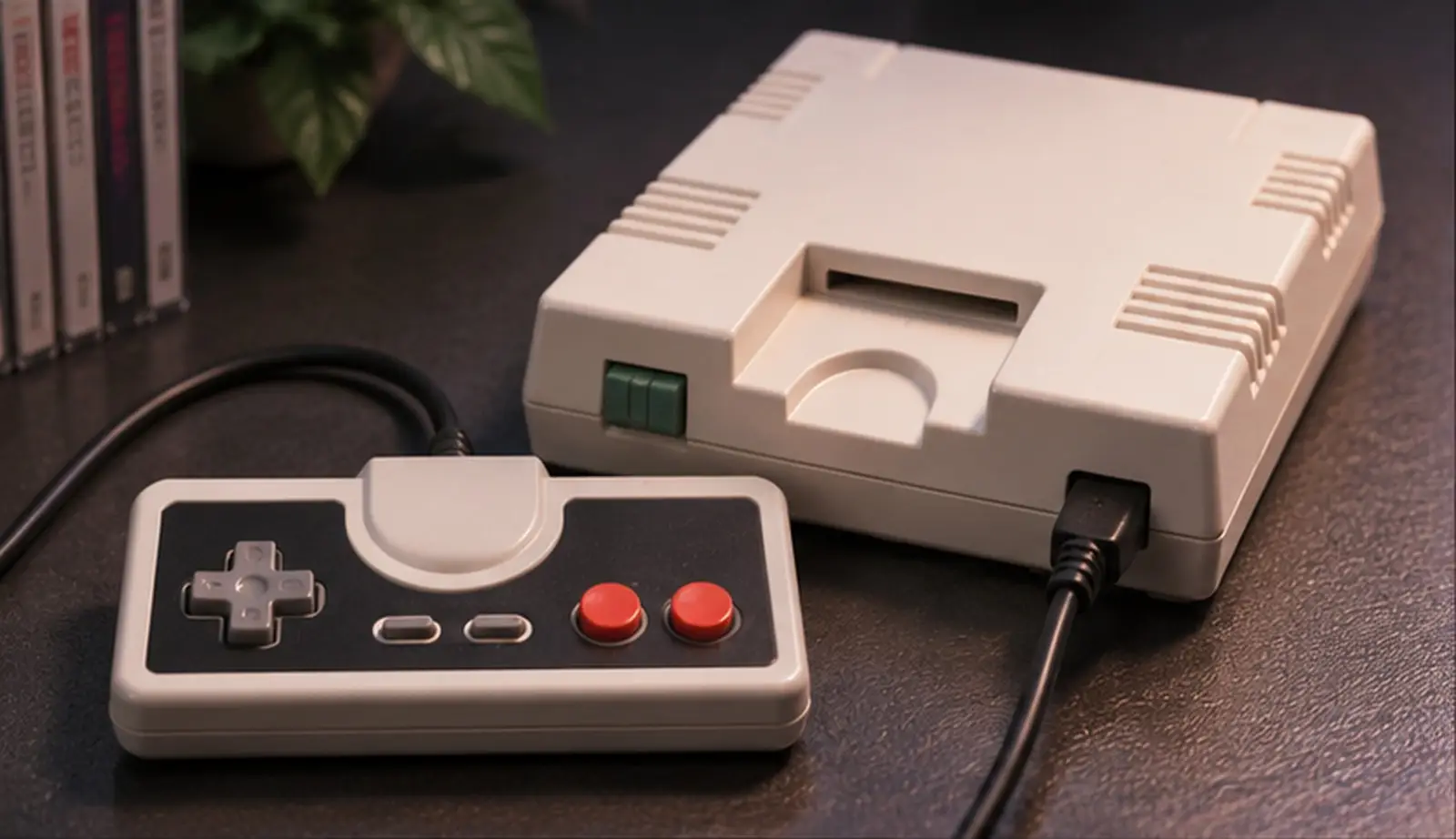
PC Engine went on sale in Japan on October 30, 1987. Its appearance was its first selling point: the white, square case looked almost impossibly small beside conventional home consoles. Ditching tall plastic cartridges helped reduce its size. But this was more than decorative minimalism. The designers were looking for a balance between cost, fast access to game data, and enough technical capability for dynamic 2D games.
In its early years, the platform was associated with a strong library of arcade conversions and original Japanese projects. Players remember R-Type, Bonk's Adventure, Bomberman, and other games with fast action, expressive sprites, and a distinctive palette. Unlike systems whose fate depended on a single mascot, PC Engine remained a platform for different publishers and genres. That software variety helped it establish a place in Japanese homes even as the Famicom dominated the market.
An eight-bit CPU and specialized graphics
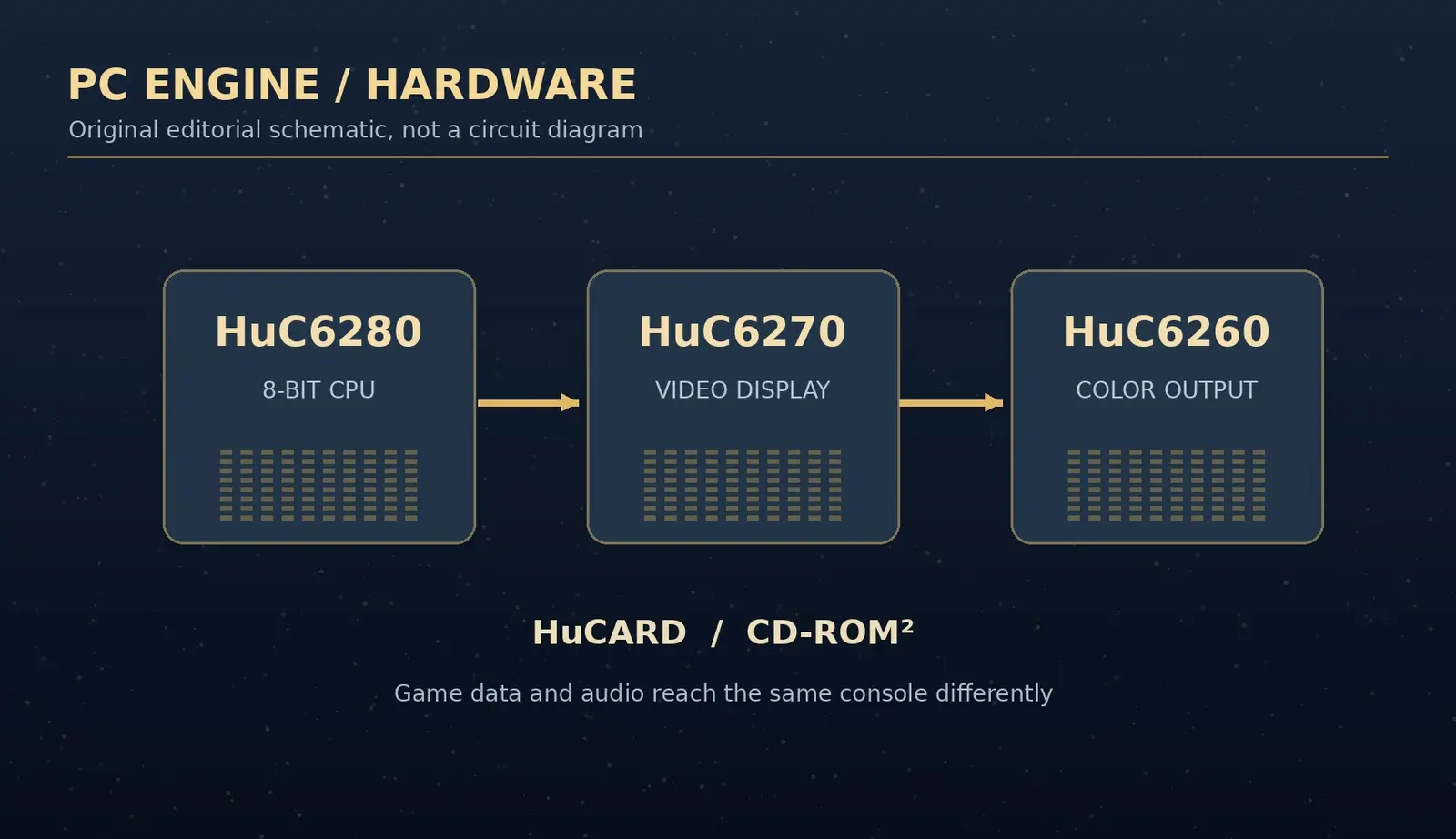
The name TurboGrafx-16 can be misleading: it may suggest that every part of the console is 16-bit. In fact, its central processor, the Hudson HuC6280, is an eight-bit CPU based on the 65C02 family. It is often described as running at around 7.16 MHz in its fast mode, but clock speed alone does not tell the whole story. Special instructions and data-transfer organization helped move information between memory and the video subsystem. This did not make the CPU a general-purpose “16-bit processor”—the system was a hybrid.
Graphics work was split between the HuC6270 video display controller and the HuC6260 color encoder. The former handled tiles, sprites, and video memory; the latter converted the digital image into a signal for the screen and worked with a palette of 512 color values. It is important to distinguish the full range of available shades from the number of colors a game displays at once. Saying “512 colors on screen” without qualification would be incorrect.
In practice, this division gave developers expressive backgrounds, large sprites, and fast 2D action. The CPU did not have to draw every pixel on the screen individually as if it were running an ordinary program on a general-purpose computer. Specialized units handled common video tasks. That is why the compact console could feel as though it was “punching above its weight,” even though some of its magic came not from the bit count but from a well-chosen architecture.
Of course, hardware capabilities did not replace the work of artists and programmers. Colorful screens were built from limited graphic elements that had to be reused efficiently. Animation needed memory for frames, music required its own planning, and game levels called for careful data transfer. The same hardware could therefore produce both modest early projects and later games with impressive-for-the-era presentation. Comparing PC Engine with the Mega Drive solely by the label “16-bit” means overlooking differences in architecture and design goals.
HuCard: a library on slim cards
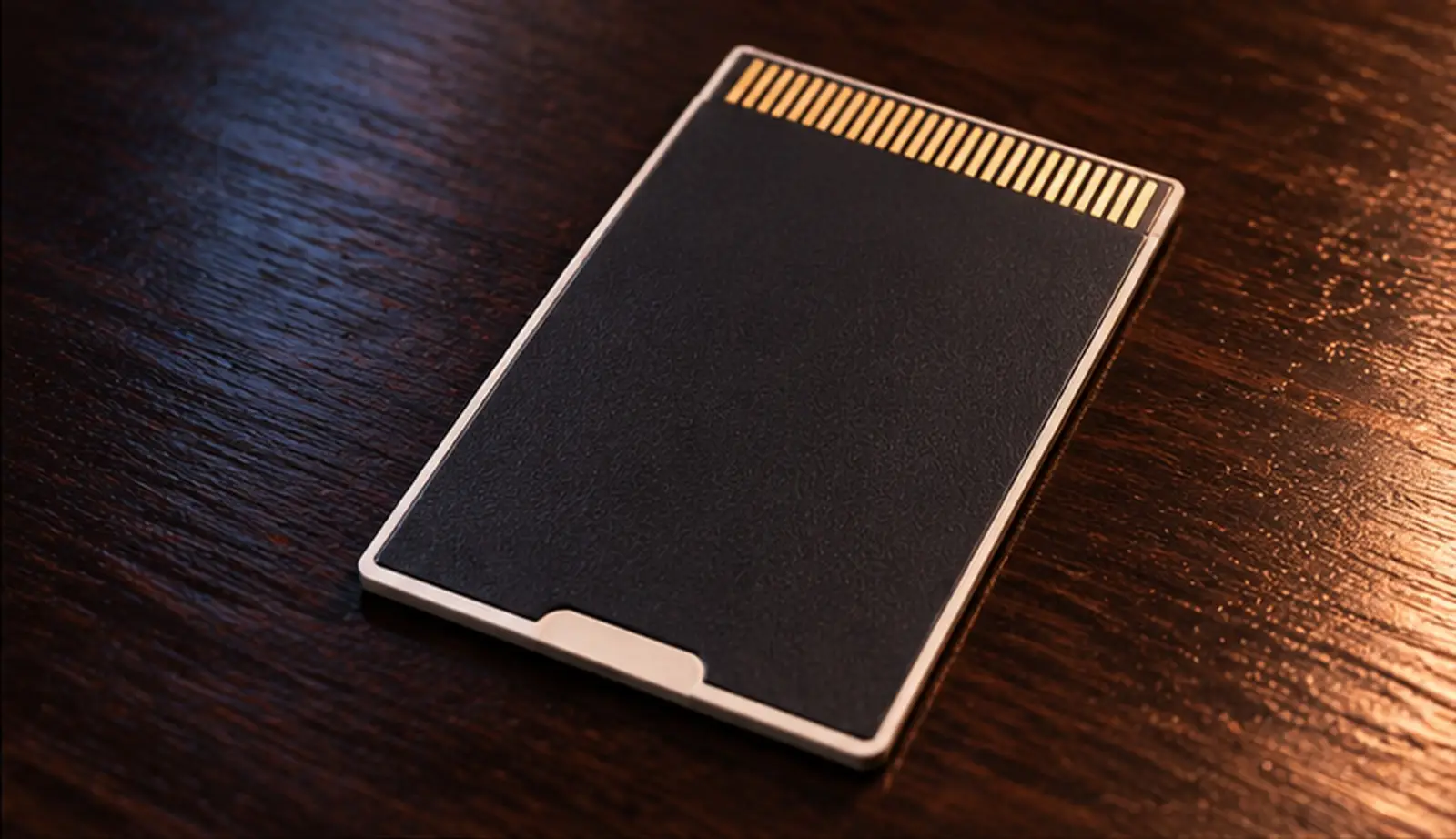
A HuCard looked like a thick plastic card with a row of exposed metal contacts. In the Japanese PC Engine, it was inserted directly into the top slot. Players got several advantages at once: the medium took up little space, needed no moving mechanism, and delivered data without waiting for a disc to be read. That made it a sensible choice for arcade games, where quick starts and short pauses mattered.
Its slimness did not magically shrink the size of a game program. The card still contained ROM chips, and the board’s capacity determined how much graphics, sound, and code could fit into a project. When developers wanted long scenes, large portraits, or high-quality recorded music, the card’s capacity became a limitation. HuCard was ideal for some tasks, but it forced compromises in others.
On a store shelf, the medium was often kept in a small case resembling a compact-disc jewel case, with a manual and an insert. This detail captured the platform’s character: a miniature game module paired with familiar retail packaging. For collectors today, it means paying particular attention to storage and checking the contacts. The thin card is durable in use, but its exposed contact area should not be touched with bare hands or cleaned with harsh products.
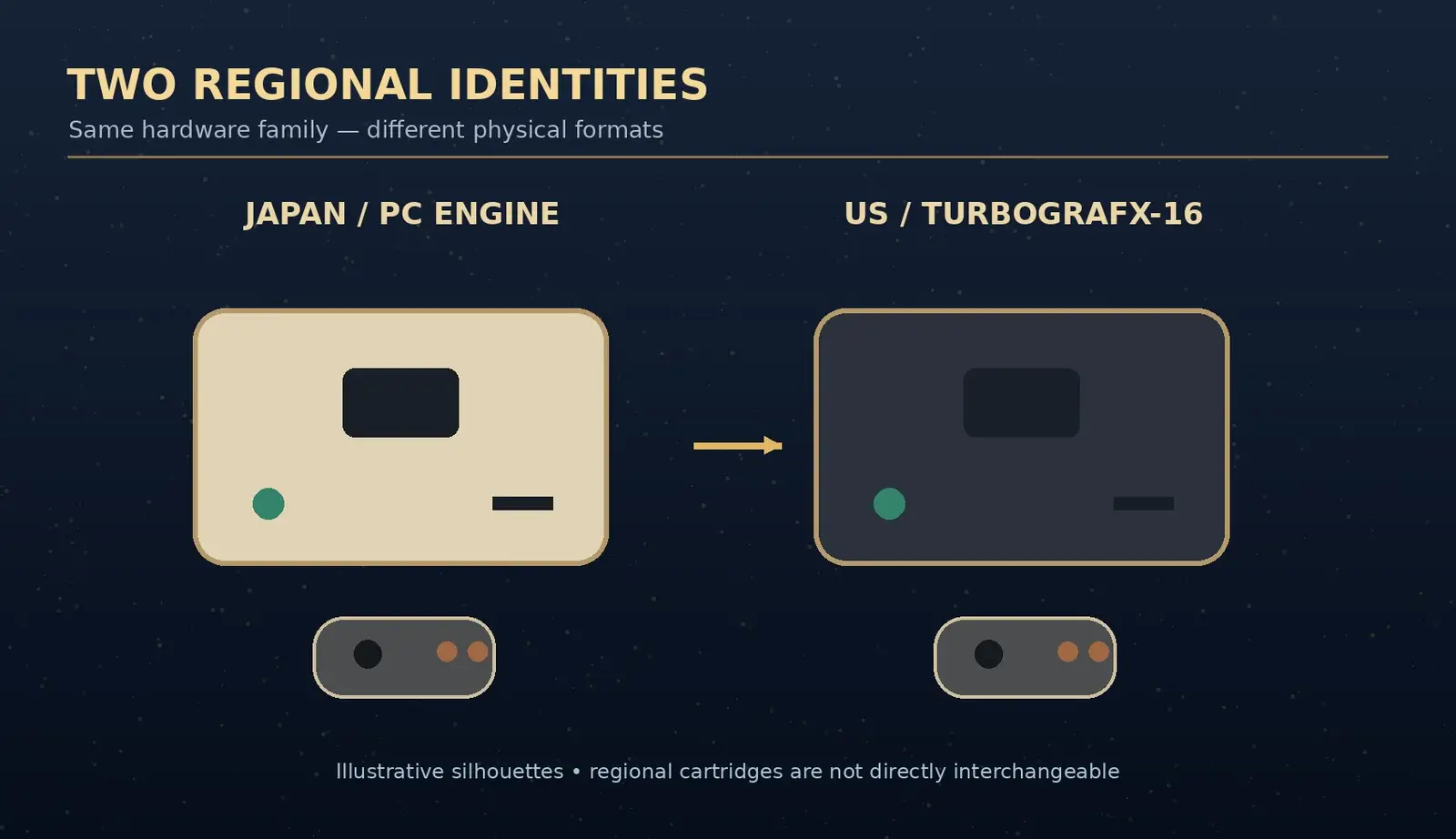
The American TurboGrafx-16 used a closely related platform, but with a different industrial design and a region-specific TurboChip format. The geometry and contact layout differed, so compatibility was not as simple as “put a Japanese card into an American console.” Adapters and technical workarounds are available, but buyers of a specific collector’s system should check compatibility between the console, accessories, and game individually. A shared architecture does not guarantee that every medium is interchangeable.
One more interesting detail: the word “card” does not mean the game was stored as data on a modern flash card. HuCard is a physical ROM medium that works directly with the game system. There is no installation, app store, or wait for an optical disc to load. This simplicity goes a long way toward explaining the affection HuCards still inspire: they are practical, distinctive, and technically characteristic of their era.
CD-ROM²: when data became sound and voice
On December 4, 1988, the Japanese PC Engine gained the CD-ROM². It was not a new version of the console itself, but an add-on set: an interface unit and an external disc drive that worked with the existing system. A special system card was also needed to run programs. The package was more expensive and bulkier than the original console, but it opened up possibilities HuCard could scarcely offer.
A CD physically held incomparably more data than a typical card. Along with software, it could store standard CD Audio tracks, character dialogue, and other prerecorded material. Music could play as a full studio recording, not just a sequence of instructions to a sound chip. Voice also became more than a rare effect. This shift was especially important for games that relied on dialogue, opening scenes, and music to establish their mood.
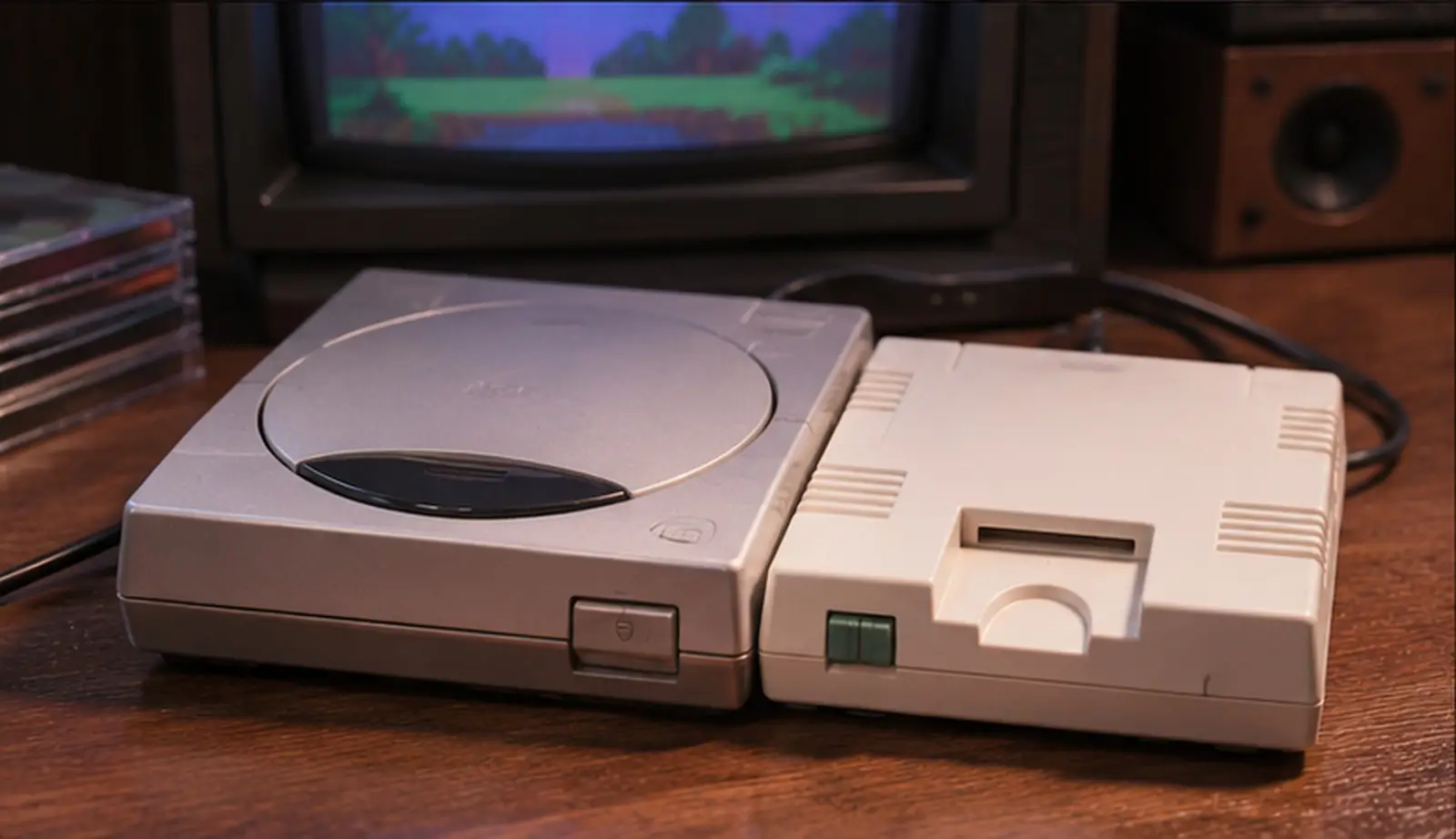
But one widespread myth needs an immediate caveat: a CD did not, by itself, make graphics 3D or remove the console’s technical limitations. The drive delivered data much more slowly than chips could read ROM; the system still had to place the necessary images and code in accessible RAM. So a larger game did not mean an unlimited number of objects on screen. Developers learned to preload scenes, pace dialogue, and combine disc-based music with familiar sprite graphics.
The combination of an older graphics foundation and a new medium proved fruitful. The Ys series, later Snatcher, various role-playing adventures, and games with voiced sequences showed that CDs were useful for more than simply providing a longer list of levels. The disc changed storytelling: an opening scene could set up the plot with voice and music, while dramatic pauses could appear between gameplay segments. Visual novels and JRPGs especially benefited from this approach.
Later came the expanded Super CD-ROM² standards, systems with different memory configurations, and the combined PC Engine Duo models. This illustrates an important principle of the era: “a game for PC Engine CD” does not always fully describe compatibility. For any given disc, it is necessary to check which System Card and memory expansion level are required. A timely warning can spare real-hardware owners an unpleasant purchase.
When discussing the “first CD-ROM,” it is more accurate to specify the category of the record. PC Engine CD-ROM² is widely considered the first commercial CD-ROM add-on for a home game console. That does not make it the first optical medium in the history of computing, nor does it negate the existence of early experimental systems. But December 1988 really was an important milestone for the mass console market. The Sega Mega-CD appeared in Japan only on December 12, 1991—almost three years later.
Why Japanese success did not carry over to the West
In Japan, PC Engine carved out a notable place in an era when competing with Nintendo seemed almost impossible. But adapting the platform for other markets involved more than transferring the electronics. The North American TurboGrafx-16 went on sale in 1989, with a much larger black case and a new name that clearly emphasized 16-bit power. The result had little connection to the Japanese idea of a small, elegant console.
The system launched during Sega Genesis’s aggressive marketing push, while Nintendo remained a formidable competitor thanks to its library and recognizable franchises. NEC’s console needed to make a clear case for why people should choose it: technical superiority is difficult to communicate when competitors have eye-catching advertising, strong exclusives, and familiar brands. The high cost of the CD expansion also made it harder to sell the main innovation as an affordable feature for the average family.
Not every part of the Japanese library could automatically become an advantage in the West. Genres aimed at the domestic market needed localization and distribution, while publishing agreements affected which projects were available. As a result, what appeared in stores did not always show the full breadth of the system’s capabilities. For a North American player, PC Engine was often not a platform with a huge, varied library, but another console whose value had to be proven against Genesis and the forthcoming Super Nintendo.

Today, this divergence is especially revealing. The Japanese PC Engine is a story of smart component choices, a well-designed medium, and an early experiment with CDs. TurboGrafx-16 shows how the same hardware idea can have a different fate because of positioning, price, and game libraries. Both stories matter when evaluating the hardware. The little white box was a big deal not because it won everywhere, but because it showed what a home gaming medium could be several years before the CD revolution of the 1990s.
Quick facts
• PC Engine launched in Japan on October 30, 1987; in the United States, the platform was sold as TurboGrafx-16.
• Its central processor, the Hudson HuC6280, is an eight-bit CPU with a fast mode of around 7.16 MHz.
• The graphics subsystem included the HuC6270 controller and HuC6260 color encoder; its palette contained 512 values.
• HuCard was a ROM game card with exposed contacts, not an optical or rewritable medium.
• PC Engine CD-ROM² debuted in Japan on December 4, 1988, as an add-on with an interface unit and disc drive.
• Japan’s Sega Mega-CD appeared on December 12, 1991.