The Atari bubble: market saturation, an unchecked flood of third-party software, and failed releases
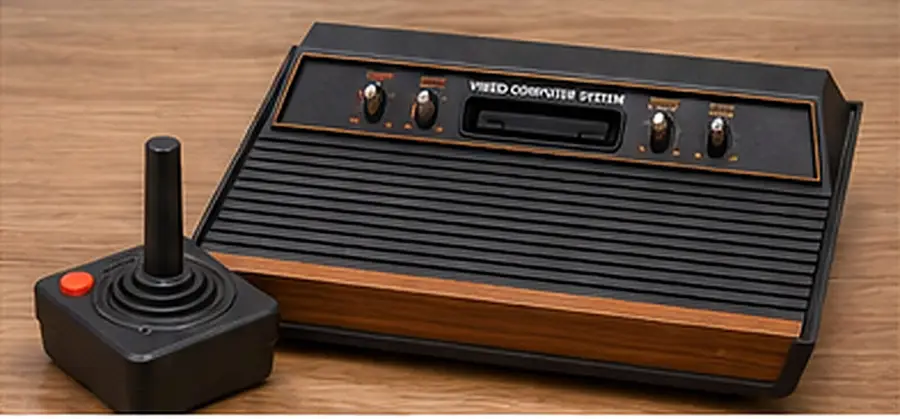
In 1977, Atari released the Video Computer System, a console later widely known as the Atari 2600. Its advantage was simple: one box under the television could run different games from cartridges. From the late 1970s onward, the success of Space Invaders and other home versions of arcade hits made the system a must-have for many American families. The convenient format for buyers proved more complicated for retailers: each new cartridge had to be ordered, put on a shelf, and—ideally—sold before the next wave of releases arrived.
Atari wanted to control games for its own machine, but the arrival of Activision showed that independent developers could sell cartridges without being part of a console manufacturer. For creative work, this was a breakthrough: former Atari employees could release their own games and seek recognition. But after the first successful publishers came dozens of companies, often without programming experience or the ability to ensure consistent quality. The technically open platform gave the console's owner no effective way to screen out weak releases in advance.
By the early 1980s, warehouses were filling up with both successful games and decidedly second-rate ones. Publishers counted on rapid growth to continue and produced too much; retail chains bought batches that they later had to sell at steep discounts. Experienced developers, hastily assembled studios, and companies treating video games as a short-term way to cash in on a trend all ended up in the same basket. A game's cover and grand title became increasingly poor predictors of its actual quality.
The best-known symbols of the overheated market were Pac-Man for the Atari 2600 and E.T. the Extra-Terrestrial, both released in 1982. The console version of Pac-Man sold millions, but disappointed some players when compared with the arcade game. E.T., created by Howard Scott Warshaw in an exceptionally short time, earned a reputation as confusing and awkward to play. Both stories matter, but explaining the entire crash through them is a myth: problems with overproduction, discounting, and competition began earlier and affected many more companies.
In December 1982, Warner Communications, Atari's owner, announced a sharp downward revision to its growth expectations. Investors saw that record shipments did not guarantee sales to consumers. Cheap leftover stock undercut expensive new releases—why pay full price for an unknown game when one next to it costs several times less? Retailers were losing money and became increasingly wary of the entire category. It was this loss of confidence, rather than one failed release, that made the crash systemic.

The familiar figure of $3.2 billion refers to estimates of the American home video game market at its peak, usually dated to 1983. For 1985, $100 million and a decline of nearly 97% are often cited. But historian Alex Smith, who compared industry publications from the time, considers the lower figure popularized by Nintendo likely understated: the real figure was closer to $200 million. It is therefore more accurate to speak of a decline of roughly 94–97%, rather than statistics precise to the dollar. And this was primarily about home consoles in the United States: computer games and the Japanese market did not disappear along with American consoles.
Myth and reality in Alamogordo: what is known about the buried E.T. cartridges and what the 2014 excavation revealed
The industry that had suffered a financial collapse acquired an almost perfect symbol: a desert dump in Alamogordo, New Mexico. In September 1983, trucks brought unwanted Atari goods there from a distribution center in El Paso. Local newspapers reported the disposal at the time, but the real event gradually turned into an urban legend. In its most dramatic version, the company supposedly buried millions of copies of a single game—E.T.—underground.
The myth: the entire buried shipment consisted only of E.T., and the dump was a secretive way to conceal the company's shame. Reality was more prosaic. Atari was disposing of mixed warehouse stock: games with different titles, packaging, and equipment. The circumstances were commercial, if painful for the company. The story does not need a secret conspiracy: transporting, destroying, and burying unwanted goods were part of the grim economics of overstocked warehouses.
A separate part of the story is the number 728,000, regularly repeated as the confirmed number of buried E.T. cartridges. Former Atari manager James Heller, who was responsible for the disposal, said that about 728,000 cartridges from warehouse stock were involved; other accounts give rounded figures of 700,000–750,000. This is a participant's testimony about the size of the shipment, not a count of recovered items—and certainly not the number of E.T. copies alone. It is impossible to reconstruct an exact inventory from these recollections.
On April 26, 2014, archaeologists and the crew of the documentary project Atari: Game Over excavated part of the old landfill. E.T. cartridges really were recovered, but so were Pac-Man, Centipede, and other games, along with boxes, documentation, and fragments of equipment. The Henry Ford museum reports that about 1,300 cartridges were recovered. The excavation proved the burial took place, but did not measure everything in the enormous dump: the 1,300 recovered items cannot simply be equated with the entire volume of the disposal or the number of E.T. copies.

Some of the finds went to museum collections and private owners. One recovered E.T. cartridge entered the Smithsonian Institution's National Museum of American History. The trash of an era thus became a source of evidence: the story now had datable objects, eyewitness accounts, and a site that could be studied archaeologically. Alamogordo matters not as proof that one game destroyed the business, but as a rare material trace of an entire chain of bad decisions.
New York, 1985: the “Entertainment System” campaign—how Nintendo of America persuaded retailers, and the roles of R.O.B. and the light gun
While American stores were clearing out Atari cartridges, almost the opposite was happening in Japan. On July 15, 1983, Nintendo released the Family Computer, or Famicom. The red-and-white home console quickly gained popularity, proving that interest in games had not disappeared. But success on one side of the Pacific did not mean U.S. retail chains were ready to risk money on consoles again. For Nintendo of America, the main challenge was not even explaining what the hardware could do, but overcoming the label “video game.”
So the American version was redesigned visually and marketed differently. The angular gray Nintendo Entertainment System looked more like home electronics than the bright Japanese Famicom. Its name avoided the word “video game,” which had become dangerous for retailers. Bundles included the Zapper light gun, while the most unusual accessory—R.O.B., the Robotic Operating Buddy—turned the console into a display of something like a toy wonder. The robot moved in response to signals from the television screen and interacted with game accessories.
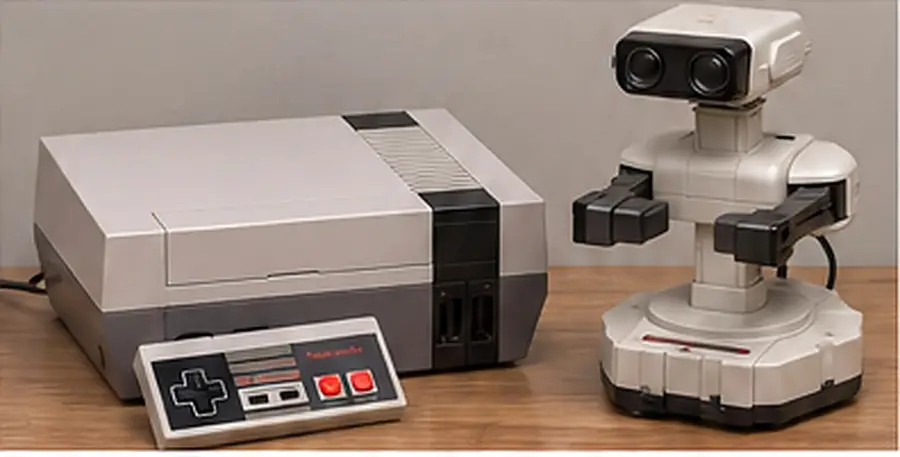
R.O.B. was supported by only two games: Gyromite and Stack-Up. Its purpose was not to become a full-fledged control platform for years to come. It helped a sales representative convince a store manager that this was a new family entertainment product that could sit alongside toys. The Zapper with Duck Hunt offered a more straightforward demonstration of instant fun: the customer saw a target, pulled the trigger, and immediately understood how it worked.
The test launch took place in the New York area in the fall of 1985; October 18 is often given as the date. About 500 retail locations were involved. Nintendo's team set up demo displays, explained the system to shoppers, and offered retailers terms that reduced their risk. A key part of the pitch was a willingness to buy back unsold stock. After several years of costly clearance sales, that guarantee spoke louder than any advertising slogan.
It would also be wrong to call the launch an instant rescue of all America. In the fall of 1985, this was a limited test, not a full nationwide rollout. More markets followed, including Los Angeles, and then a broader release in 1986. Success depended on more than a robot and clever packaging: people came back for games, and quality titles—especially Super Mario Bros.—made the new platform appealing after the first encounter. R.O.B. helped open the door to stores, but developers and an accessible gaming experience kept customers coming back.
The “Seal of Quality” and the 10NES chip: how Nintendo controlled publishers and created the modern licensing model
Once the new console reached store shelves, Nintendo needed to avoid Atari's fate. Its answer was a controlled ecosystem. Games carried the Official Nintendo Seal of Quality, a mark showing that they were officially licensed. For a parent or retailer, it was a clear signal: the product had been released under the platform owner's rules, rather than appearing from an unknown source. But the seal should not be equated with a guarantee of excellent game design: official games could still be dull or technically flawed.
A stricter form of control came from 10NES, a lockout system involving chips in the console and authorized cartridges. When the console started, it checked for the correct response from the game; under the standard mechanism, an unauthorized cartridge was not supposed to work. This was not just a decorative sticker, but a technical barrier that supported the business model: if you wanted to release a game for the NES, you had to make a deal with Nintendo.
Agreements with publishers limited their freedom. The court case Atari Games v. Nintendo documented rules under which a licensee could release no more than five new NES games a year, while versions of those games for competing home systems were subject to a two-year restriction. Nintendo also controlled the manufacture and supply of official cartridges. In this way, the company managed the flow of releases, the production of physical goods, and its own revenue from third-party games.
In practical terms, this helped prevent a situation where anyone could fill stores with cheap, unsellable stock. But control came at a price: independent studios depended on the platform owner for approval, production volumes, and contract terms. Not everyone considered the system fair. Atari Games tried to release unauthorized NES cartridges under the Tengen brand; the dispute over 10NES reached a U.S. court and showed how contentious the fight for the right to write software for someone else's device could be.
The myth: Nintendo invented game licensing from scratch. Third-party developers, rights, and contracts existed before. The innovation was the combination of broad market reach, a recognizable consumer-facing seal, contractual discipline, and hardware verification. This combination became one model for later console systems: the manufacturer sells the device, sets the platform's rules, and earns money not only from its own games but also from its partners.
Legacy: what the crash changed for the industry over the decades that followed
The 1983 crash is often described as the moment the public fell out of love with video games and Nintendo made them fall in love again. But that version erases important distinctions. The hardest hit was the American market for home consoles and related retail sales. Arcades went through their own crises and changes, home computers continued to develop, and in Japan the Famicom and competing systems opened the next chapter. Games did not die—one way of selling them to a mass market collapsed.
For retailers, the lesson was the cost of unlimited selection: dozens of cheap boxes are pointless if customers no longer trust any title. For publishers, it was the danger of chasing shipment growth without checking real demand. For developers, the new era was a double-edged sword: licensing and technical requirements reduced chaos but increased dependence on platform owners. Standards brought predictability at the cost of making the market harder to enter.
Echoes of this structure can be recognized in later console generations: the platform sets publishing terms, certifies software, and establishes relationships with publishers. Modern digital storefronts are, of course, far more complex than the cartridge era, and licensing does not prevent failures. But Nintendo's story shows how a hardware maker became an organizer of the market, a rule-setter, and an intermediary between games and their audience.
The crash's most lasting mark is not even the concrete over the cartridges in New Mexico, but the change in the question buyers ask. In 1982, it seemed that simply having a game for a popular console promised entertainment. A few years later, publishers had to prove again why their products were worth the money. Nintendo won that argument through disciplined supply, clever positioning, and a library people wanted to return to. The desert remains a convenient metaphor for what happens when an industry mistakes the number of boxes for the trust of its customers.
Reference
• The Atari Video Computer System (later the Atari 2600) went on sale in the United States in 1977.
• The Famicom launched in Japan on July 15, 1983; the NES test launch in the United States took place in October 1985.
• Estimates for the American home video game market: about $3.2 billion at its peak and approximately $100–200 million in 1985; a decline of roughly 94–97%.
• The Alamogordo landfill excavation took place on April 26, 2014; the team recovered about 1,300 cartridges from different games.
• On the NES, the R.O.B. robot was used in two games: Gyromite and Stack-Up.
• Nintendo reports worldwide lifetime sales of 61.91 million Family Computer/NES consoles.