Fog as salvation: how Team Silent turned the PlayStation’s weakness into Silent Hill’s fear
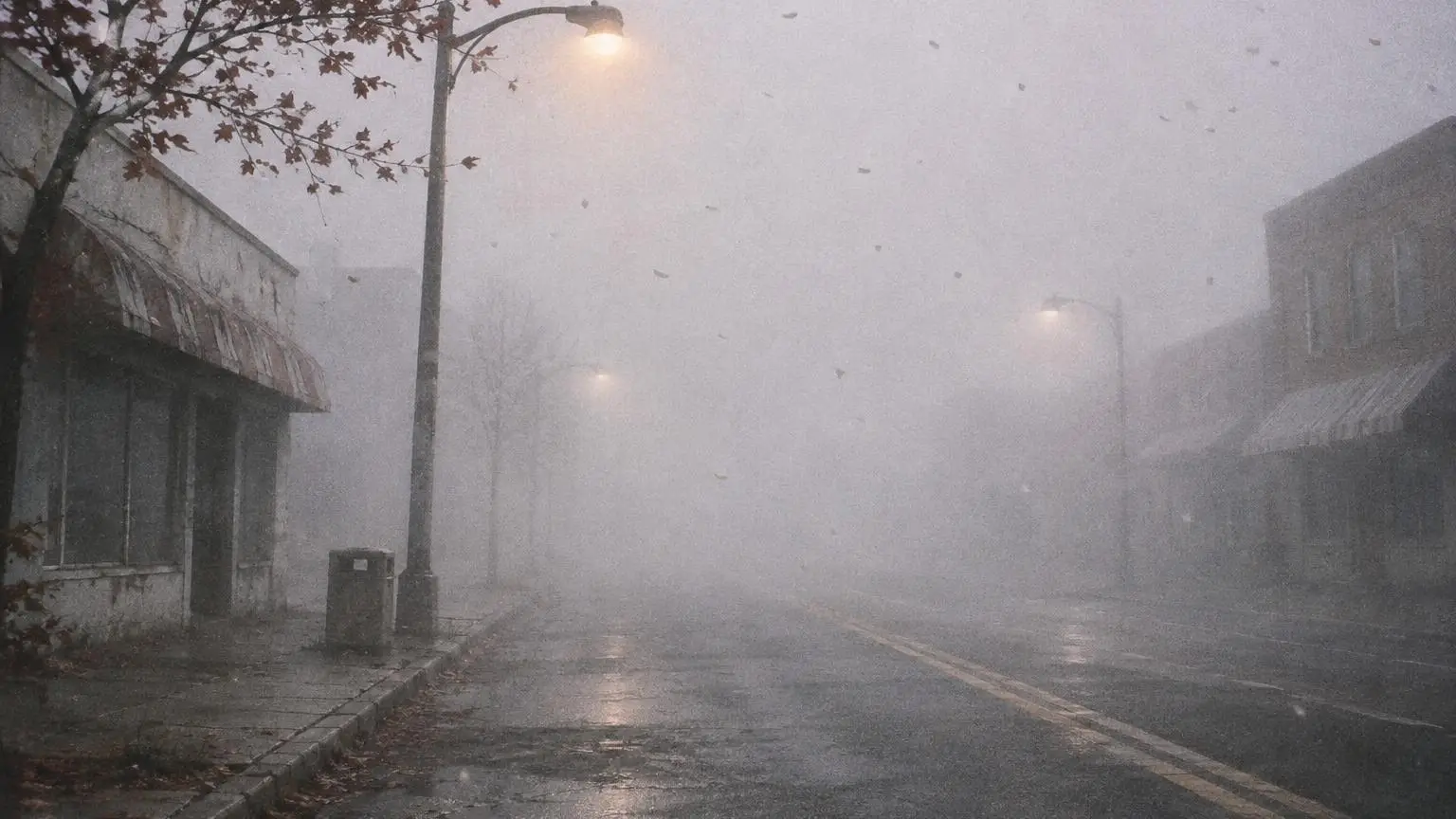
Fog and darkness concealed the limits of the original PlayStation, but gradually became Silent Hill’s defining expressive tools. Instead of making another variation on Resident Evil, Konami’s team built horror around the fear of what you can’t see.
By the mid-1990s, Konami didn’t need to explain why the industry needed horror. Resident Evil, released on PlayStation in 1996, showed that fear could sell as well as arcade action. Sony had a rapidly growing audience; Capcom had a recognizable formula of zombies, scarce ammunition, and cinematic staging. Konami decided to try its hand at the genre, too. But no one inside the company handed Silent Hill’s future creators a detailed recipe for success.
Keiichiro Toyama later recalled that the proposal to make a horror game came from management. At the time, he didn’t consider himself an expert in the genre: he studied contemporary films and literature, trying to understand why familiar everyday life frightened people. His previous work at Konami included contributions to Snatcher and the sports game International Track & Field. Silent Hill was his first experience leading a game on such a large scale—and a project where artistic choices could not be separated from technology.
The team formed within Konami Computer Entertainment Tokyo and entered history under the name Team Silent. It wasn’t a studio with a school built up over decades. The team brought together people with different roles and tastes: Toyama handled the overall direction, scenario, and staging; Takayoshi Sato worked on characters and computer-generated cutscenes; Masahiro Ito worked on creatures and environments; Akira Yamaoka handled music and sound. Gozo Kitao produced the first project, while the programming side also called for unusual solutions.
Yamaoka later described the work as a departure from Konami’s usual boundaries. Some artists wanted to move from pixel art to 3D; others were tired of standard game melodies. These admissions explain the project’s boldness better than the popular legend of a team made up of rejected employees: there are no reliable documents confirming that “the failures were sent away.” More likely, a new team got the chance to make something that strict corporate rules had not yet dictated.
Their most important choice turned out to be the protagonist. Harry Mason is neither a police special agent nor a trained fighter, but a father who arrives in a resort town with his daughter Cheryl and loses her after a crash. Toyama deliberately emphasized his awkward movements: he gets out of breath after running and handles weapons clumsily. The game doesn’t promise the player confidence. First it takes away familiar support, then asks them to walk unfamiliar streets and search for a child.

Fog and darkness as a technical device
The technical problem was straightforward: the original PlayStation couldn’t continuously render large stretches of a 3D city all the way to the horizon without substantial costs. Houses, fences, cars, sidewalks, and creatures had to appear as the player moved. Showing the world too far into the distance hurt performance; cutting the image off sharply made the eye notice details popping into existence. For a game whose goal was to make the player believe in a place, both options were dangerous.
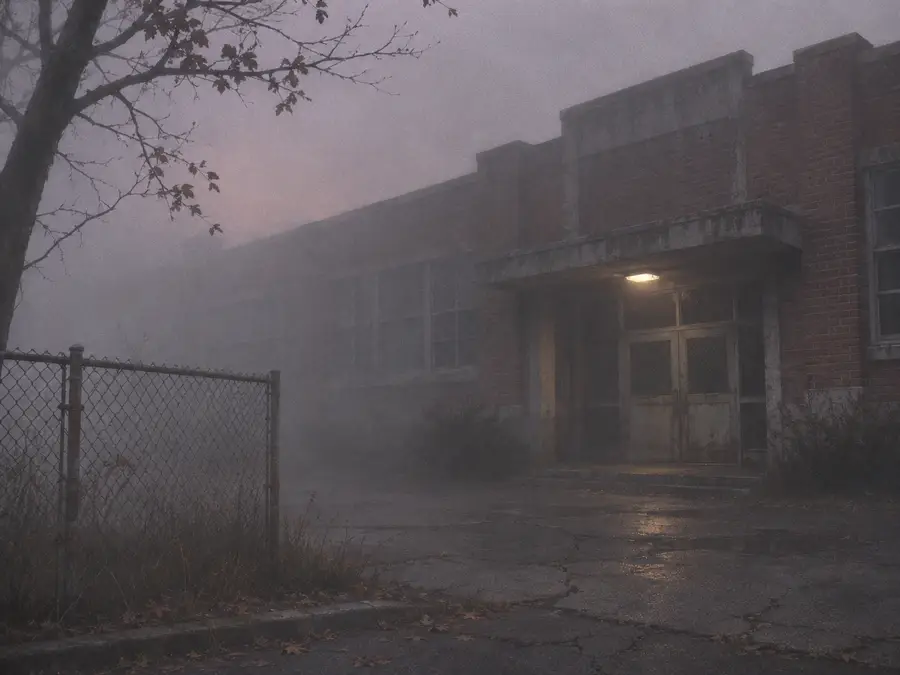
The solution was fog in the streets and darkness indoors. In a postmortem on Silent Hill 4 for Game Developer magazine in 2005, Akihiro Imamura and Akira Yamaoka directly explained this combination as a response to the original PlayStation’s limited draw distance. Crucially, the technique didn’t remain a technical screen: the unknown beyond the visible world became the very stuff of fear. The player doesn’t so much see a monster as prepare to see one.
Toyama deliberately made the town fully three-dimensional. Early Resident Evil games more often used pre-rendered backgrounds and fixed camera angles, with 3D characters moving across them. Silent Hill let the camera follow the protagonist through the streets, change its angle, and sometimes look from the side or from an unsettling height. In a 1999 PSM interview, the director explained that fog, darkness, and camera movement were arguments in favor of a real 3D environment, despite the production challenges.
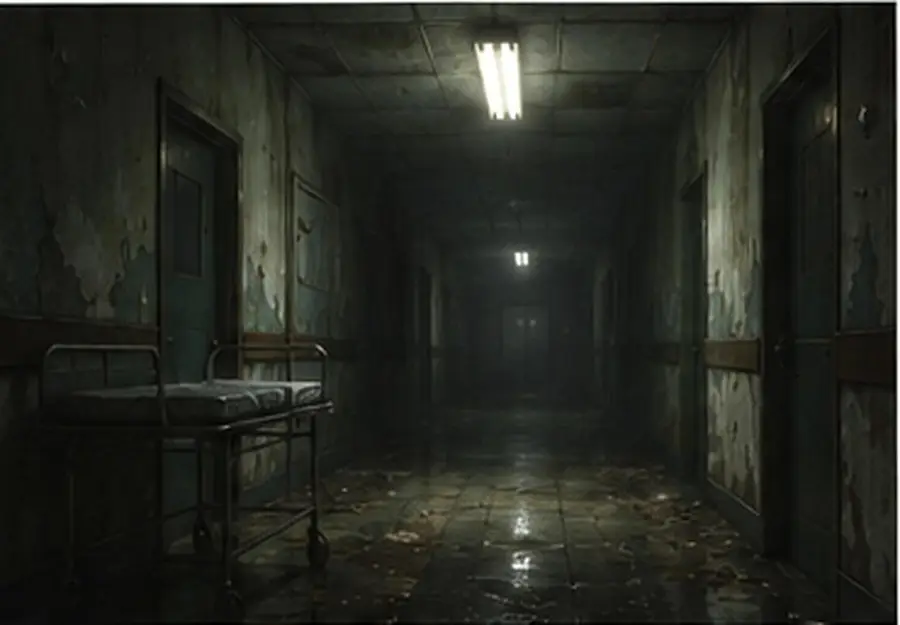
Dark rooms worked on a similar principle, but felt different. The field of view narrowed to the beam of a pocket flashlight: it lit the surface of a wall, the edge of a door, a patch of floor, and left everything else unknown. The game had a custom lighting system, which Toyama discussed even before release. Distorted perspectives and abrupt changes in camera shots strengthened the sense that space did not obey everyday logic. This wasn’t merely a way to save resources; it was a way to control where the player looked.
Finally, the city became memorable through the act of moving around it. The player consulted a paper map, encountered blocked roads, retraced their route, and constantly heard more than they could see. During a first playthrough, fog conceals not only geometry but also the scale of each location: the next intersection seems farther away than it is, and a familiar route feels unfamiliar. Here, a hardware limitation became a rule for how the player perceives the world.
Figures such as an allegedly guaranteed draw distance of less than ten metres don’t appear in reliable interviews. The exact distance isn’t necessary in this case: what matters is that the developers consciously controlled the limit of visibility and turned it into an artistic tool.
Sound that unsettles the mind
Fog deprives the player of images, and sound immediately fills the resulting gap. A rusty scrape, a muffled thump somewhere behind a wall, a fragment of melody resembling a broken record—these elements in Silent Hill are hard to separate into “music” and “effects.” Akira Yamaoka set out to blur that boundary. In a 1999 interview, he explained that he didn’t want to write conventional cinematic accompaniment: he was more interested in hearing what the town itself would sound like if it existed.
That’s how a soundtrack unusual for a mass-market console game came about: industrial textures, heavy low frequencies, repeated metallic sounds, and brief melodic islands. Instead of the familiar orchestral signal that says “something scary is about to happen,” Silent Hill often offers noise whose nature can’t be identified. Yamaoka later said he chose an industrial style to distinguish the game from others, and because its cold, metallic feel suited this world.
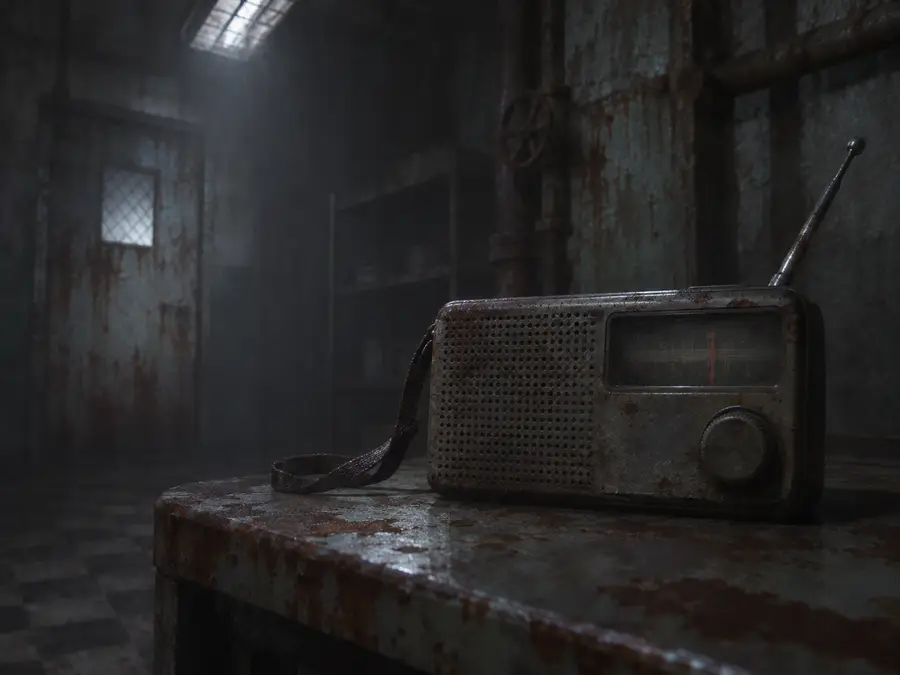
Silent Hill’s most famous sound device doesn’t resemble a musical instrument at all. The pocket radio starts crackling when an enemy is nearby. It signals danger, but doesn’t draw a map of the threat or guarantee a safe direction. Because of the fog, a creature may remain invisible even after the first warning. The result is a device with two functions: a useful detector and a constant source of anxiety. The game gives just enough information to make things scarier.
Yamaoka didn’t limit himself to compositions. In an interview with Spelmusik.net, he described his work on sound effects, their timing, mixing, and preparing data for the game. The result is a cohesive sound world: the siren, footsteps, radio, and background hum don’t belong to different styles. Even pauses seem part of the score. When the noise suddenly disappears, the player expects a new disturbance and starts listening to their own movements.
At the same time, the soundtrack isn’t made up of one endless scrape. Yamaoka uses melody as a rare place to feel sadness and loneliness, not just danger. That’s one reason his music has endured: it sustains Silent Hill’s mood beyond any individual game episode, while never becoming safe background music within the game. Sound constantly reminds us that visible reality can’t be trusted.
Faces and bodies
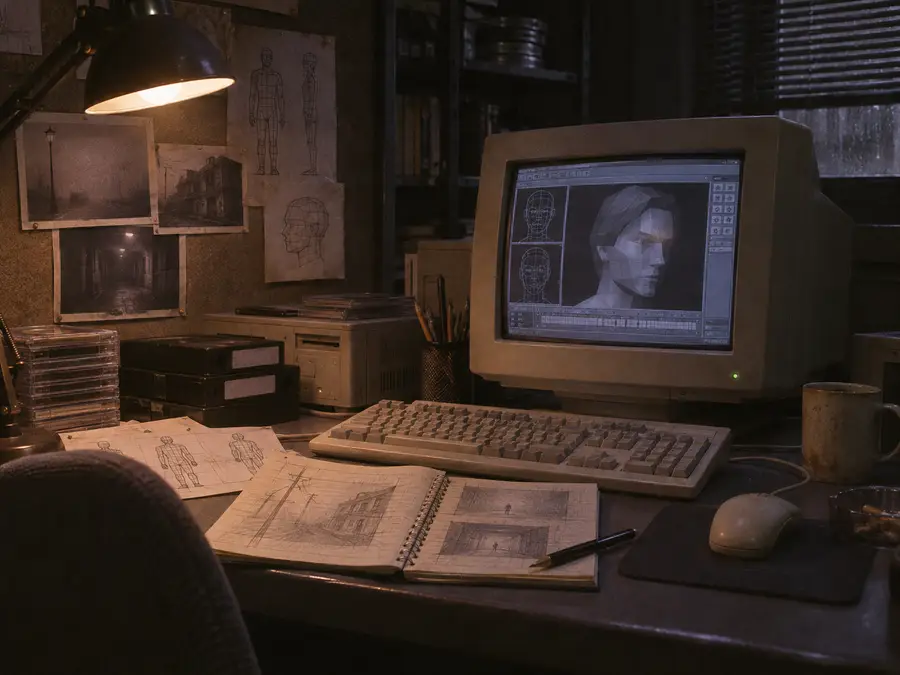
Silent Hill’s technical appearance is often remembered for the rough textures of its streets and its jittering polygons. But the team devoted considerable effort to faces, gestures, and the way people looked on screen. Takayoshi Sato was responsible for the characters’ computer graphics and pre-rendered story cutscenes. Many scenes required not real-time game models but separate, more detailed images. These gave close-ups an emotional expressiveness the console couldn’t deliver during walks around town.
In the spring 1999 issue of Official U.S. PlayStation Magazine, Toyama confirmed that Sato was the one working on the video sequences. Sato recalled that rendering just one second of animation could take three or four hours of computation, while creating models and preparing scenes took even longer. It’s a reminder that a brief cutscene in the late 1990s was a production project in its own right, not a button labeled “make it cinematic.”
In a 1999 developer interview, Sato explained the purpose of computer graphics in almost paradoxical terms: they had to use it to make completely ordinary people and an ordinary town believable, and then disrupt that believability. A nightmare works better when it contains recognizable movements and human proportions. That’s why even relatively calm scenes don’t feel safe: faces seem alive, but their reactions don’t always explain what’s happening.
The creatures’ visual design was built in a different way. Masahiro Ito was one of the key artists behind the monsters and environments. Toyama later recalled trusting the young designer’s imagination and giving him freedom within a few guidelines. Ito himself clarified that he didn’t create every monster in the first Silent Hill: Toyama and Naoko Sato also came up with some of the designs. Among the creatures he worked on at the director’s request, Ito named the child-like enemy and the Incubus.
For the original game, what matters isn’t the famous Pyramid Head—he appears only in Silent Hill 2—but the general instability of the enemies’ forms. It’s unclear whether we’re looking at a sick body, an animal, or a creature merely imitating a familiar shape. In the half-light and at a short distance, it’s easier to fill in such silhouettes with your imagination than to see them completely. Ito, Sato, and Toyama tackled different tasks, but worked toward the same effect: the familiar human form suddenly becomes alien.
Influence and legacy
Silent Hill is often described as a Japanese answer to American horror. That’s only half true: its creators certainly paid close attention to Western stories, but they didn’t assemble a collection of recognizable quotations. Toyama named the influence of Stephen King’s novels and the films of David Lynch and David Cronenberg. In a later interview, he separately recalled Adrian Lyne’s Jacob’s Ladder and Jan Švankmajer’s animated film Alice. These names converge not in the number of monsters, but in how familiar reality can suddenly stop feeling dependable.
There’s also an important correction to the mythology. In a PSM interview, Toyama said the team was inspired by cult films from the 1970s and 1980s, as well as 1950s science fiction. He didn’t reduce the game’s story to a single literary source. Yes, the atmosphere of an American small town recalls King, but Silent Hill itself is an independent construction, not a screen or game adaptation of any particular novel.
To make the town convincing, the developers observed more than just movies. Toyama described a trip to Chicago after E3: the team photographed seedy neighborhoods because Silent Hill was conceived as a resort by the water. The director separately emphasized that the setting wasn’t tied to any one real American town. Its residential streets, shop windows, and school corridors were assembled to make the place feel familiar to someone who had never been there.
Comparison with Resident Evil is inevitable, but the mechanics of fear were already different in 1999. In Capcom’s game, a familiar route could suddenly turn into a fight, while knowledge of the location helped you survive. In Silent Hill, the map itself inspires distrust: the space changes state, the world can disappear into darkness, and noise warns of what can’t yet be seen. Harry remains an ordinary person, and the story of his missing daughter gives the search personal stakes. The director openly criticized Resident Evil 2’s action-oriented approach and sought a more instinctive kind of fear.
Contemporary critics noticed the difference right away. In a GameSpot review published on the day of the North American release, Joe Fielder praised the unsettling atmosphere and flashlight, while not ranking the game above Resident Evil 2 in every respect. That’s a useful reminder: its status as a genre benchmark didn’t arrive automatically at launch. It took shape later, as Silent Hill’s methods became a recognizable language—fog, an unnerving radio, hostile emptiness, and sound that makes the world seem broken.
The first game still tells a fairly concrete story about a cult, a child, and the city’s nightmarish underside. Later games, especially Silent Hill 2, develop themes of personal guilt and trauma more intensely. Attributing the series’ entire mature psychological mythology to its debut would be an oversimplification. But its central discovery was already there: hardware limitations needn’t be hidden from the player; they can become part of the experience. The PlayStation couldn’t show the whole city; Team Silent convinced us that we didn’t need to see it all.

Facts
· Silent Hill is a game for the original Sony PlayStation, developed by Konami Computer Entertainment Tokyo, known as Team Silent.
· It was released on February 23, 1999, in North America and on March 4, 1999, in Japan; Konami’s catalog confirms the Japanese release date.
· The original game’s director and writer was Keiichiro Toyama; the producer was Gozo Kitao.
· Akira Yamaoka was the composer and sound director; Takayoshi Sato created key cutscenes and character graphics.
· Masahiro Ito worked on creatures and environments, but confirmed that other team members also designed some of the first game’s monsters.
· In Game Developer (2005), the creators directly connected the original game’s fog and darkness with the PlayStation’s limited draw distance.