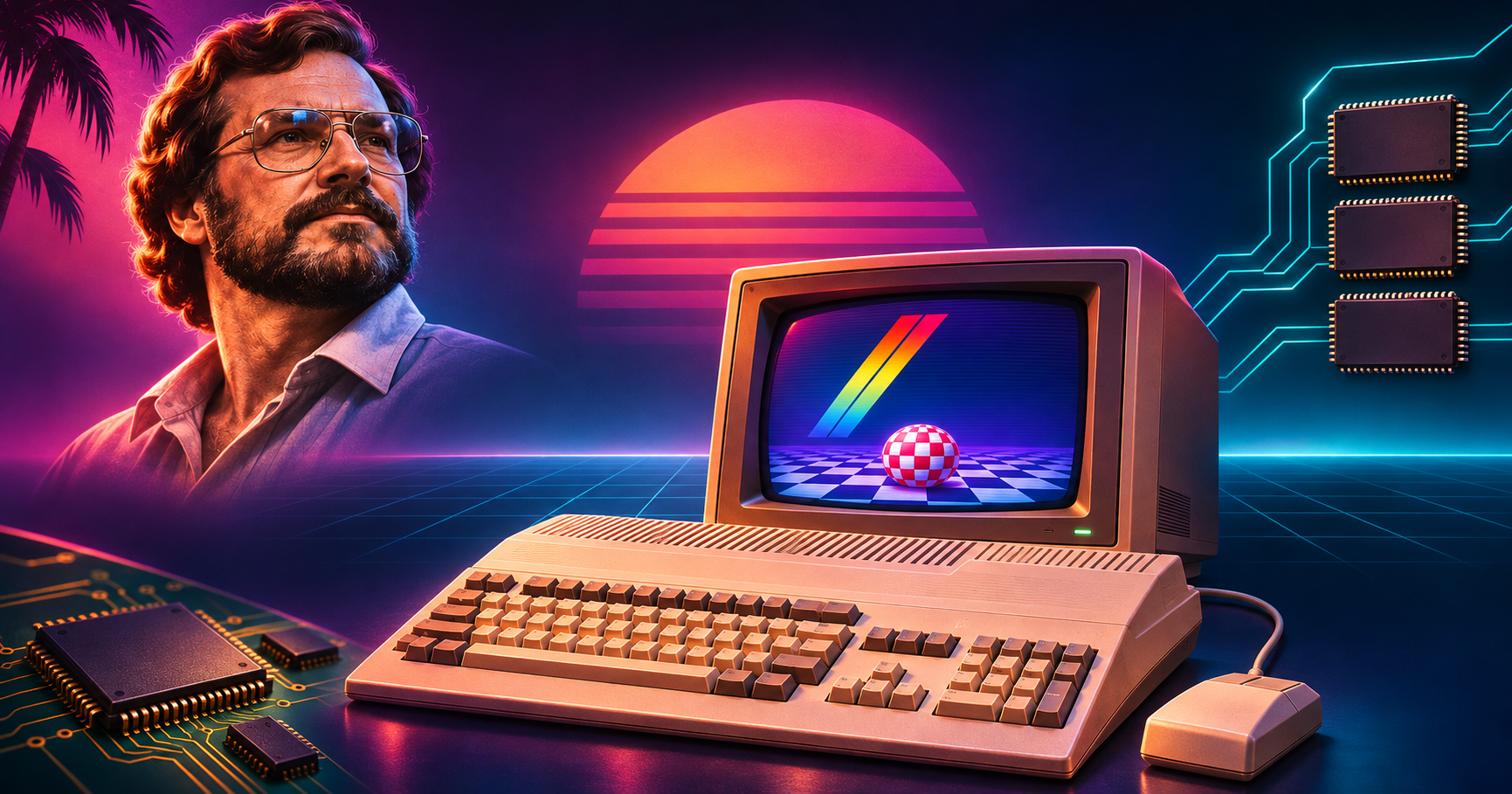
A computer from the future: how Jay Miner built the Amiga around three chips
While many IBM-compatible PCs made do with a built-in beeper, the Amiga played four-channel stereo sound and moved graphical objects with dedicated hardware. Its great secret was not processor speed, but that the processor did not have to do everything itself.
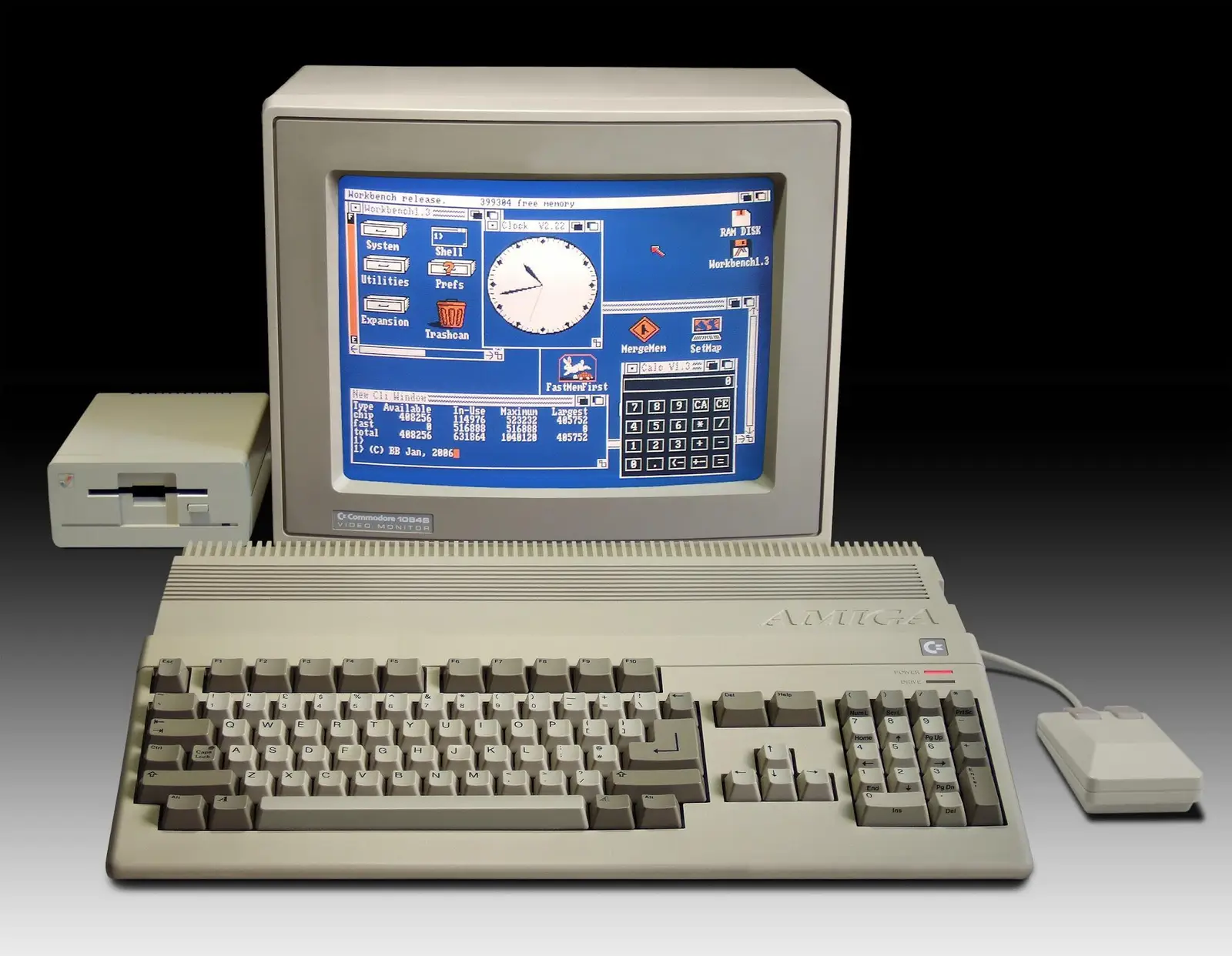
Years before the Amiga, Jay Miner already knew how to make an inexpensive computer do things people did not expect of it. At Atari, he helped create specialized electronics for game systems and home computers. That experience taught him a simple rule: if the central processor has to handle every pixel on the screen, a beautiful frame quickly becomes too expensive. It is much better to assign repetitive operations to dedicated circuits.
In the early 1980s, Miner wanted to build a machine around the Motorola 68000. The processor was powerful for its time, but it was not enough on its own for the graphics he had in mind. Atari’s management did not share his plans for a new, costly project. In 1982, Miner joined the small company Hi-Toro, founded around the idea of a next-generation game system. It was later renamed Amiga Corporation, and the gaming concept gradually evolved into a full-fledged home computer.
The prototype’s internal name, Lorraine, referred to the wife of company head Dave Morse. This was not a romantic flourish added to a finished product, but a startup tradition: engineers assembled future microchips from bulky test boards, debated component costs, and tried to predict the market. Miner was responsible for the hardware architecture, but the Amiga was not the work of one person. Important contributions came from, among others, Ron Nicholson, Dale Luck, Carl Sassenrath, and R. J. Mical. The idea of hardware working in parallel required not only circuits but also a software system capable of using them.
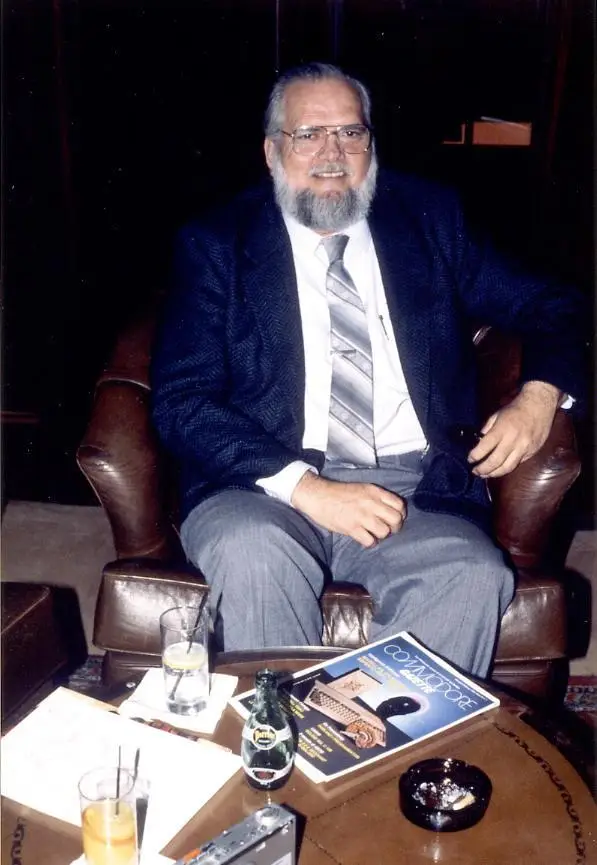
Among the most human details of the story is Miner’s dog, Mitchy. In a 1992 interview, Miner said that bringing her to the office was part of his work agreement. This was not a later legend invented by fans: Mitchy’s presence really did become associated with the team’s relaxed atmosphere. But behind that homely comfort lay serious financial problems. Development required money, and after the 1983 crash the video-game market no longer looked like a reliable source of support.
In 1984, Amiga Corporation came under Commodore’s control, giving the project the resources to reach the market. The first machine was the Amiga 1000, introduced in 1985: expensive and unusual, with a multitasking system and graphics that looked fantastical to many buyers. It is important not to confuse it with the Amiga 500. The A500, which appeared in 1987, packed the related architecture into a more affordable keyboard-style case with a built-in floppy drive. Miner’s idea had finally reached not just demonstrations but bedrooms, living rooms, and school clubs.
Three chips instead of one processor
Inside the Amiga 500 was a Motorola 68000 running at approximately 7.09 MHz for PAL and 7.16 MHz for NTSC. Those figures may look laughably small by modern standards. But judging the A500 only by megahertz is like judging an orchestra by the speed of the conductor’s baton. The central processor ran programs, managed the system, and handled game logic, while three specialized chips in the OCS—Original Chip Set—shared the demanding repetitive tasks.
Agnus was the memory and data-movement dispatcher. It organized direct memory access—DMA—so dedicated units could read and write data without making the Motorola 68000 move every byte by hand. Inside Agnus were two especially useful assistants: Copper and blitter. Denise turned graphical data into an image: color registers, screen bitplanes, hardware sprites, and the video signal. Paula played digital sound and helped manage input/output, including the disk drive.
The memory shared by the processor and chips was called Chip RAM. A typical early Amiga 500 had 512 KB of RAM; some configurations could be expanded further. This was not the same as a modern graphics card with its own fast memory. On the Amiga, all the participants shared access to a common bus. So the specialized chips did not make operations free: intensive graphics could take cycles away from the CPU. Even so, dividing up the work delivered a huge practical benefit.
Imagine a game in which a ship flies over a multilayered background while the music plays without stuttering. On a simple computer, the main processor might have to copy the background, update every moving image, output audio data, and only then deal with collisions. The Amiga could offload a significant part of this routine work to DMA and hardware units. The processor remained essential, but it was no longer the only worker in the workshop.
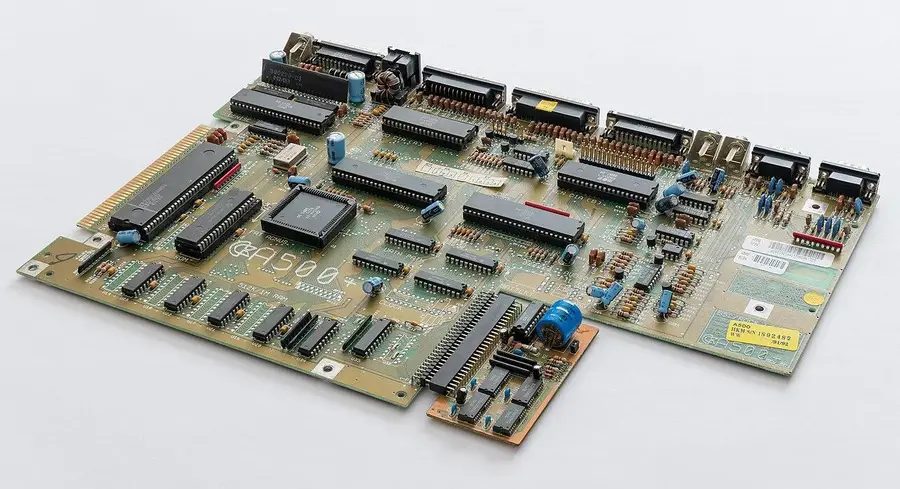
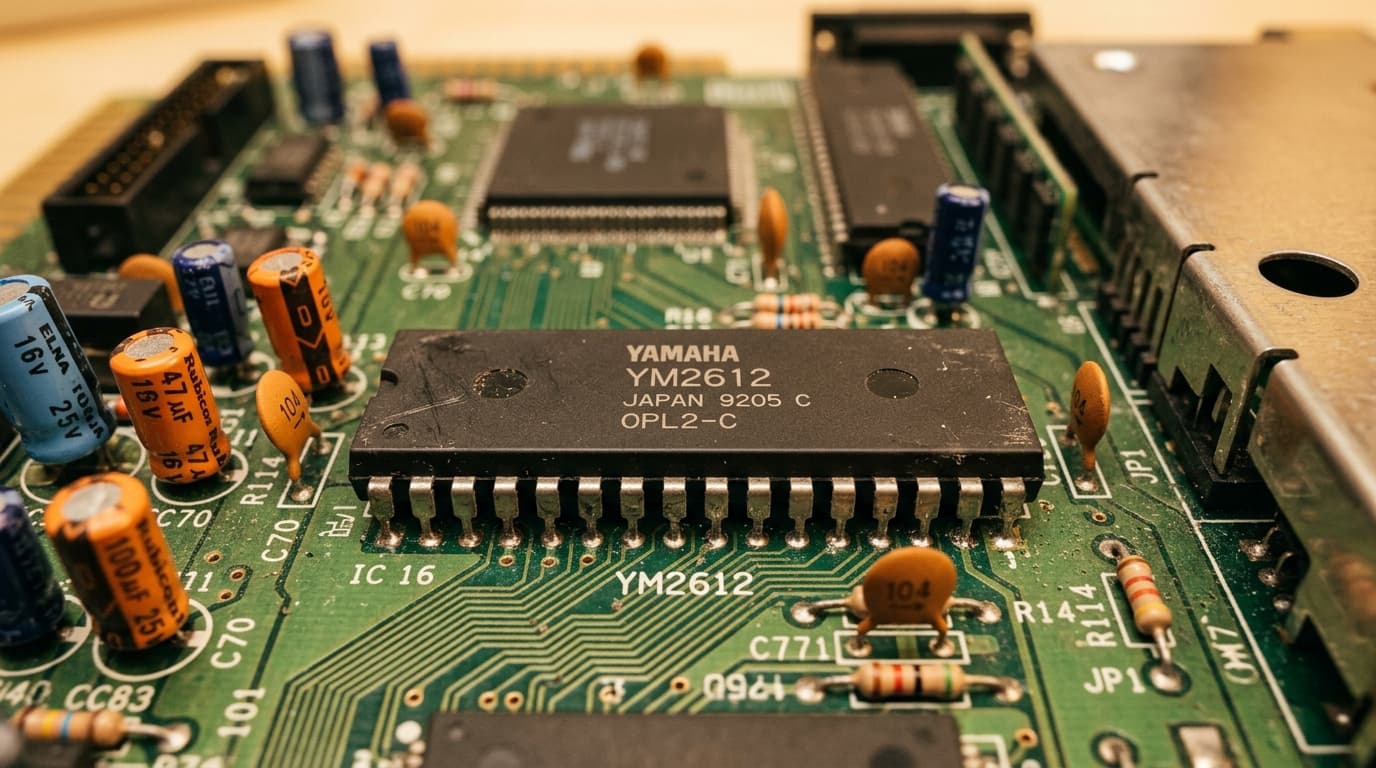
This architecture explains why photographs of the board show so many large chips that are not the central processor. An important distinction: OCS is the name of the original feature set, not a claim that every Amiga 500 revision contained exactly the same chip versions. Later boards could use updated versions of Agnus and other components. The system’s basic idea remained unchanged: graphics, sound, and data exchange were part of the computer’s design, not an assortment of expansion boards bought later.
Copper, blitter, and 4,096 colors
The most elegant device in the Amiga is hard to show in a photograph: Copper worked like a tiny director for the television frame. Screens of the cathode-ray-tube era were built line by line. Copper tracked the position of the scan and changed graphics-hardware registers at just the right moment. A programmer prepared a sequence of simple commands in advance, and the sequence ran in sync with the moving beam. The central processor did not have to catch the right moment on every line.
This made the famous “copper bars” possible: the background color could change as the frame was being drawn. The palette could be changed in different parts of the screen, the display divided into zones with different settings, scrolling adjusted, or hardware sprites reassigned. Copper did not “draw” the image in the usual sense; it controlled how and when other units displayed it. To the viewer, though, the result looked like graphics magic.
The blitter handled another kind of work. If a rectangle of pixels needed to be moved from one place in memory to another, masked, used to fill an area, or turned into a line, the blitter could do it much more efficiently than a series of ordinary CPU instructions. In games, that meant moving large objects, clearing remnants of the previous frame, and assembling a new image. Such software-drawn objects were often called bobs—blitter objects. They should not be confused with Denise’s actual hardware sprites.
The classic Amiga had eight hardware sprites. The video system read their data separately from the background, so they could move without redrawing the entire playfield. But eight is not infinite, so developers combined sprites, the blitter, scrolling, and Copper tricks. In a good game, the viewer should not have to guess which figures are being moved by a separate video unit and which are copied into memory. They should see only smooth movement.
The Amiga is also often described with the phrase “4,096 colors on screen.” This needs clarification. A standard low-resolution OCS screen usually displayed up to 32 colors at once, selected from a 12-bit palette of 4,096 possible shades. The HAM mode, or Hold-And-Modify, expanded the visible range of colors in an unusual way: instead of selecting a whole new color, the next pixel could preserve part of the previous one and change just one of its three components—red, green, or blue.
Through a chain of these changes, HAM could show practically the entire palette of 4,096 shades in one image, but with limitations: neighboring pixels depended on one another, and sharp color transitions could produce artifacts. That made HAM well suited to photographs and static illustrations, but not a universal way to draw every dynamic game. It was an engineering innovation, not a magic “make everything 4,096 colors” button.
In real games, the effect often came not from one record-breaking feature but from combining techniques: multiple scrolling planes, palette changes by scanline, carefully calculated DMA timing, and artistic skill. An Amiga developer thought not only about objects and frames, but also about which parts of the future image the hardware itself could build. That is why the platform’s best graphics demonstrations were both works of art and lessons in low-level engineering.
Paula and programmable music
On a typical early IBM PC, the built-in speaker was more a signal generator than a full-fledged musical instrument. Paula, by contrast, played four independent streams of 8-bit PCM samples—short digital recordings of sound. Two channels went to the left output and two to the right. They could be used for percussion, bass, melody, and effects; when needed, all four could play at once. Hardware DMA fed samples into the audio stream while the CPU worked on the program.
Unlike synthesis based on a fixed set of simple waveforms, PCM made it possible to put almost any recorded timbre into a composition: a drum hit, a string, a snippet of voice, or a short burst of noise. Quality was limited by eight bits, memory, and playback frequency; this was not uncompromised studio sound. But the ability to manipulate real sounds on an inexpensive home computer opened up a new way to compose music.
Imagine a musical box with four tapes. Each tape records which sound sample to play, at what pitch, volume, and effect. All four run at once; changing their contents from beat to beat makes it possible to create a much denser arrangement than the number of physical channels might suggest. That was the basic idea behind tracker music: a composition consisted of patterns of commands and a collection of samples.
In 1987, Karsten Obarski created Ultimate Soundtracker, an important starting point for the module-music format known by the MOD extension. Other editors and offshoots followed, including NoiseTracker and ProTracker. A file could store the sounds themselves together with notes and instructions for playing them. This compactness was nearly ideal for sharing on floppy disks and exchanging music between creators, although file size depended on the samples used.
The music scene quickly grew beyond games. Demo programs circulated on floppy disks, in which groups of coders, artists, and musicians competed to get an increasingly improbable result from the same machine. At first these were often title screens and intros, then full demos—standalone audiovisual works. The tracker became the musical language of this community: creators exchanged modules, studied one another’s patterns, and rebuilt compositions, much as programmers study source code.
It is important not to rewrite history as if the Amiga invented digital sampling or computer music. Those technologies existed earlier, often on much more expensive systems. The Amiga’s achievement was different: four hardware sound channels, convenient software, and a mass-market home computer combined to make music creation an accessible practice. Music was made not only by professional composers but also by teenagers with a floppy disk, patience, and a good ear.
Why the Amiga lost, but stayed with us
The Amiga’s story is especially poignant because its creator’s weakness was not a lack of ideas. While engineers proposed further hardware capabilities, Commodore had to decide how much to invest, which models to release, and how to explain the differences between its computers to customers. The successful Amiga 500 helped create a large market, especially in Europe, but it did not turn the whole product line into a system capable of sustaining technological leadership indefinitely.
By the early 1990s, IBM-compatible PCs were changing rapidly. VGA graphics, sound cards, more powerful x86 processors, and a growing software market gradually eroded the early Amiga’s advantage. Game consoles were also taking attention away from home computers. One particular problem was that the specialized chipset that had once given the platform an edge required complex and expensive coordination for every major upgrade. For a new PC, it was easier to buy a processor and graphics card from different manufacturers than to quickly design an entirely new Amiga.
Commodore released the Amiga 1200 and Amiga 4000 in 1992, now with the more advanced AGA graphics, but the moment had passed: the market and expectations had shifted. Management, marketing, supply, and financial problems added to the difficulties. On April 29, 1994, Commodore announced the start of liquidation and bankruptcy protection. This did not mean that every Amiga computer stopped working that day or that its users disappeared. What ended was a production center vital to the platform.
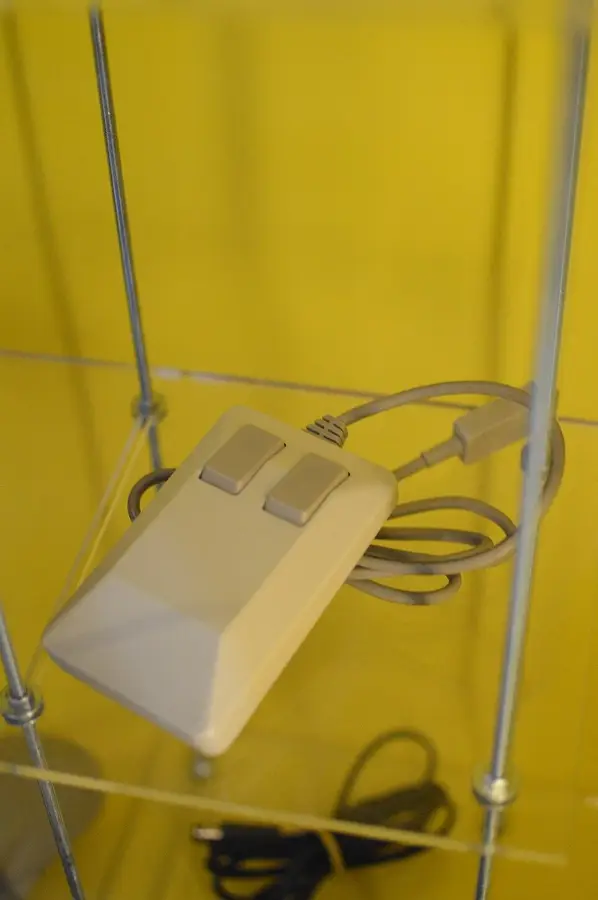
In Europe, the Amiga 500 had become a cultural environment. For some, it was their first game machine with amazing sound; for others, their first encounter with graphics editing, animation, programming, and a multitasking operating system. Local communities, floppy-disk exchanges, fan publications, and the demoscene grew out of it. In this memory, the Amiga lives on not just as a product with a list of specifications, but as an experience: you could open the case, study the registers, write your own effect, and show it to your friends.
The games themselves also helped cement the legend. Shadow of the Beast was remembered for its layers of moving scenery and sound; Another World for its cinematic animation and unusual visual direction; Sensible Soccer for its speed and precise controls. None of these strengths was directly “created by the chips”: design, code, graphics, and music were the work of people. But the hardware platform provided a set of artistic tools and made them available on a relatively affordable computer.
Amiga’s ideas eventually stopped looking exotic. Specialized graphics processors, hardware acceleration for image operations, separate sound subsystems, and parallel processing became familiar parts of the industry. It would be wrong to draw a direct line from Amiga to every modern technology; similar solutions developed in different places. Still, its importance is clear without exaggeration: in 1985, and then in the mass-market Amiga 500 of 1987, it showed ordinary people how cohesive a multimedia computer could be when its architecture was designed around image and sound from the start.
There is no single Commodore mistake or one successful competitor that explains why the Amiga lost. It lost the contest between platforms and business models, but won a rarer contest—for its users’ imagination. People remember it not because the Motorola 68000 had a particularly high clock speed, but because three specialized chips let the machine sound, move, and surprise as if it had arrived from the next decade.
At a glance
The Amiga 1000 was introduced in 1985; the more affordable Amiga 500 followed in 1987.
The A500’s central processor was a Motorola 68000, running at approximately 7.09 MHz in PAL and 7.16 MHz in NTSC.
The original OCS chipset comprised Agnus (DMA, Copper, blitter), Denise (video, sprites), and Paula (sound and input/output).
Paula’s sound system played four independent 8-bit PCM channels: two left and two right.
A typical OCS screen selected up to 32 colors from a palette of 4,096; HAM mode expanded the number of displayed shades, with limitations.
Commodore announced the start of asset liquidation on April 29, 1994.