The Era of Bootleg Cartridges: How Steepler, Dendy, and Gray Imports Brought Us Video Games
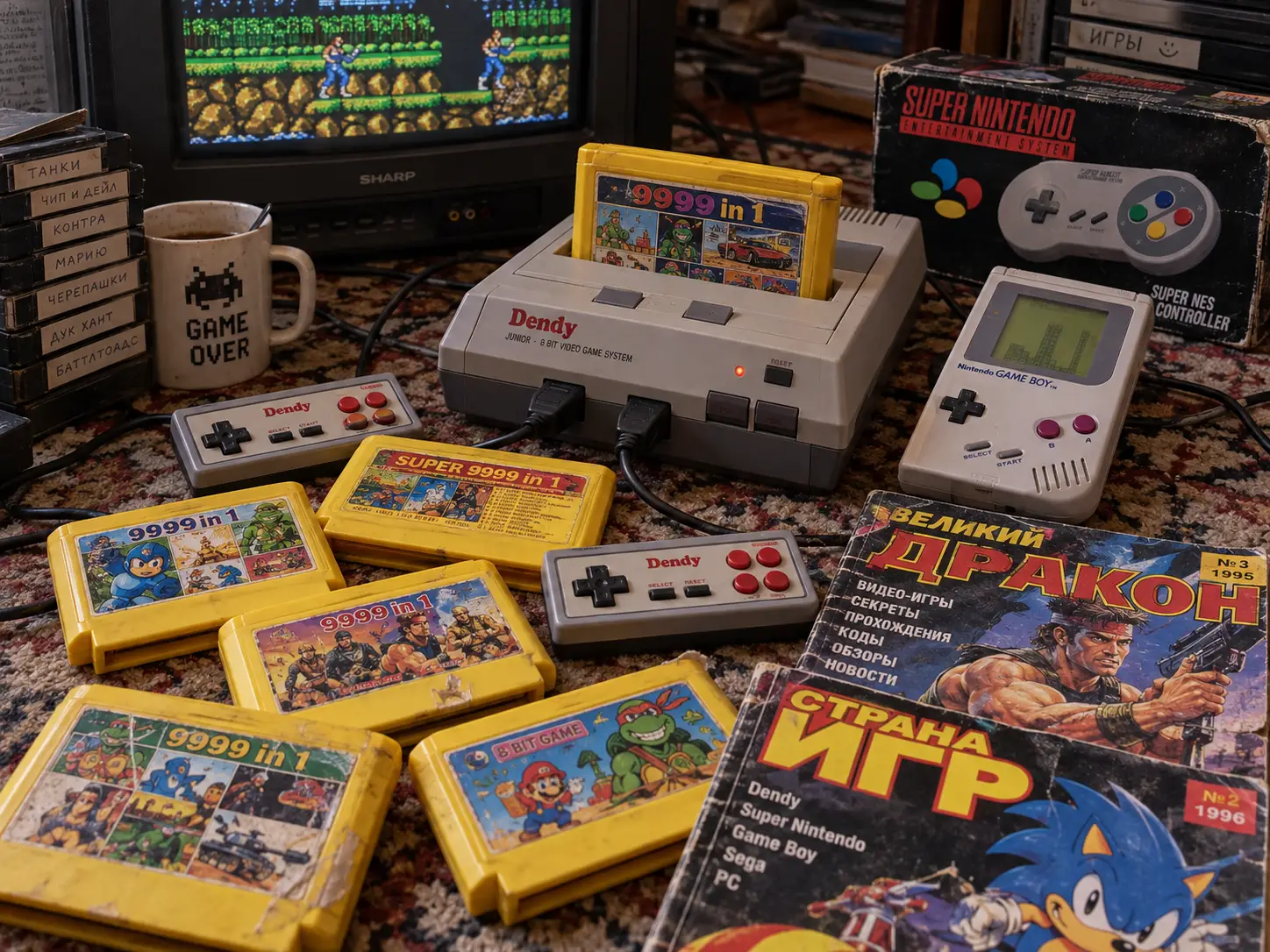
Atmospheric still life featuring a Dendy Junior game console, yellow cartridges, a magazine, and a television. AI-generated illustration.
FactBox: Key Figures and Facts
| Параметр | Значение / Описание |
| Число проданных консолей | Свыше 2 000 000 штук (без учета безымянных клонов других компаний) |
| Стоимость Dendy в 1992 году | ~39 000 неденоминированных рублей (около $94 по курсу конца 1992 года) |
| Компания-основатель | «Стиплер» (Steepler) — российская IT-компания, занимавшаяся системной интеграцией |
| Аппаратная основа | Тайваньские клоны 8-битной Nintendo Famicom (Micro Genius IQ-501 от TXC) |
| Визуальный символ | Слоненок Dendy, созданный художником-мультипликатором Иваном Максимовым |
| Главный медиа-драйвер | Телешоу «Денди — Новая реальность» (2x2, ОРТ) с ведущим Сергеем Супоневым |
01. Viktor Savyuk and the Steepler Idea: How to Sell a Clone in a Vacuum
In the early 1990s, the post-Soviet consumer electronics market was taking shape chaotically. Major international video game companies such as Nintendo and SEGA had no official presence at all. The market was filled with scattered “gray” imports, while the term “game console” brought to mind either rare Soviet handhelds from the Elektronika series (copies of Game & Watch) or expensive foreign equipment that was out of reach.
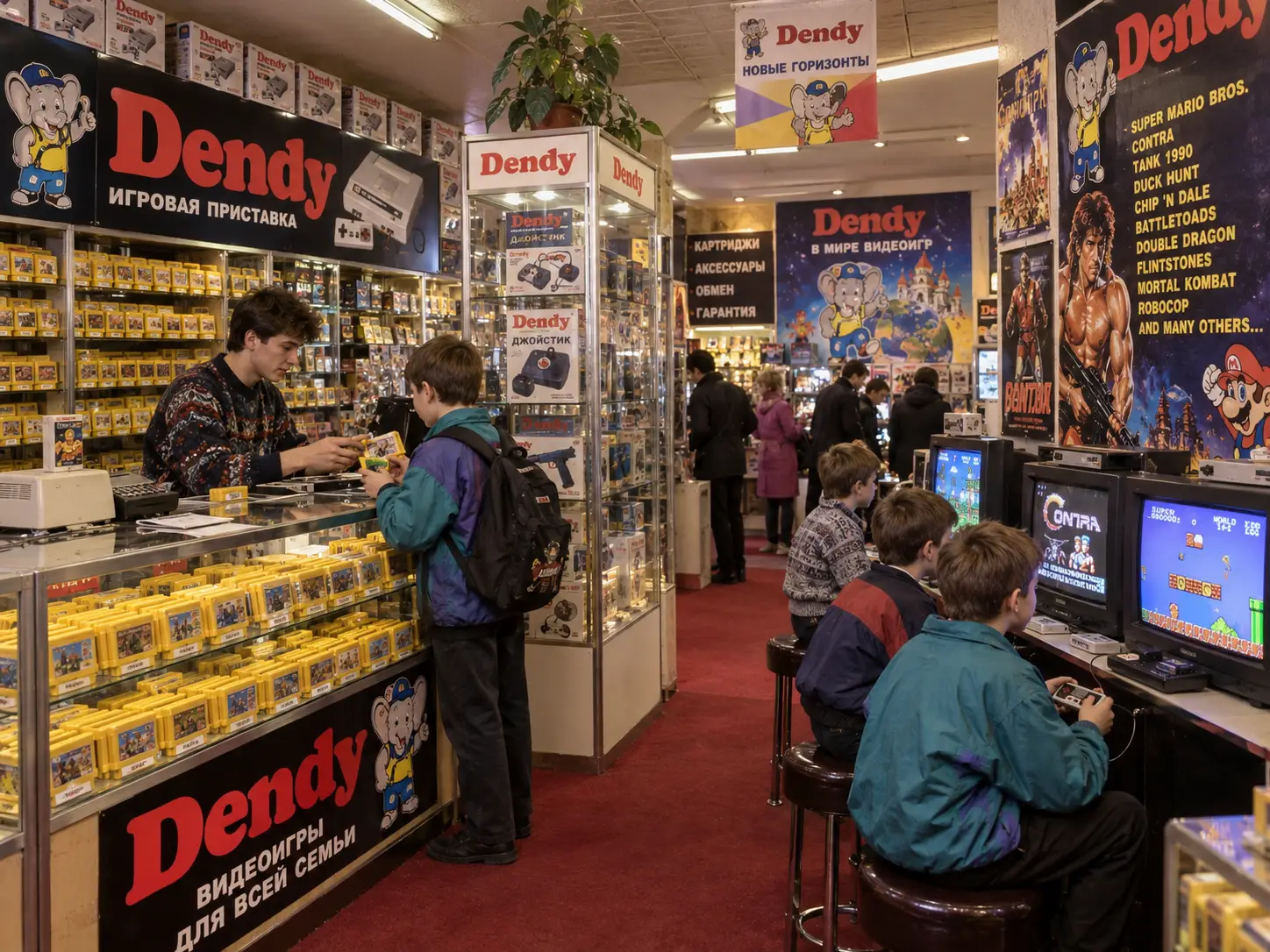
A Dendy video game store in the 1990s. AI-generated illustration.
The idea of building a legitimate business around clones of Nintendo’s 8-bit Famicom (known in the US as the NES) belonged to entrepreneur Viktor Savyuk. In 1992, he approached the management of Steepler, a young but successful IT company. Savyuk presented a business plan: instead of chaotically importing nameless Asian knockoffs, create a single, recognizable brand and provide warranty service, distinctive packaging, and an aggressive advertising campaign.
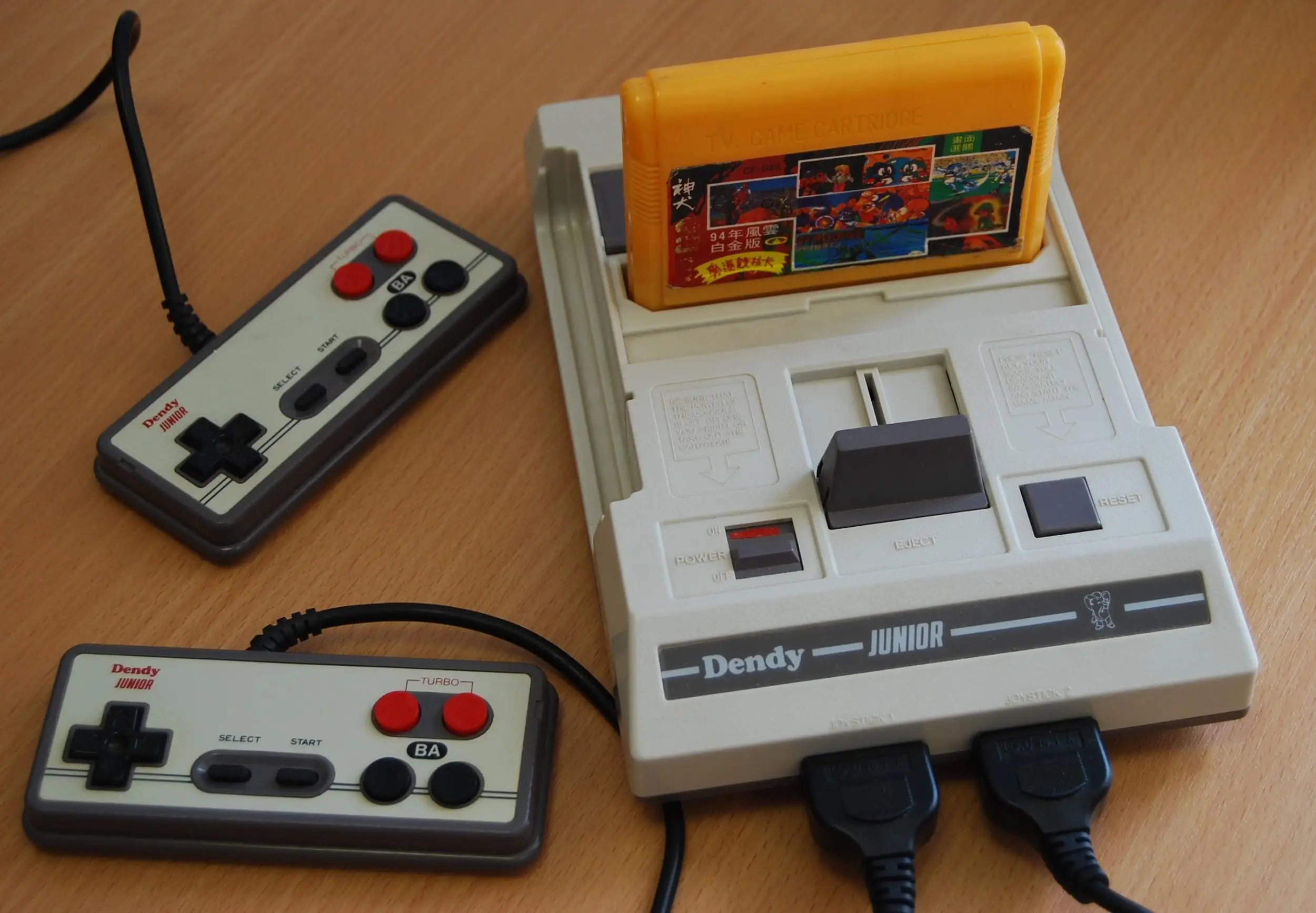
Dendy Classic and Dendy Junior consoles with cartridges and controllers. Source: Wikimedia Commons; CC BY-SA 4.0 and CC BY-SA 3.0 licenses, respectively.
Building the Brand and Dendy’s Mascot
To manufacture its game systems, Steepler signed an agreement with Taiwanese company TXC Corporation, which produced Famicom hardware clones under the Micro Genius name. The consoles were adapted to work with the SECAM/PAL television standards widely used across the CIS.
But marketing proved to be the key to success:
• Brand name: The catchy name Dendy was created to be easy for children to remember.
• Mascot: Russian animator Ivan Maximov drew the famous blue elephant wearing a cap and a T-shirt with the Dendy logo.
• Branded stores: Specialized Dendy showrooms began opening in Moscow and the regions, featuring red carpeted floors, game-testing stations, and courteous salespeople that created a premium-service feel.
“We weren’t just selling plastic with microchips inside; we were selling access to an entirely new world, one children in the ’90s had never even been able to dream of,” Viktor Savyuk recalled.
02. Anatomy of a Cartridge: Yellow Plastic, Epoxy Blobs, and Bootleg Hacks
The era’s true symbol was the bright yellow plastic cartridge casing. Unlike Nintendo’s original gray-and-white cartridges, whose authenticity and origins were strictly controlled by rights holders, yellow cartridges were manufactured by hundreds of semi-underground factories in Taiwan, China, and Hong Kong.
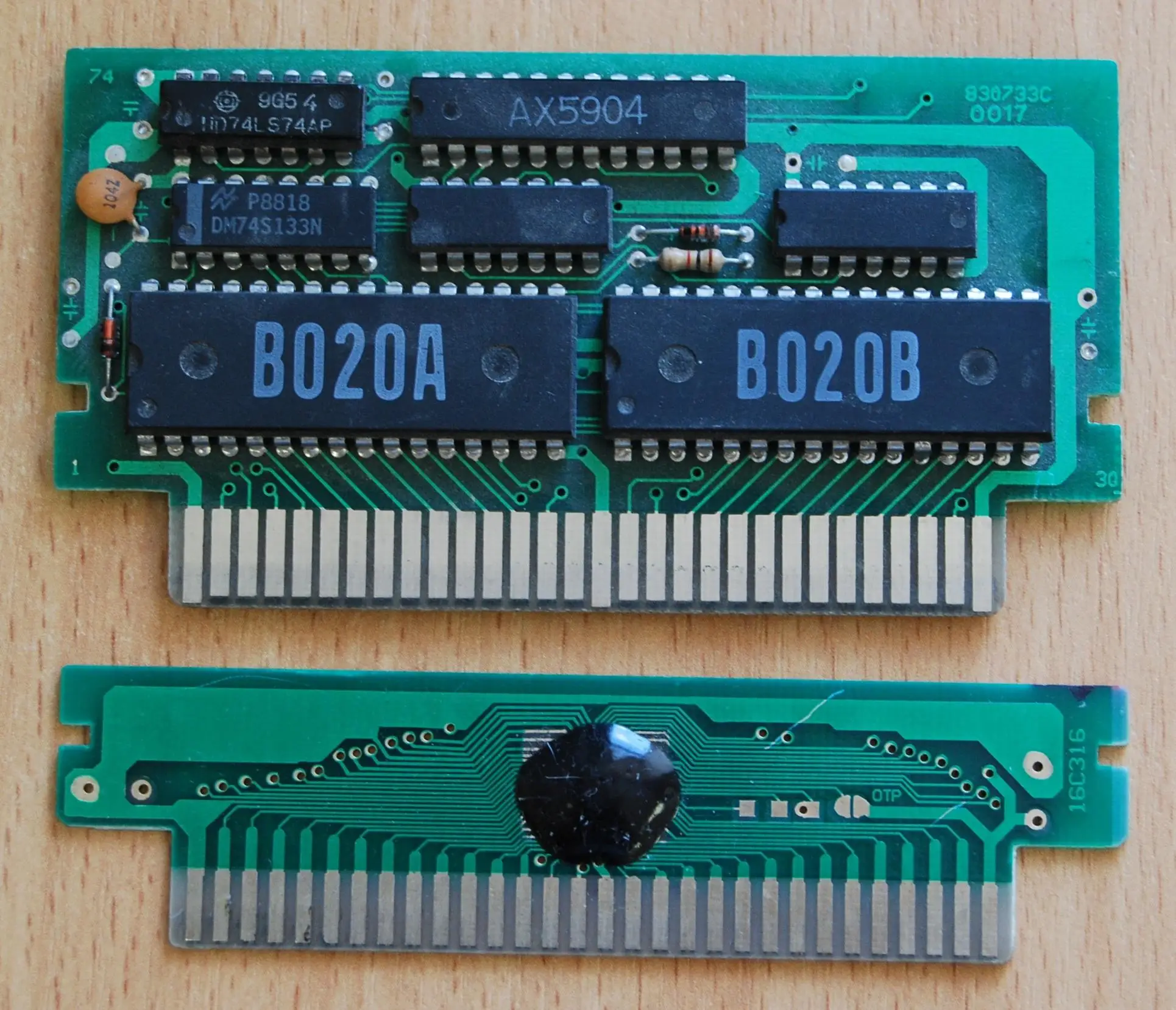
Dendy cartridge circuit boards. The typical layout of cheap Famicom cartridges is clearly visible. Source: Wikimedia Commons, CC BY-SA/GFDL.
Technical Features of Bootleg Hardware
• Epoxy blobs (Chip-on-Board): To reduce manufacturing costs, ROM and RAM chips were soldered directly onto the circuit board without ceramic or plastic packages, then covered with black epoxy compound (“blobs”).
• “9999 in 1” multicarts: With cartridges in short supply, compilations were incredibly popular. Claims of “9999 games in one” were achieved by duplicating 3–5 base games (for example, Super Mario Bros., Duck Hunt, Galaxian, and Wild Gunman) with changes to starting levels, color palettes, initial weapons, or music.
• Bootleg hacks and modifications: Asian engineers rewrote game code. Unique ports appeared, including Somari (Sonic running on the Super Mario engine for Famicom), bootleg versions of Street Fighter and Mortal Kombat, and ROM hacks with altered character sprites (for example, replacing characters with Mario, Pokémon, or characters from Disney cartoons).
Everyday Gaming Rituals
• “Blowing” on cartridges: Because of poor contact between the console’s oxidized brass connectors and the cartridge board, players would blow as hard as they could into the cartridge slot before each game.
• Contact cleaning with an eraser: Rubbing the copper contacts with a school pencil eraser was the main way to “resuscitate” a game that wouldn’t start.
• Trading in the courtyard: Cartridges were swapped “for the evening” or “for the weekend.” A valuable single-game cartridge (such as Prince of Persia, Battletoads & Double Dragon, or Darkwing Duck) might be exchanged for two or three multicarts.
03. Sergey Suponev: The Magic of ’90s Television and a Childhood Dream
Without television, Dendy could never have become a true sociocultural phenomenon. In September 1994, the show “Dendy — New Reality,” sponsored by Steepler, premiered on channel 2x2 (and later on ORT).
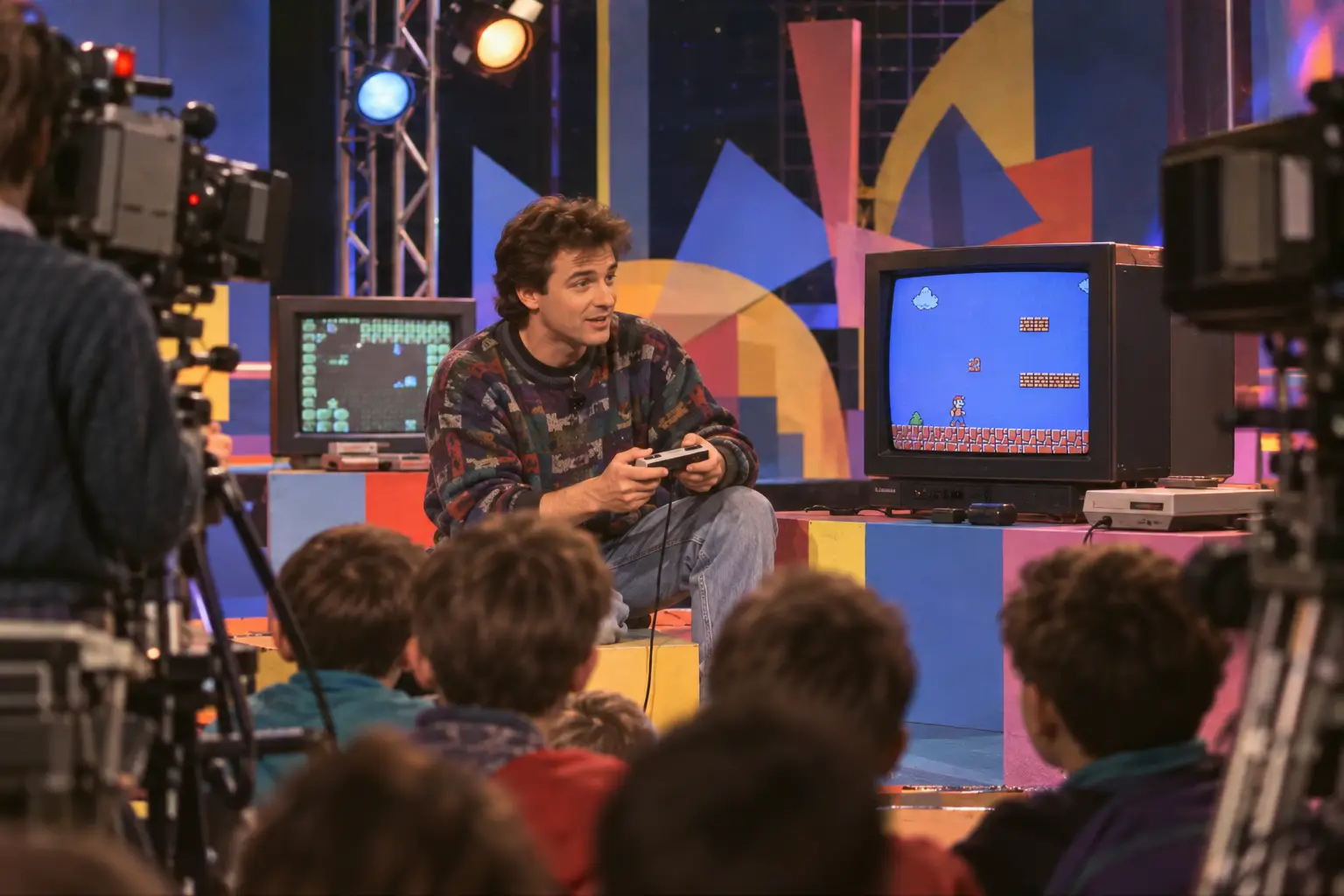
An artistic reconstruction of a 1990s video game TV studio in the style of “Dendy — New Reality.” AI-generated illustration; not an archival image.
A Television Phenomenon
The host, the incredibly charismatic Sergey Suponev, spoke to children as equals, without lecturing or official-sounding language. He played through levels with excitement, shared secrets and cheat codes, and demonstrated games right on the television screen.
The show covered not only Dendy’s 8-bit games, but also more advanced 16-bit systems: the Super Nintendo (SNES) and Game Boy. The show’s slogan, “Dendy, Dendy, we all love Dendy! Everyone plays Dendy!” and its signature jingle stayed in the memories of millions of viewers.
An Ecosystem Around the Brand
A whole media industry formed around Dendy:
• The magazines “Video-Ass Dendy” and “Dendy — New Reality,” featuring reviews, secrets, and walkthroughs.
• Telephone helplines and teletext.
• Disney cartoons (“DuckTales,” “Chip ’n Dale,” and “Darkwing Duck”), airing on TV during the same years, fueled the explosive interest in their video game adaptations.
04. The Official Nintendo Deal: How a Bootleg Brand Went Legit
By 1994, Dendy sales across the CIS had become so enormous that they caught the attention of Nintendo’s headquarters in Kyoto. In effect, Steepler had captured a sixth of the globe by selling Famicom clones under its own registered brand.
Meetings in Kyoto and Going Legit
In 1994, Viktor Savyuk and Steepler’s management traveled to negotiate with Nintendo president Hiroshi Yamauchi. The negotiations ended in an unexpected compromise:
• Exclusive rights: Steepler received official rights to distribute the 16-bit Super Nintendo (SNES) console and the Game Boy handheld system in Russia and the CIS countries.
• Waiver of claims: Nintendo agreed not to pursue legal claims over past Dendy sales or obstruct future sales of Dendy 8-bit consoles, provided Steepler stopped importing third-party clones and focused on official Nintendo products.
The Decline of Steepler
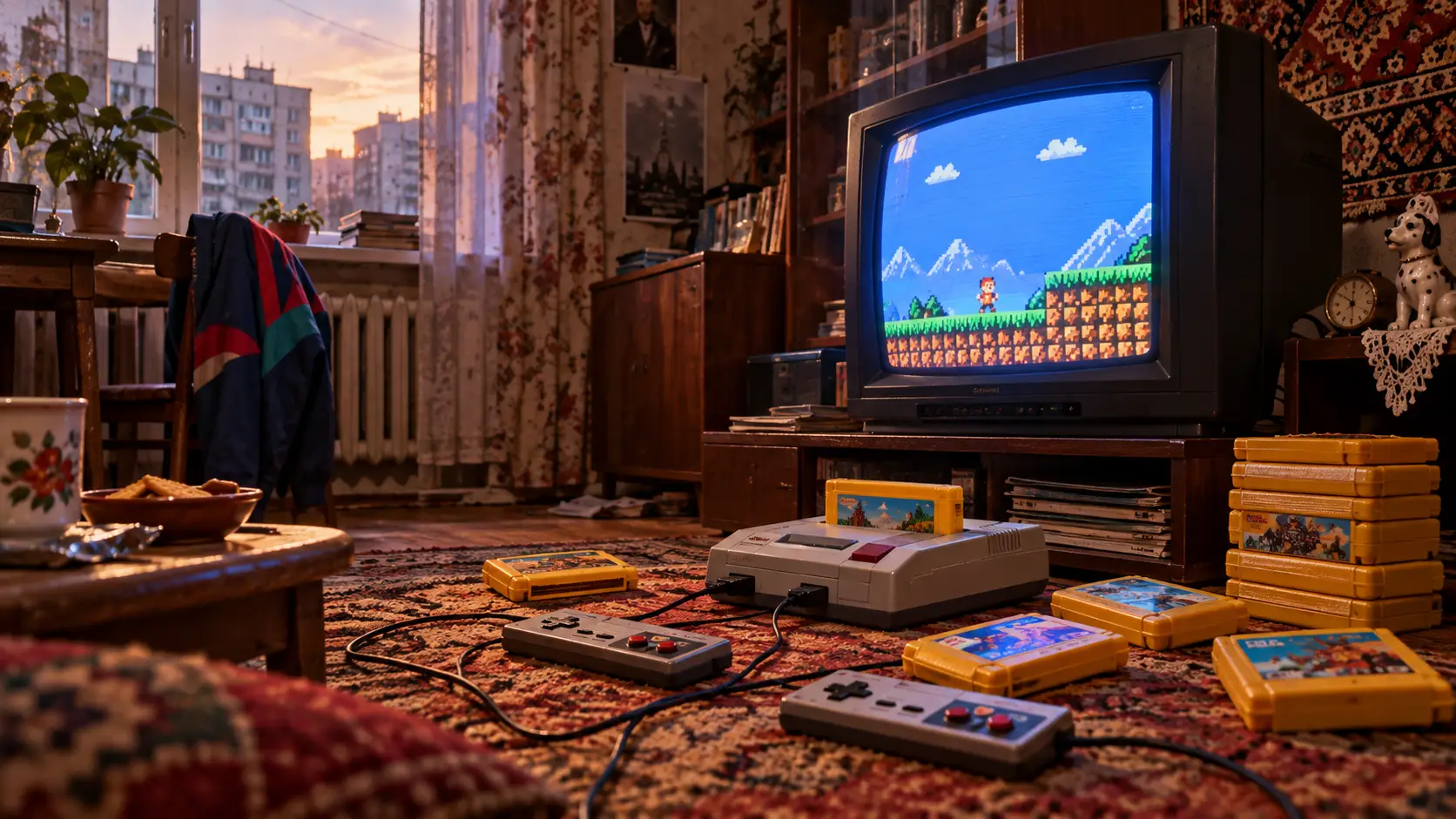
The interior of an apartment with a Dendy console in use in the 1990s. AI-generated illustration.
Despite its move into the legitimate market and commercial success, Steepler’s story ended dramatically in 1996. Its collapse was caused not by video game problems, but by the company’s involvement in a major tender to automate the State Duma of the Russian Federation and by banking disputes. The Dendy manufacturing and sales project came to an end, but the brand became forever synonymous with 8-bit gaming in the Russian-speaking world.