Symphony of Darkness: How Shinji Mikami and a Small Capcom Team Created Resident Evil (1996)
An engineering triumph born from the harsh limitations of the Sony PlayStation system, the conceptual heritage of Famicom classics, and B-movie inspiration. A detailed historical and technical breakdown of how a small group of developers changed the video game industry.
Parameter
Details and Values
Original Title
Biohazard (バイオハザード)
Development Budget
~$1.5M
Development Time
2.5 years (Mid 1993 — Early 1996)
Project Lead
Shinji Mikami
Producer & Initiator
Tokuro Fujiwara
Target Platform
Sony PlayStation (SCPH-1000)
Tech Stack
Pre-rendered 2D background masks, 3D Real-time Polygons (GTE/GPU), CD-DA Audio
Total Sales
>5.05 million copies (original PS1 release)
01 The Legacy of Sweet Home: From Famicom RPG to the Spencer Mansion
In late 1993, Capcom was at the peak of commercial success thanks to Street Fighter II dominating arcades and 16-bit consoles. However, company management realized the upcoming 32-bit disc-based era would require brand-new franchises and technological approaches.
Tokuro Fujiwara, legendary head of Capcom Production Studio 1, approached 28-year-old game designer Shinji Mikami with an offer he initially wanted to refuse. Fujiwara assigned Mikami to create a modern remake or spiritual successor to Sweet Home — a horror RPG released by Capcom on the Famicom (NES) in 1989, based on Juzo Itami's horror film of the same name.
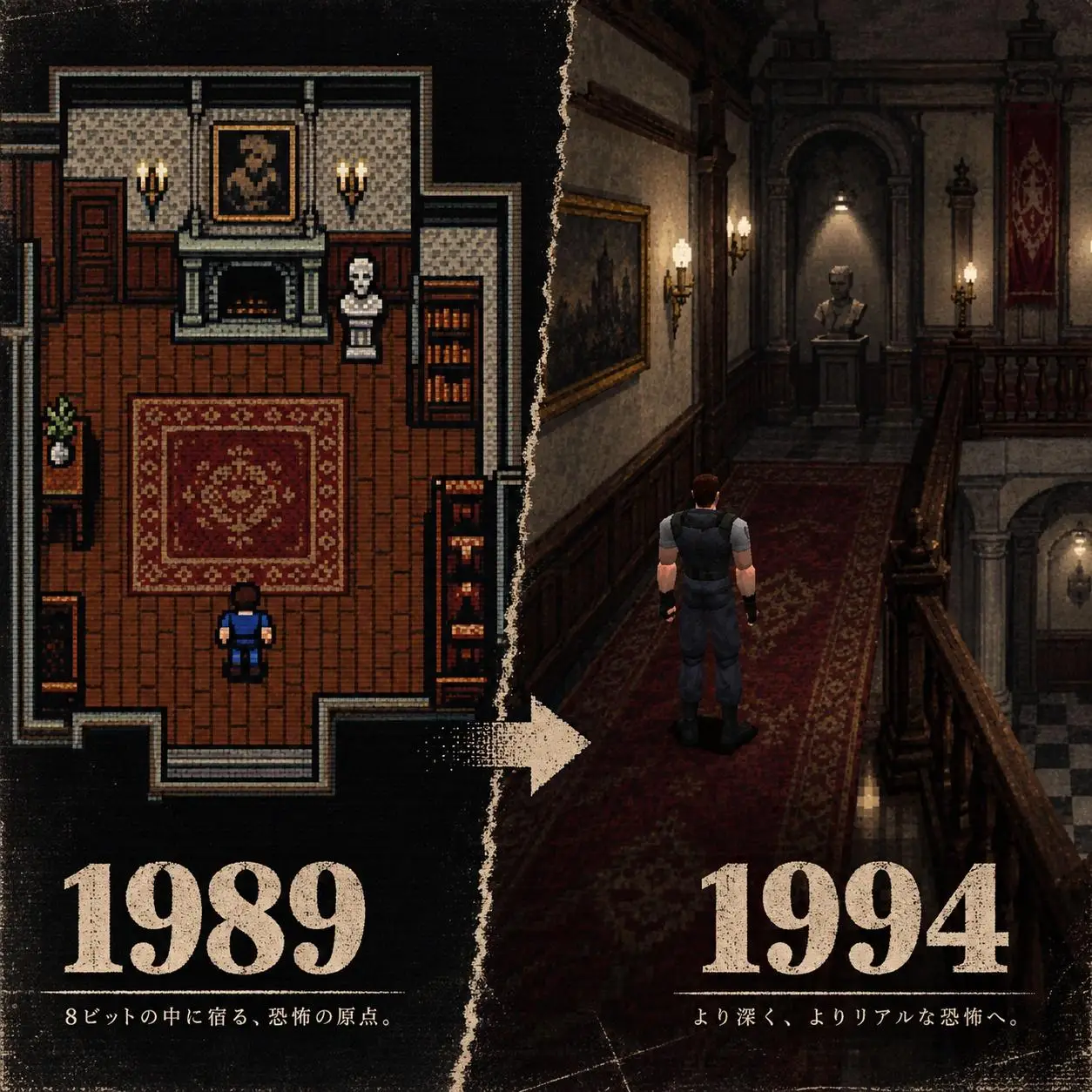
Prior to this, Shinji Mikami worked exclusively on colorful and friendly Disney-licensed projects like Goof Troop and Aladdin for the Super Nintendo. The idea of making a game about monsters and gore did not spark enthusiasm in Mikami; he admitted that since childhood he had a weak stomach for horror films and scared easily. However, this very personal sensitivity to fear became his main creative trump card. Mikami knew precisely what mechanisms make the human heart beat faster.
A deep analysis of Sweet Home reveals that Resident Evil's foundational DNA was entirely borrowed from this 8-bit title:
• Isolated Mansion: Action took place in a terrifying abandoned Yamamura estate filled with traps, locked doors, and puzzles.
• Strictly Limited Inventory: Players could carry only a fixed number of items, forcing constant resource management.
• Notes and Diaries: The story unfolded not through direct dialogue, but through dying notes of former residents and researchers.
• Door Opening Animation: Room transitions were accompanied by a close-up of an opening door, creating a nervous anticipation of the unknown.
• Crests and Kerosene: Single-use items to solve puzzles and overcome obstacles.
The team assigned to Biohazard started with just 15–20 people. Most of them were young novices who had just graduated from university. With no prior experience working with 3D graphics, the team had to learn on the fly, turning the technical limitations of the Sony PlayStation platform into artistic advantages.
02 Abandoning First-Person View and the Magic of Fixed Cameras
The initial prototype of Biohazard, created by Mikami during the first six months of development, differed drastically from the final game. The project was conceived as a pure 3D first-person action game. Mikami was inspired by cutting-edge Western technologies and wanted to immerse the player in the mansion, giving them the ability to look at the horror directly through the character's eyes.
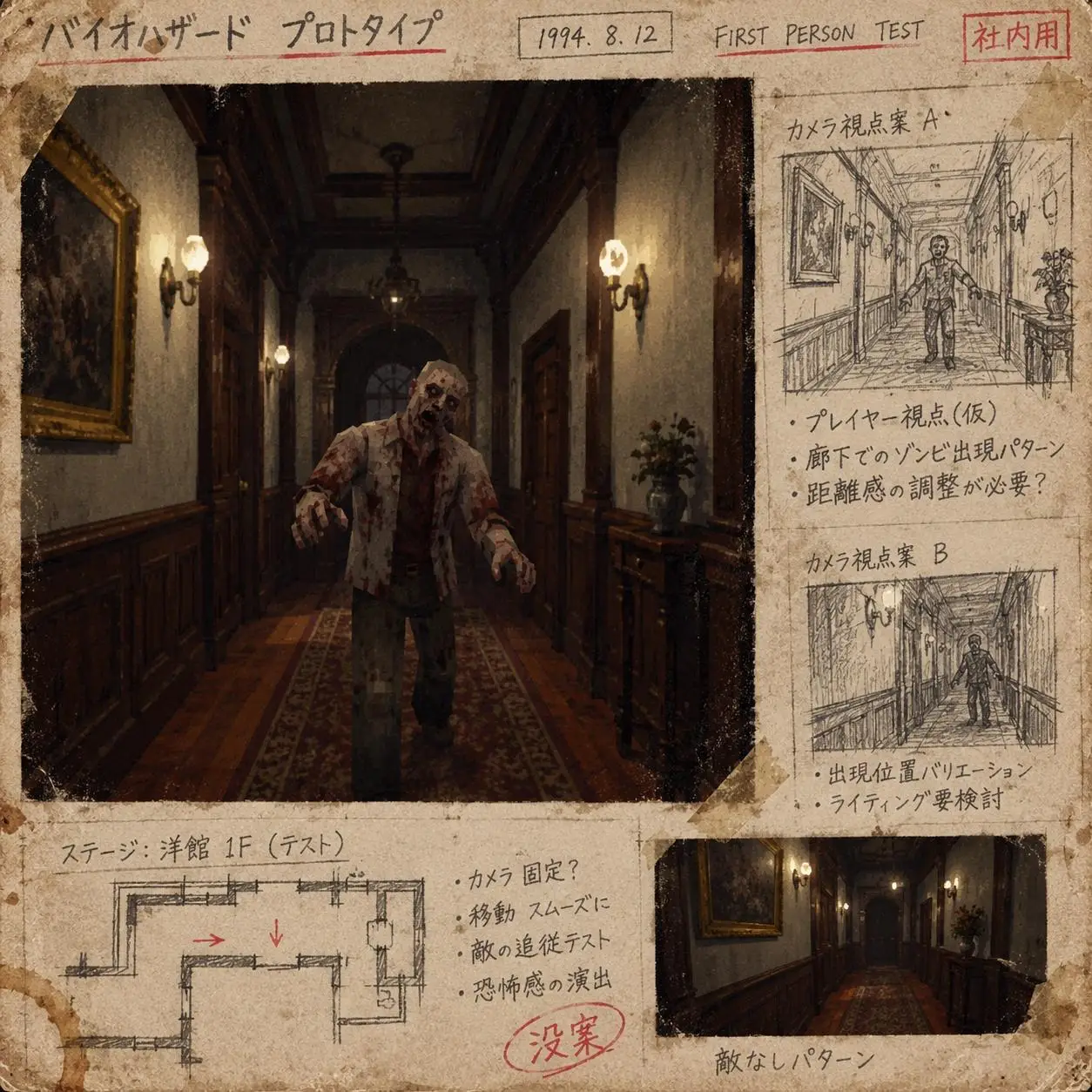
However, by mid-1994, the team faced the harsh reality of Sony PlayStation's hardware capabilities. The console's processor (MIPS R3000A at 33.86 MHz) and GPU lacked a floating-point unit (FPU) and hardware texture perspective correction. Attempting to render a fully 3D mansion with high interior detail, true lighting, and complex monster details led to a catastrophic frame rate drop — below 10–12 FPS.
Furthermore, PlayStation's RAM capacity was a modest 2 Megabytes of Main RAM and 1 Megabyte of VRAM. Fitting high-quality wall textures, 3D room geometry, and complex enemy models into this volume from a first-person perspective was mathematically impossible.
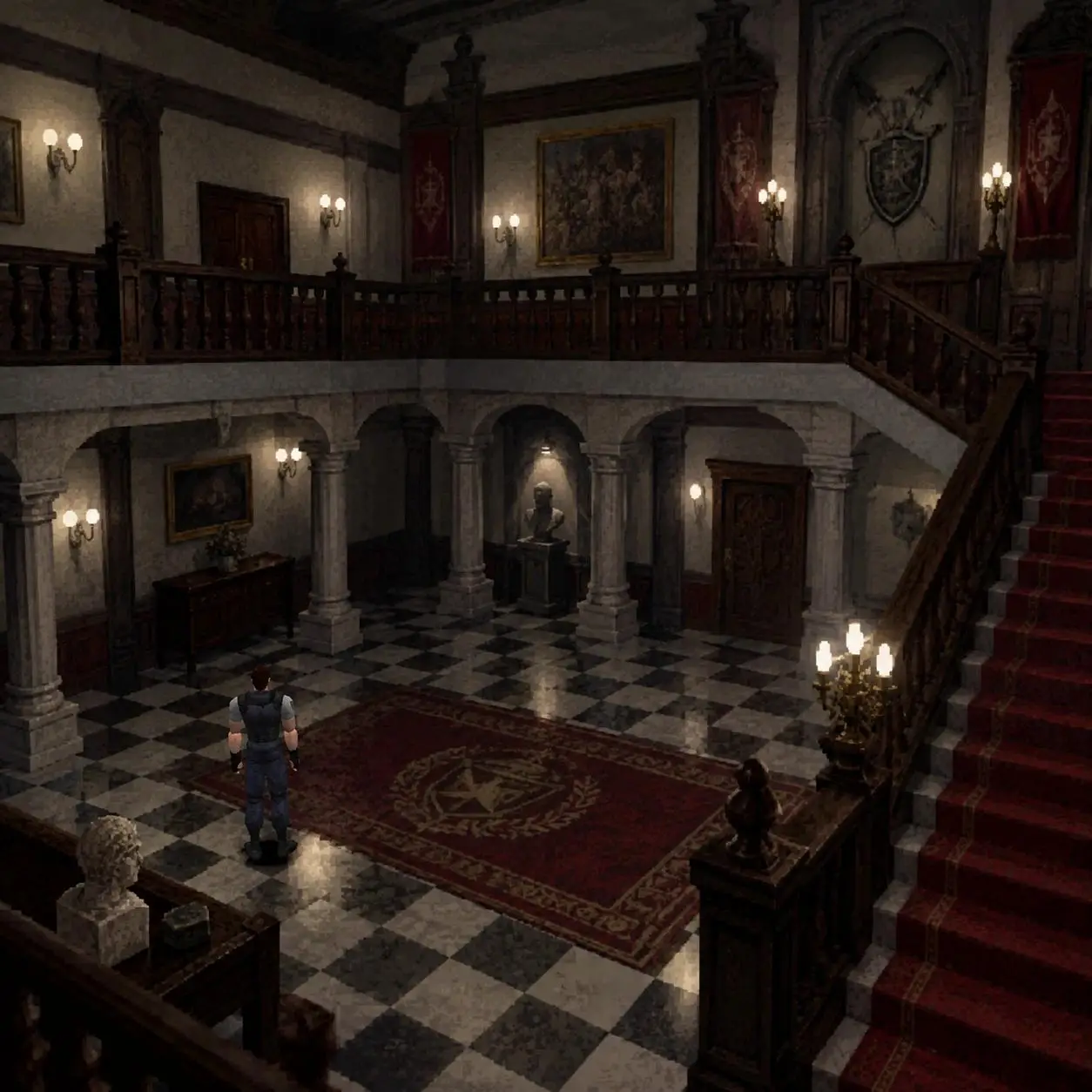
Salvation came in the form of studying the French horror game Alone in the Dark (1992) by Infogrames. Shinji Mikami made the decision to completely abandon true 3D environments in favor of fixed cameras and pre-rendered 2D backgrounds.
Technical Anatomy of Pre-rendered Backgrounds
The production process of Resident Evil locations turned into a complex technological pipeline:
• 3D Location Modeling: Artists created high-poly mansion rooms on powerful Silicon Graphics (SGI) workstations using Softimage.
• Lighting Baking: SGI workstations calculated physically correct lighting, soft shadows, and reflections, taking hours to render a single frame.
• 2D Export: The finished 3D scene was "flattened" into a static 2D image at 320x240 resolution in TIM format, ideal for PS1 memory.
• Z-Buffer and Depth Masks: So character 3D models (Chris and Jill) could walk behind tables, columns, and couches, programmers manually cut depth masks and applied invisible collision geometry over the 2D image.
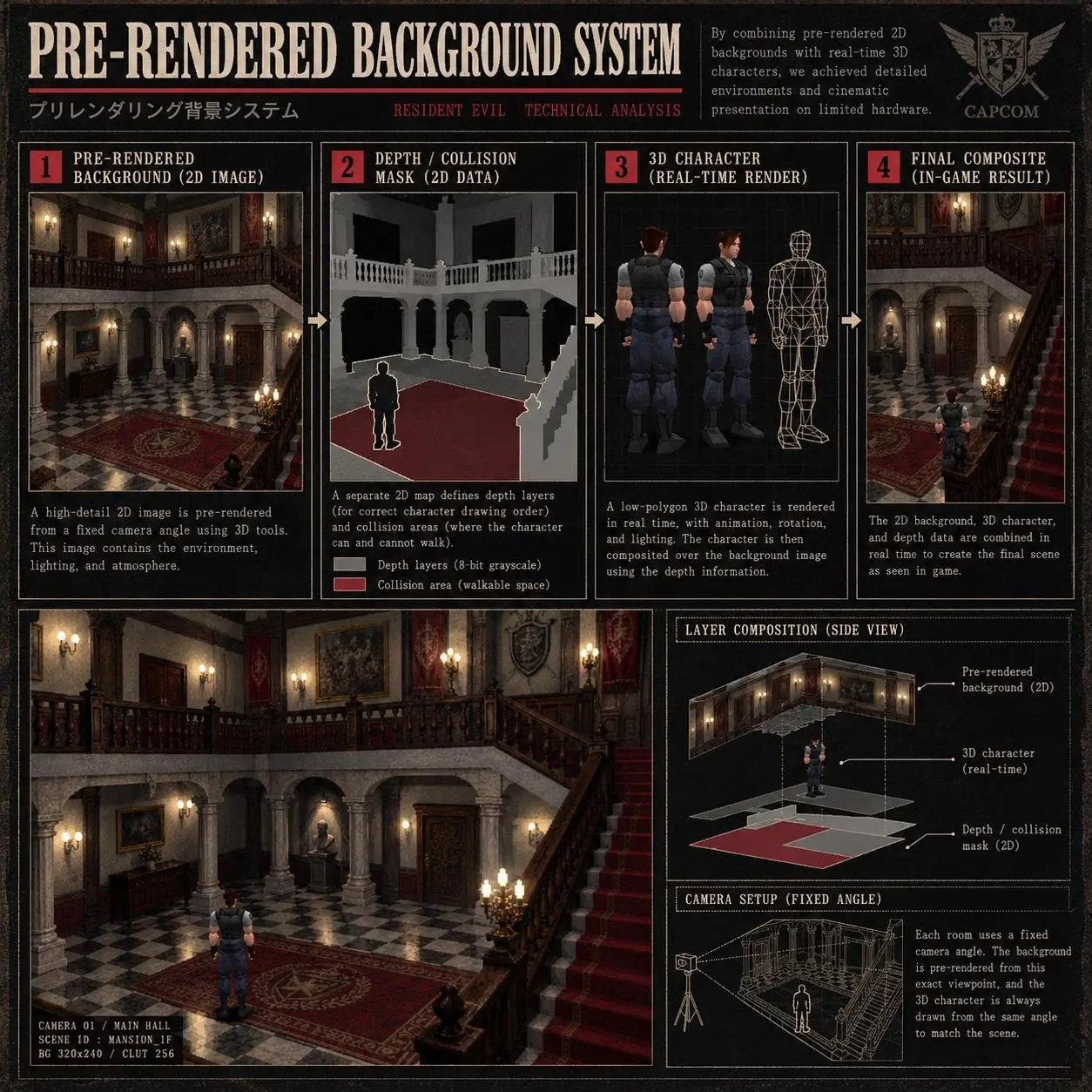
Abandoning the 3D environment freed up massive processing power from the PS1 graphic chip. The console now spent resources exclusively on rendering 3D character and zombie models (around 300–500 polygons per model), achieving unprecedented detail in animation for 1996.
Fixed cameras gifted the game a cinematic language. Mikami placed virtual lenses in the style of Alfred Hitchcock and Dario Argento: low angles, basement viewpoints, and hidden zones around corners. Players regularly heard footsteps or zombie groans, but couldn't see the threat until making a fateful step into the room, changing camera angles.
03 B-Movie Voice Acting and the Legendary "Jill Sandwich"
Striving to make the game appealing to the Western market, Capcom decided to fully voice Biohazard in English even for the Japanese release. In 1995, live voice acting on CD-ROM was a relatively new phenomenon, and quality standards in the gaming industry were in their infancy.
Voice recording took place in a small studio in Lancaster, California. Little-known non-union actors and members of a local amateur theater troupe were hired for voice roles and FMV sequences.
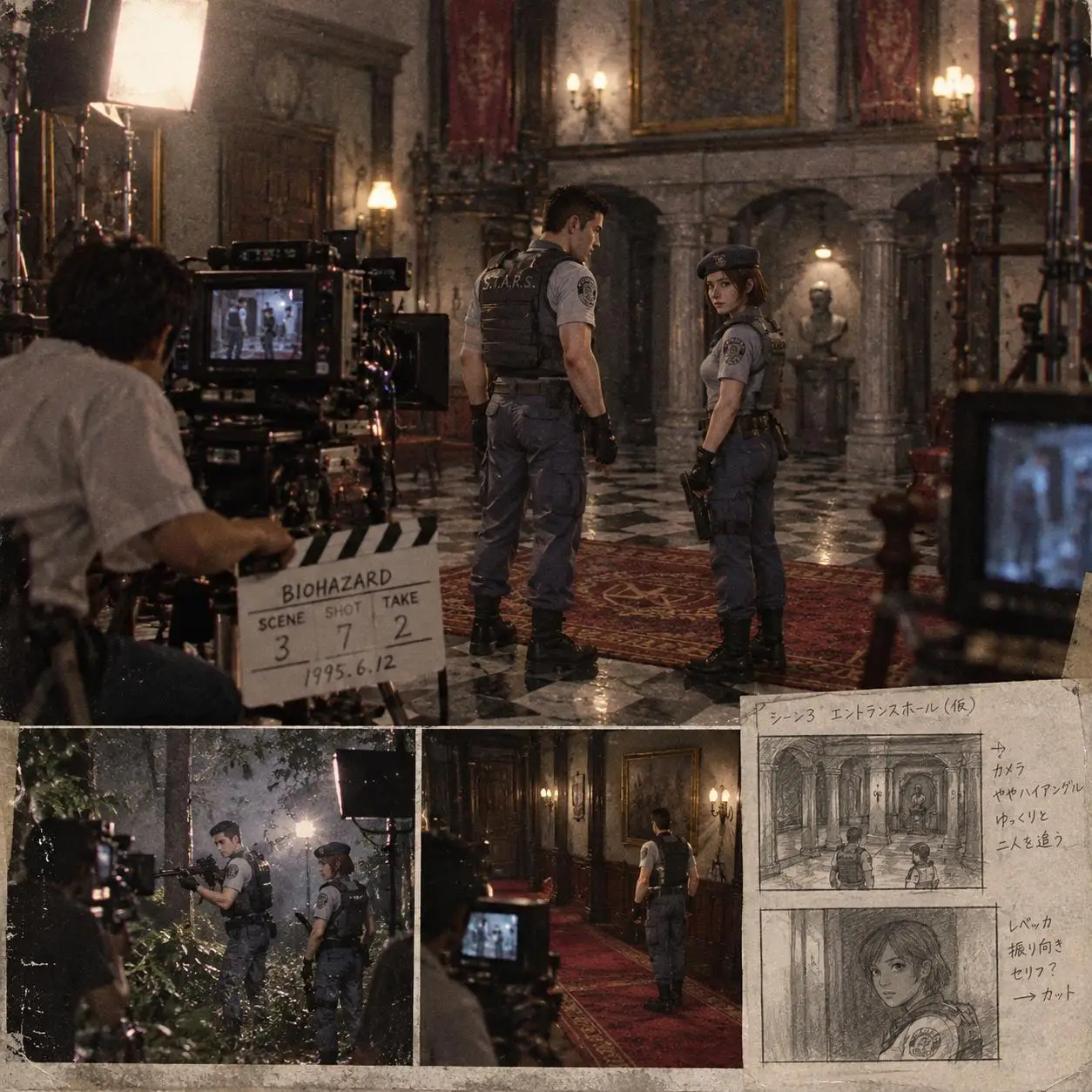
Shinji Mikami personally attended the recording sessions. Since Mikami spoke little English, he relied entirely on emotional expression. He felt that the more overacted and dramatic the lines sounded, the more it matched the spirit of American B-horror movies like The Evil Dead or Night of the Living Dead.
This led to the birth of lines and quotes that forever entered the hall of fame of video game meme culture:
• "You were almost a Jill sandwich!" (Barry Burton and Jill Valentine discussing after surviving a falling ceiling).
• "Here’s a lockpick. It might be handy if you, the master of unlocking, take it with you."
• "Hope this is not Chris's blood!"
Musical Accompaniment and Silence as an Instrument of Horror
Unlike the purposely comedic voice acting, the sound design under the direction of Masami Ueda, Makoto Tomozawa, and Akari Kaida created an atmosphere of unbearable, sticky nightmare.
Composers consciously avoided continuous melody. In most corridors of the Spencer mansion, music is absent entirely — replaced by ambient drones, echoes of the hero's footsteps (varying on wood, carpet, metal, and water), creaking old doors, and distant groans. The famous tense piano theme in the Safe Room gave players a rare moment of catharsis and illusory safety before returning to the dark.
04 Doors as CD-ROM Loading Masks: Genius Optimization
The transition from cartridges to compact discs in the fifth console generation brought not only gigabytes of memory for video and audio, but also a serious technological problem: slow data read speeds.
The PlayStation CD-ROM drive was double-speed (2x), providing a maximum throughput of just 300 Kilobytes per second. Meanwhile, laser head positioning (Seek Time) could take from 1 to 3 seconds.
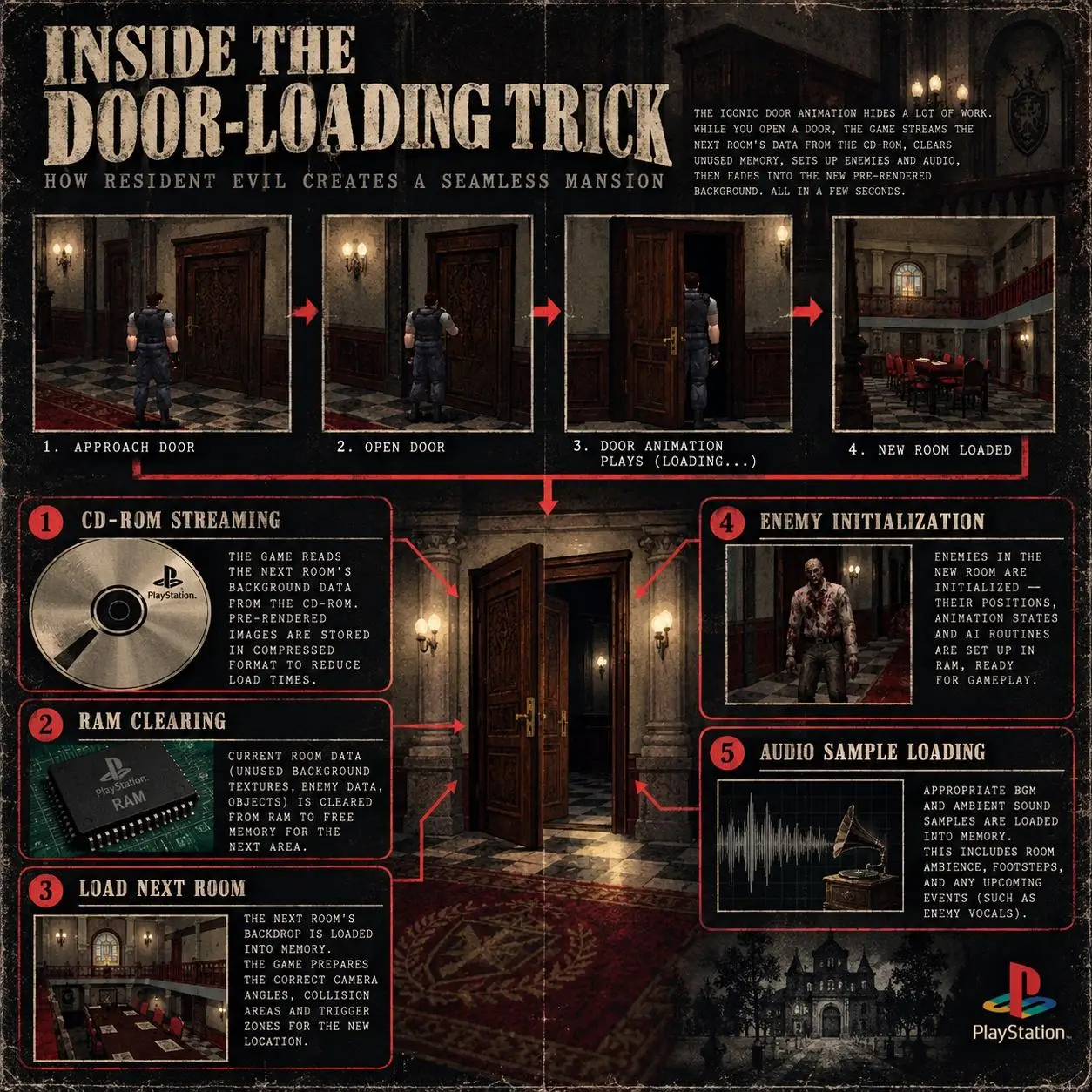
If developers had made a standard instantaneous transition between rooms, players would encounter a 4–6 second black loading screen every time they opened a door. This would completely destroy the game's rhythm and immersion.
Shinji Mikami and lead programmer Yasuhiro Anpo came up with an elegant solution: turn a technological flaw into a key suspense-building element.
During the playback of the famous 3D zoom-in and slow door-opening animation (which took exactly 4 seconds), the game engine performed the following operations in the background:
• RAM Cleanup: Graphical backgrounds, depth masks, audio samples, and 3D models of the previous room were completely unloaded from the 2 Mb RAM.
• Disc Read: The laser head moved to the next sector of the CD and read the new location file.
• Decompression: The graphics chip unpacked the 2D background and loaded new enemy textures into VRAM.
• AI Initialization: The processor placed enemy coordinates and initialized their behavior algorithms.
The door animation became a psychological barrier. Players didn't just wait for loading — they stared with racing hearts into the growing darkness behind the doorway, not knowing what would meet them: an empty corridor or a swift leap from a Hunter.
The Philosophy of Tank Controls
Another crucial technical decision was the introduction of so-called "tank controls." In this scheme, pressing the "Up" button always moves the character forward relative to their body's direction, while "Left" and "Right" rotate them around their axis.
Many modern gamers criticize this system for its clumsiness, but in 1996 it was the only way to maintain adequate control amidst constantly changing fixed camera angles. If control had been absolute (screen-relative), moving from one frame to another with an opposite viewpoint would instantly flip the movement vector, causing the hero to run back and forth endlessly at the camera boundary.
Ultimate Legacy: Birth of a New Genre
Released on March 22, 1996, in Japan as Biohazard, and later in autumn in North America and Europe as Resident Evil, the game struck like an exploding bomb. The warning screen before the title menu featured a term that gave a name to an entire video game direction for the first time: "Survival Horror."
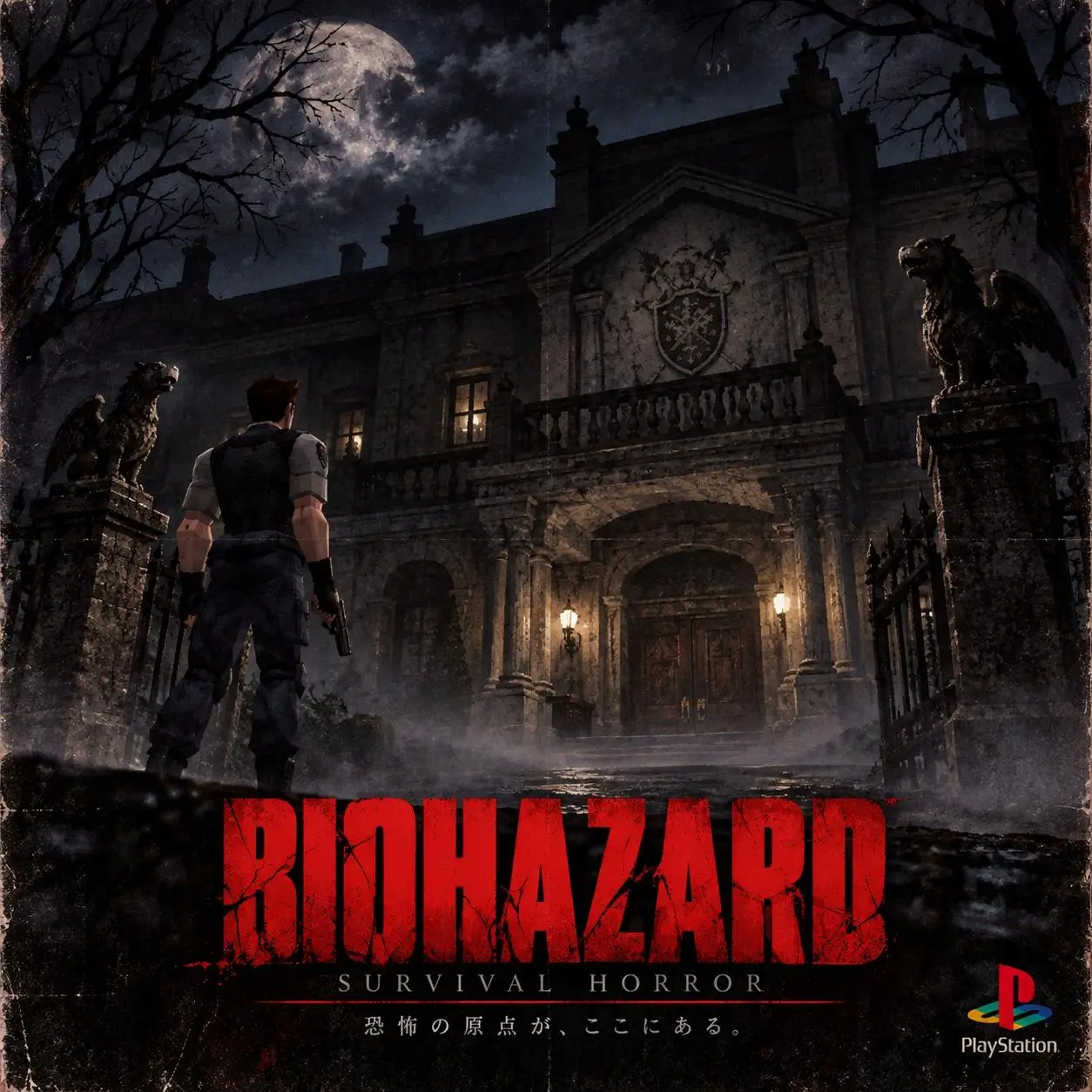
The game not only recovered its modest $1.5M budget in its first weeks of sales, but also became a major system-seller for the young Sony PlayStation platform, selling over 5 million copies.
Shinji Mikami and his small team proved to the world that meticulous engineering calculations, rational use of hardware limitations, and a deep understanding of fear psychology can turn technical barriers into immortal classics of interactive art.