Moscow, 1984: a puzzle without graphics
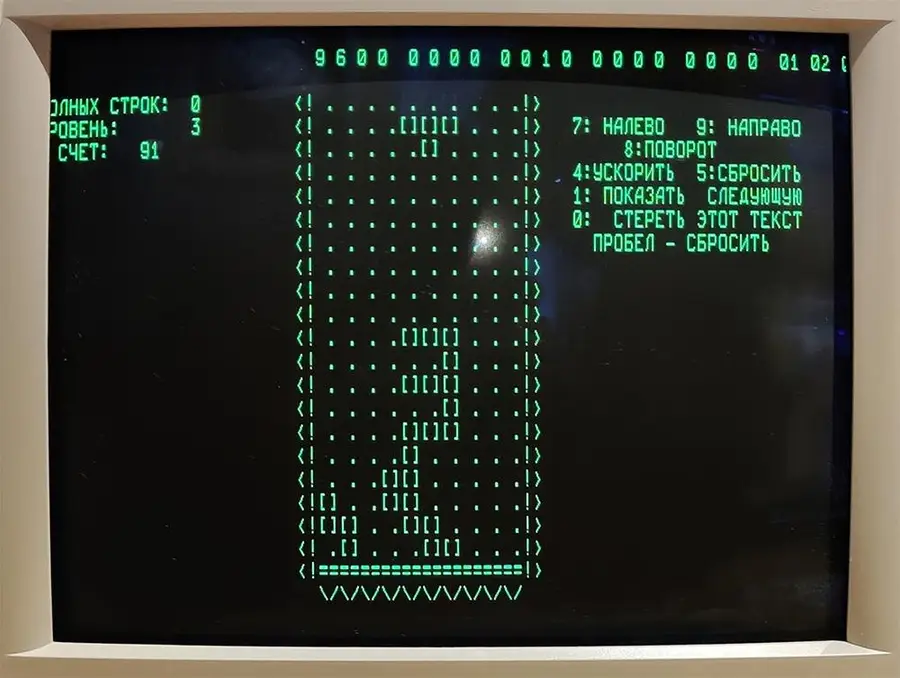
This story begins without a game publisher, artists, or an advertising campaign. Instead, it starts at the Computing Center of the USSR Academy of Sciences in Moscow, with staff member Alexey Pajitnov and an Elektronika-60 computer. The machine belonged to a family of Soviet minicomputers architecturally compatible with the PDP-11. Instead of a familiar game display, the programmer had a text terminal. Pajitnov had to come up with an activity that could work even under those conditions.
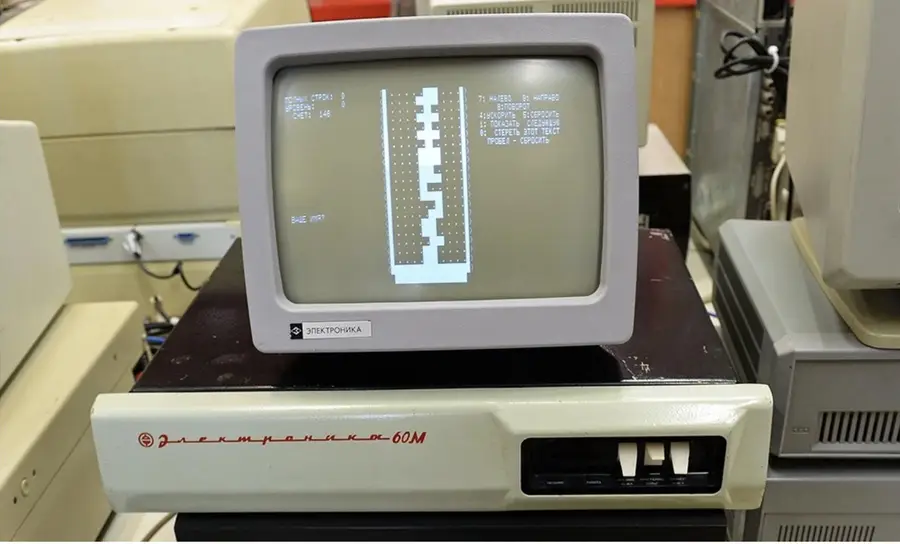
The Tetris Company considers June 6, 1984, the game's birthday. The company chose this date for its 40th-anniversary celebrations in 2024. It is an official anniversary date, not a day for the program's first launch established by a surviving development log. The available materials contain no independent document from 1984 that could confirm the exact date. The year Tetris was created is therefore much more certain than the specific day.
The idea came from the board puzzle pentominoes: shapes made up of five squares joined edge to edge. The player has to fill a given area with them. Pajitnov brought the principle to the screen, but changed two important things. He chose shapes made of four squares—tetrominoes—and made them fall from above. The task was no longer simply to find an elegant arrangement for the pieces: the player had to decide before the next shape reached an obstacle.
When a horizontal line was completely filled, it disappeared. This made the limited playfield a renewable resource rather than a one-time puzzle. In a 2014 interview with TIME, Pajitnov explained that rows disappeared to make room for the next pieces. The result was a game in which every successful move creates space for a new decision. A mistake does not always end a round immediately, but it makes the game harder to continue.
On the Elektronika-60, individual squares could be represented by pairs of text characters—square brackets. The core mechanics did not require colored sprites, special graphical effects, or music. Seven types of tetromino, movement, rotation, and checking for completed lines formed a sufficiently expressive game language. The name Tetris combines the Greek root tetra, meaning four, with the name of Pajitnov's favorite sport, tennis. The key achievement was turning a static puzzle into a sequence of decisions made under time pressure.
How the game made it beyond the computing center
To reach a mass audience, the puzzle had to make its way onto more widely used computers. Vadim Gerasimov played an important part here. A school student who had met the computing center's staff, he knew how to program for the IBM PC. On his Original Tetris page, he describes the work on the game from 1984 to 1986 as a joint project by Pajitnov, Dmitry Pavlovsky, and himself. He attributes the original idea and the Elektronika-60 prototype to Pajitnov.
Gerasimov ported the program to the IBM PC and helped develop it further. He recalled that the first DOS version appeared just a few days after the prototype. The official Tetris timeline dates the port to 1985, while widely used archival catalogs list 1986 for an early PC version. There is no reason to choose one date for every stage: the first port, later revisions, and a surviving copy of the program are different events. Gerasimov made version 3.12 available to download, allowing people to explore the result of this work.
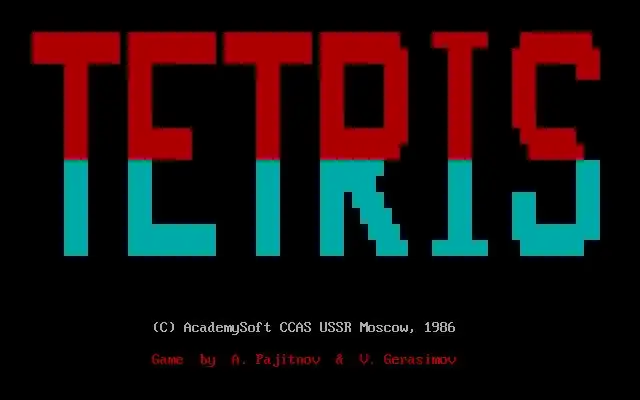
On the IBM PC, color helped distinguish the pieces, although it was still not necessary to solve the puzzle. Players could rely on a piece's shape rather than its shade. This is an especially important quality of the game: it did not have to be reinvented for every new platform. The keys, presentation, and speed could change while the task itself remained the same. That independence from complex graphics proved useful to Tetris's commercial fortunes, too.
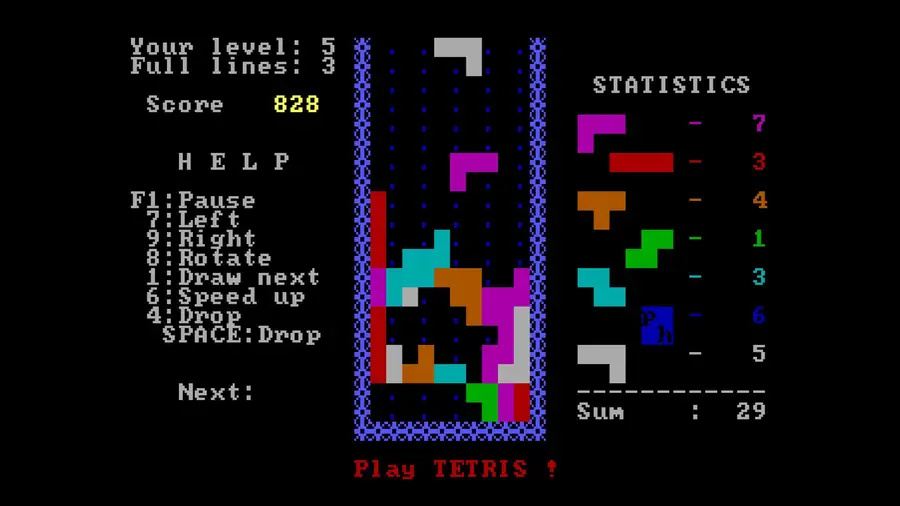
People passed copies around on floppy disks. In Pajitnov's recollections, the game's early circulation resembles the informal sharing of programs among acquaintances rather than sales through conventional retail. Estimates of the number of Soviet computers with the game installed at the time are unreliable. The broad, informal distribution itself, however, is corroborated by accounts from people involved. The program traveled faster than the means of formally commercializing it.
Eventually, the puzzle reached Hungary, where British entrepreneur Robert Stein, who was of Hungarian origin and ran Andromeda Software, saw it. He recognized an opportunity that the Moscow developers had little chance of pursuing themselves: selling the game to publishers in the West. From that point on, the story became a legal one as well as a technical one. Copying the program was easy; securing the authority to sell copies proved much harder.
Western publishers and the licenses they lacked
Stein's offer interested the Soviet developers, but an author's agreement to negotiate was not yet a full international contract. In the Soviet Union of that era, the right to control the work of a state organization and the right to conduct foreign trade did not necessarily belong to the same person. Pajitnov later said he granted the computing center the right to use the game commercially for ten years. This allowed negotiations on behalf of the organization, but did not give the programmer immediate access to revenue from overseas sales.
Stein began negotiating with Britain's Mirrorsoft and America's Spectrum HoloByte before the Soviet license was finalized. The publishers were linked to Robert Maxwell's business empire. They were interested in computer versions for different markets: Mirrorsoft primarily served European audiences, while Spectrum HoloByte focused on the United States. In the official Tetris timeline, the game's expansion into the West begins in 1987; commercial releases and an advertising campaign continued in 1988. By then, the puzzle had taken on a look markedly different from that of the Soviet text-based program.
Western computers got color graphics and designs featuring architecture and other recognizable Soviet motifs. This was a smart marketing choice: the game's origins, which might have seemed like an obstacle during the Cold War, became a distinctive feature. Buyers saw an unusual product from a country with which their own computer industry had little connection. Beneath the decorative exterior, however, was a game whose mechanics required no knowledge of Soviet history or long instructions to understand.
The key Soviet participant in the negotiations was Elektronorgtekhnika, known abroad as ELORG. It was through the organization that the rights to export the game were arranged. In the first half of 1988, Andromeda received a contract for computer versions. That did not automatically authorize releases for every kind of device containing a processor. Arcade machines, home consoles, and handheld systems proved especially contentious. Each category could be licensed separately, and exclusive rights to one did not replace permission for the others.
Meanwhile, Mirrorsoft passed the rights it considered to cover consoles and arcades to Atari Games. Its Tengen division published games for the Nintendo Entertainment System (NES). In Japan, entrepreneur Henk Rogers, founder of Bullet-Proof Software, also made a deal to distribute Tetris. In 1988, Japan's Famicom, the local version of the NES, got its own edition of the puzzle. This created a paradoxical situation: the product was already being sold on a console, even though the original agreement with ELORG did not clearly establish the right to do so.
Different historical accounts describe the intermediate Japanese sublicenses somewhat differently. But the underlying problem remains the same: an intermediary can only pass on rights it actually has. If a computer license does not cover consoles, a later agreement with a publisher making a console version does not fix the original gap. Tetris's commercial success alone therefore did not guarantee that the next cartridges could legally be released.
Moscow negotiations: why Nintendo got Game Boy
Rogers saw Tetris at the Consumer Electronics Show in Las Vegas in 1988. He recalled that wanting to return to the demo computer convinced him of the game's potential. When Nintendo was preparing the international launch of the Game Boy, he proposed including the puzzle with the handheld console. But none of the earlier chains of agreements gave him sufficiently secure rights for a new category of devices.
In 1989, Rogers traveled to Moscow and met with ELORG representatives, including Nikolai Belikov. During the negotiations, the Japanese Tetris cartridge served as clear evidence that Western intermediaries had already made deals beyond the obvious scope of the computer license. Pajitnov, Stein, and Mirrorsoft representatives, including Kevin Maxwell, were also part of the story alongside Rogers. They pursued different commercial aims; their meetings and contracts should not be portrayed as one shared auction.
ELORG clarified the limits of its agreement with Stein, including the definition of a computer. The change was crucial: the presence of computing components did not make a game console a personal computer in the contractual sense. For the rights holder, this distinction made it possible to license each market separately; for Nintendo, it meant that the company could obtain console and handheld licenses directly, without relying on the earlier chain of sublicenses.
Rogers first secured exclusive rights to handheld versions and passed them on to Nintendo. According to his account in TIME, about a month later he returned to Moscow with Minoru Arakawa and Howard Lincoln, executives at Nintendo of America, to negotiate an agreement for home consoles. Separate arrangements for arcade machines and computers remained in place. Nintendo did not acquire all Tetris rights at once: it got the rights it needed for its own systems.
Atari Games had already invested in developing and releasing Tetris for the NES under the Tengen label. In the United States, the dispute went to court. On June 21, 1989, according to a UPI report, Nintendo obtained a preliminary injunction against further sales of the Tengen version. This is a specific date that does not coincide with the Moscow negotiations. The Tengen version had reached the market but was forced to leave it. Accounts differ on the exact size of the recalled stock, so it is more reliable not to tie the outcome of the case to dramatic figures.
The story really does sound like a political thriller, but car chases and other dramatized events in the 2023 film Tetris should not be treated as documentary evidence. Much of what is known about the negotiations comes from later recollections by participants and historical reconstructions. The main result, however, can be verified through the games actually released, the official timeline, and court reports: rights were divided by category, and Nintendo gained the ability to sell its versions legally.
Game Boy, “Korobeiniki,” and the return of rights to the creator
Tetris appeared on Game Boy in 1989. In Japan, the game was released on June 14, after the console itself had launched. In North America, Nintendo included it with the console. Rogers explained that the decision was intended to attract more than the usual audience of children who played video games. It is important not to assume that the bundle was identical in every region: Nintendo's Japanese division followed a different policy from the American one, and the game was also sold in separate editions.
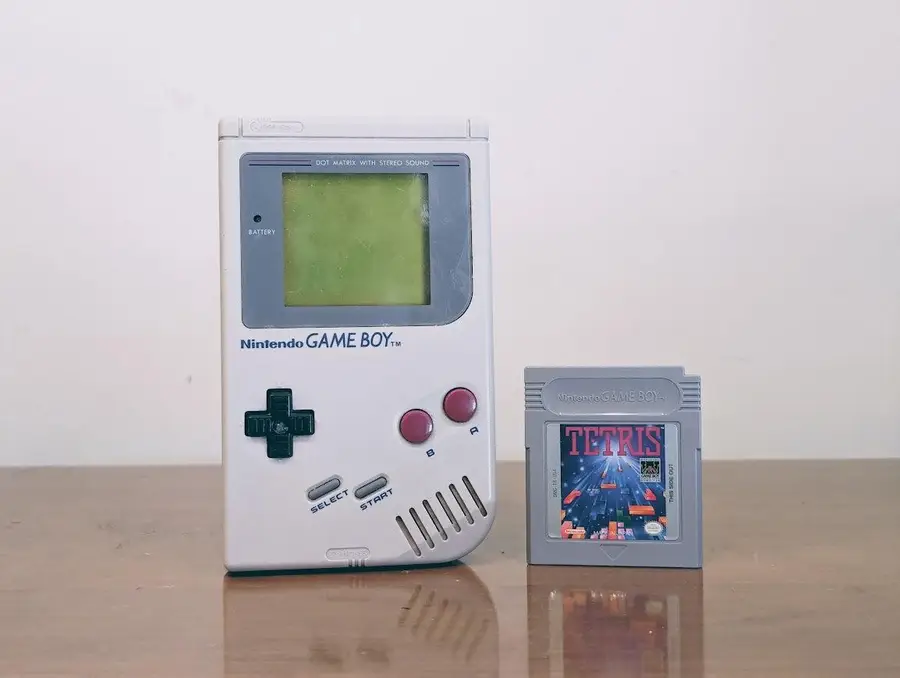
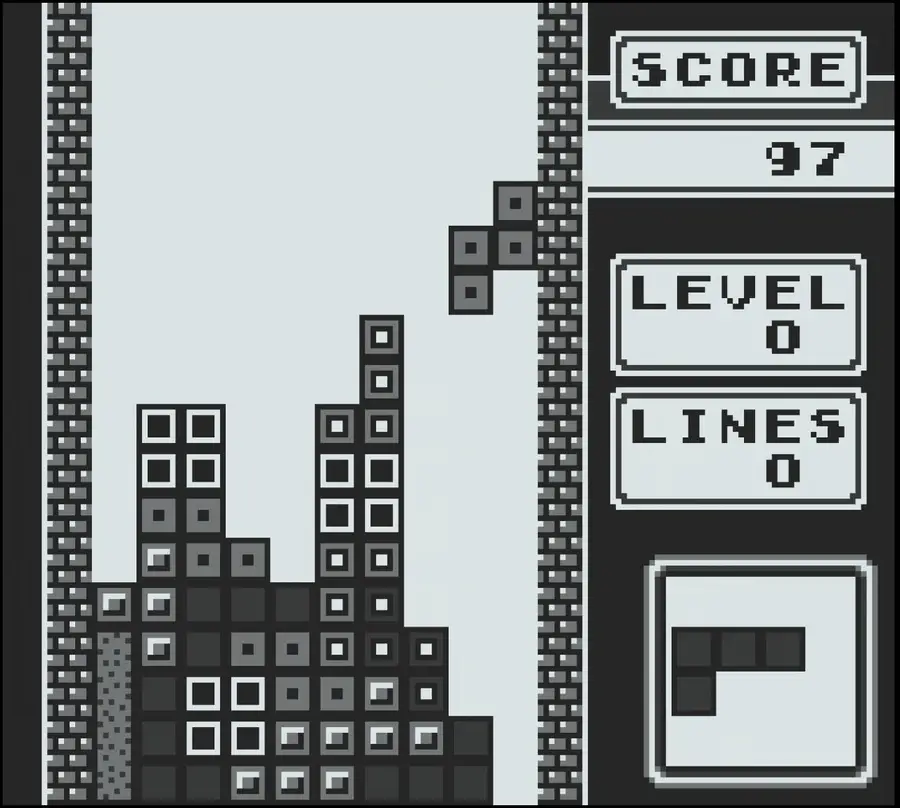
The combination felt natural. The Game Boy's small reflective screen displayed four shades, had no backlight, and required good ambient lighting. Tetris did not need fine details in a moving background. The pieces were large, the playfield boundaries stayed fixed, and the next piece appeared separately. The clear arrangement of objects made the image easy to read even without color. The small display did not force the developers to abandon the core mechanics, as might have happened with a complex arcade port.
Nintendo offered two modes. In A-Type, the goal is to keep playing, score points, and cope as the pieces fall faster. In B-Type, players must clear 25 lines; the set speed and initial height of the obstacles let them choose the difficulty. The Game Link Cable let two Game Boy owners compete against each other. The game had a convenient rhythm for trips and short breaks, while also being able to keep someone glued to the screen for hours.
Hirokazu Tanaka was responsible for the music. The best-known melody, Music A, is based on the Russian song “Korobeiniki.” Music B is an original composition by Tanaka, while Music C uses material from a Bach minuet. In an interview with Video Games Chronicle, the composer discussed how the three themes differ. There is also an early Japanese Game Boy Tetris 1.0 revision with a different A-Type melody, so “Korobeiniki” was not playing on every copy of the game from day one.
The Tetris Company estimates that the Game Boy version sold more than 35 million copies. That figure includes copies distributed with the console; it does not mean 35 million separate cartridge purchases on top of the price of the device. For Nintendo, the bundle was a way to demonstrate the strengths of its handheld system. For Tetris, it offered a distribution channel that surpassed the reach of most computer publishers in the late 1980s.
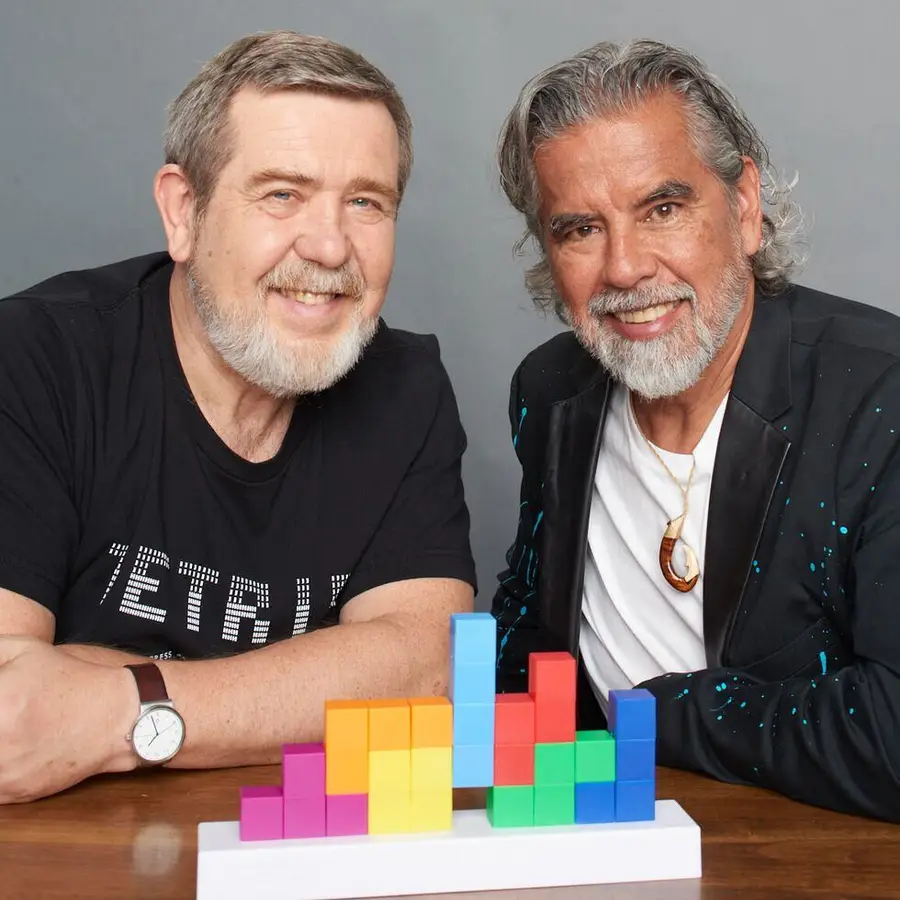
Pajitnov moved to the United States in 1991. According to his account and Rogers's testimony, the term of the original rights transfer expired in the mid-1990s. In 1996, they founded The Tetris Company, which became the central licensing organization for the brand; ELORG also took part in its early corporate history. Rogers said that he bought ELORG in 2005. The sequence matters: the return of the ability to control the rights to the creator, the creation of the company, and the subsequent consolidation of control did not happen at the same time.
Tetris survived changing computers, the disappearance of many publishers, and the shift from floppy disks to digital distribution. Modern games may add a hold function, new rotation rules, or online competitions. But the recognizable challenge remains the same: turn the incoming pieces into completed lines before the playfield fills up. In this sense, the game's commercial history echoes its own logic. Simple components proved compatible with many systems, while the hardest part of international success was not the graphics but reaching agreement on who was allowed to distribute them, and on what terms.
At a glance
• Tetris was created by Alexey Pajitnov in Moscow on the Elektronika-60; its official anniversary date is June 6, 1984.
• Vadim Gerasimov helped create an early IBM PC port; his published MS-DOS version is numbered 3.12.
• In 1989, Nintendo obtained rights to handheld and home-console versions through separate agreements.
• Game Boy Tetris was released in 1989; The Tetris Company estimates sales of more than 35 million copies.
• The Game Boy version's music was composed by Hirokazu Tanaka, including an arrangement of “Korobeiniki.”
• The Tetris Company was founded in 1996; its key participants were Alexey Pajitnov and Henk Rogers.