The Dual-Processor Labyrinth: How Sega Saturn's Complex Architecture Doomed the Console
Eight specialized processors, square polygons instead of triangles, and a mid-90s programmer's nightmare. A detailed breakdown of why Sega's engineering masterpiece turned out to be an impenetrable fortress for developers.
FactBox: Sega Saturn Technical Specifications
Subsystem
Components & Specifications
Central CPUs
2 × Hitachi SH-2 @ 28.6 MHz (32-bit RISC processors, ~25 MIPS each)
Graphics Subsystem
VDP1: Sprite rendering, polygons (quads), filling, 3D geometry. VDP2: 4 independent 2D background planes, hardware horizon and transparency calculations
Sound Processor
Motorola 68EC000 @ 11.3 MHz + SCSP (Sega Custom Sound Processor / Yamaha YMF292, 32 channels)
Auxiliary Controllers
SCU (System Control Unit / DSP), CD-ROM MCU (Hitachi SH-1)
Total RAM
2 MB Work RAM (1 MB High RAM + 1 MB Low RAM) + 1.5 MB VRAM + 512 KB Sound RAM
Bus Bandwidth
Peak 28.6 MB/s
01. Sony's Response: A Panic-Driven Architecture Redesign Before Release
In the early 1990s, Sega was at the peak of its power. The dominance of the Sega Mega Drive (Genesis) console in North America and Europe gave management supreme confidence in tomorrow. The hardware engineering department led by Hideki Sato began developing a next-generation platform under the codename "Project Gigadrive," which later evolved into the Sega Saturn.
The original Saturn project was designed to be the absolute king of 2D graphics. Engineers drew inspiration from Sega's rich arcade heritage, believing that 3D graphics would remain a niche attraction for a long time. The console was engineered for flawless performance with hundreds of sprites, a deep color palette, and multi-layered scrolling.
However, in the fall of 1993 at the Shoshinkai exhibition, a tectonic shift occurred: Sony publicly demonstrated a technological demo of its upcoming PlayStation console to the public and partners. The real-time interactive 3D demonstration of a T-Rex dinosaur head and a racing simulator shocked Sega's management. It turned out that the Sony PlayStation chip, developed in cooperation with LSI Logic, could effortlessly calculate hundreds of thousands of shaded and textured triangles per second.
Realizing that the current Saturn design would lose to the competitor at the dawn of the 3D era, Sega management ordered an emergency architecture overhaul. But there was no time left to design a brand-new graphics processor from scratch. A fateful decision was made: add a second Hitachi SH-2 central processing unit to the architecture and attempt to parallelize graphic and geometric computations.
This rush meant the system lacked a unified, cache-coherent bus. The second processor was literally "soldered" in parallel to the existing infrastructure, turning the Saturn motherboard into a chaotic labyrinth of eight microchips competing for access to shared memory.
02. Two SH-2s and VDP1/VDP2 Video Chips: 2D Genius vs. Inevitable 3D
To understand the complexity of the Sega Saturn, one only needs to look at its chipset composition. The console's motherboard housed:
• Master CPU: Hitachi SH-2 (Main logic, geometry)
• Slave CPU: Hitachi SH-2 (Auxiliary computations)
• VDP1: Geometry, sprite, and quad video processor
• VDP2: Background planes and special effects video processor
• SCU: System Control Unit with built-in DSP
• Sound CPU: Motorola 68EC000
• SCSP: Yamaha YMF292 sound chip
• CD-ROM Controller: Hitachi SH-1
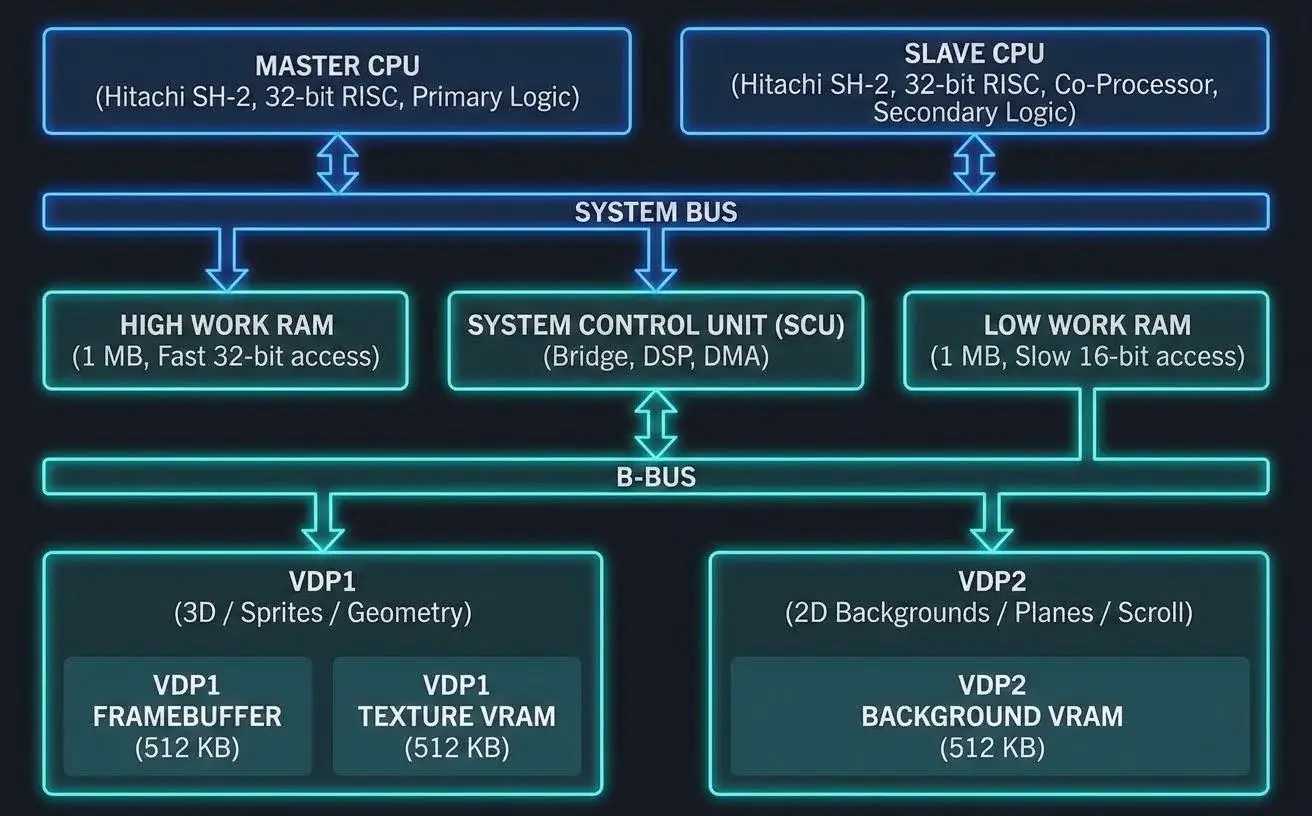
Division of Labor: VDP1 and VDP2
The graphics system was split between two highly specialized processors:
• VDP1 handled object rendering: characters, vehicles, and environmental elements. It worked with sprites and polygons, calculating transforms, texture mapping, and simple shading effects.
• VDP2 was a monstrous 2D co-processor. It could simultaneously output up to four independent scrolling background layers at resolutions up to 704×480 pixels, perform hardware floor and sky plane rotation, and compute heat haze and transparency effects.
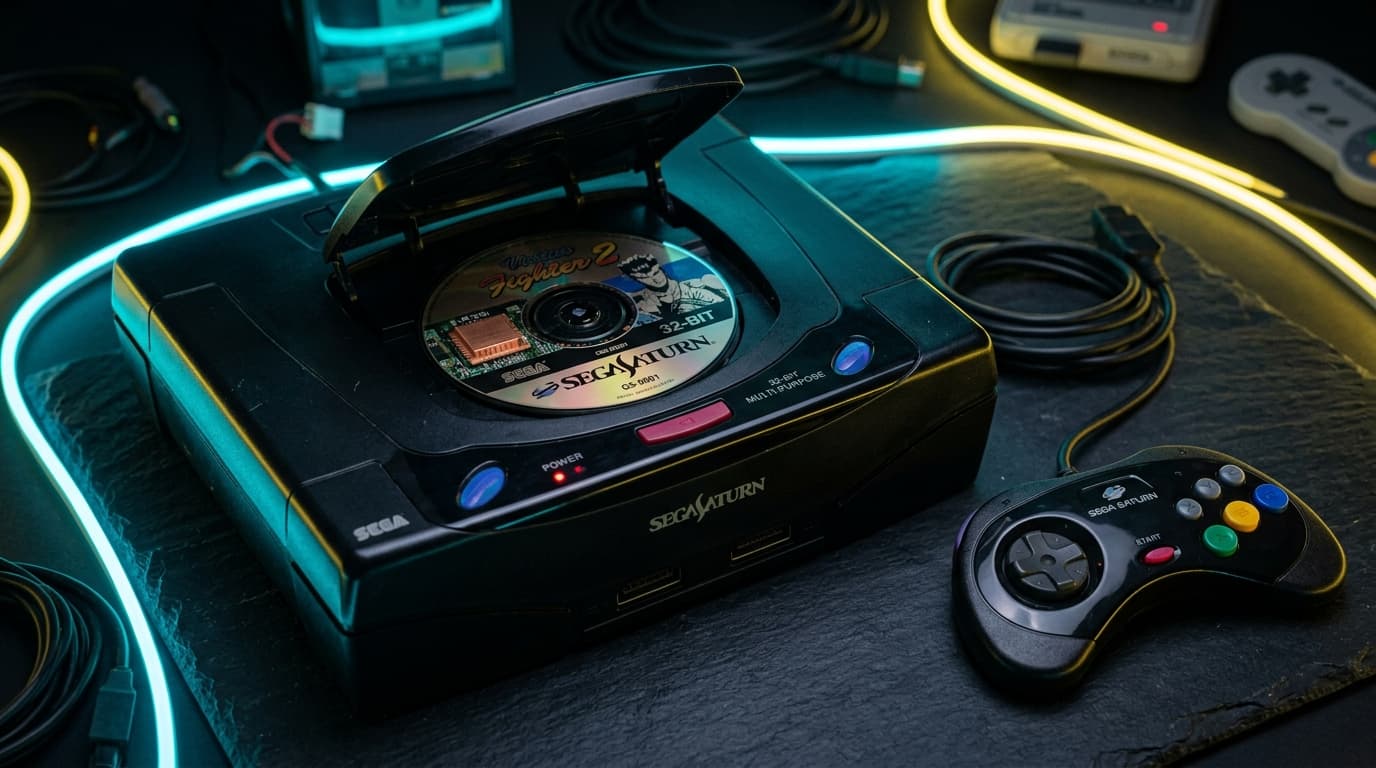
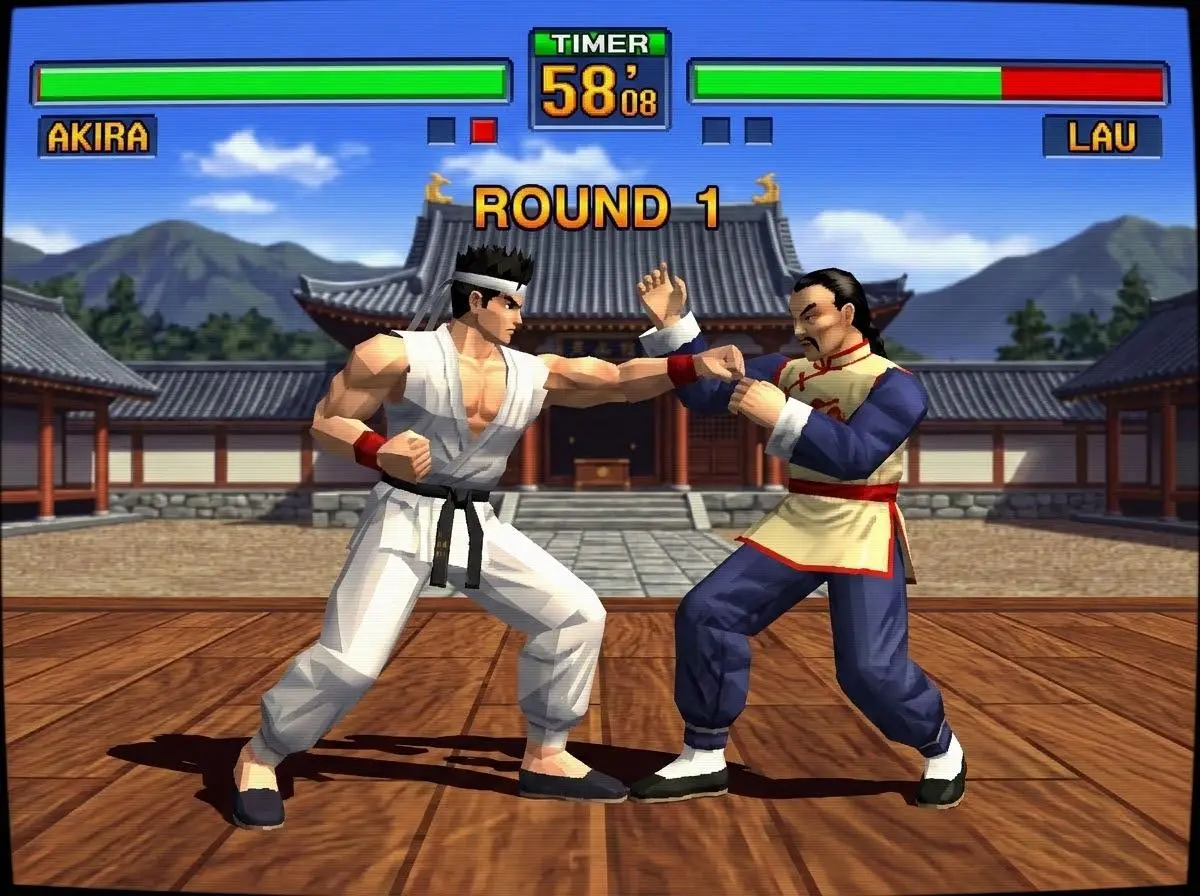
When developers learned to properly combine both chips (as AM2 did in Virtua Fighter 2 or Sega Rally Championship), the Saturn delivered stunning visual quality: VDP2 fully handled the horizon, track, and sky rendering without consuming CPU resources, while VDP1 focused all its power on highly detailed 3D fighter or car models.
Memory and Bus Bottlenecks
The system's main flaw lay in its fragmented RAM structure. Instead of a single uniform RAM pool, the Saturn featured:
• 1 MB High-speed Work RAM (32-bit bus)
• 1 MB Low-speed Work RAM (16-bit bus)
• 512 KB Framebuffer VRAM for VDP1
• 512 KB Texture VRAM for VDP1
• 512 KB Background VRAM for VDP2
If both SH-2 processors attempted to access the same memory region simultaneously, hardware bus contention occurred, and one of the CPUs would simply freeze in wait states. Without assembly language and delicate clock synchronization, the second SH-2 often idled, executed useless cycles, or outright interfered with the main CPU.
03. Quads vs. Triangles: Why Porting from PS1 Was Hell
The 3D graphics industry was built on the de facto standard — the triangular grid (Triangular Polygons). A triangle is the simplest flat geometric shape defined by three points in space. PlayStation, Nintendo 64, and PC graphics accelerators (3dfx Voodoo, Direct3D, OpenGL) were originally designed to work with triangles.
Sega Saturn went against the entire world: its VDP1 graphics chip could not rasterize triangles. The primary primitive of the Saturn was a distorted quadrilateral (Quad), essentially a deformable textured sprite.
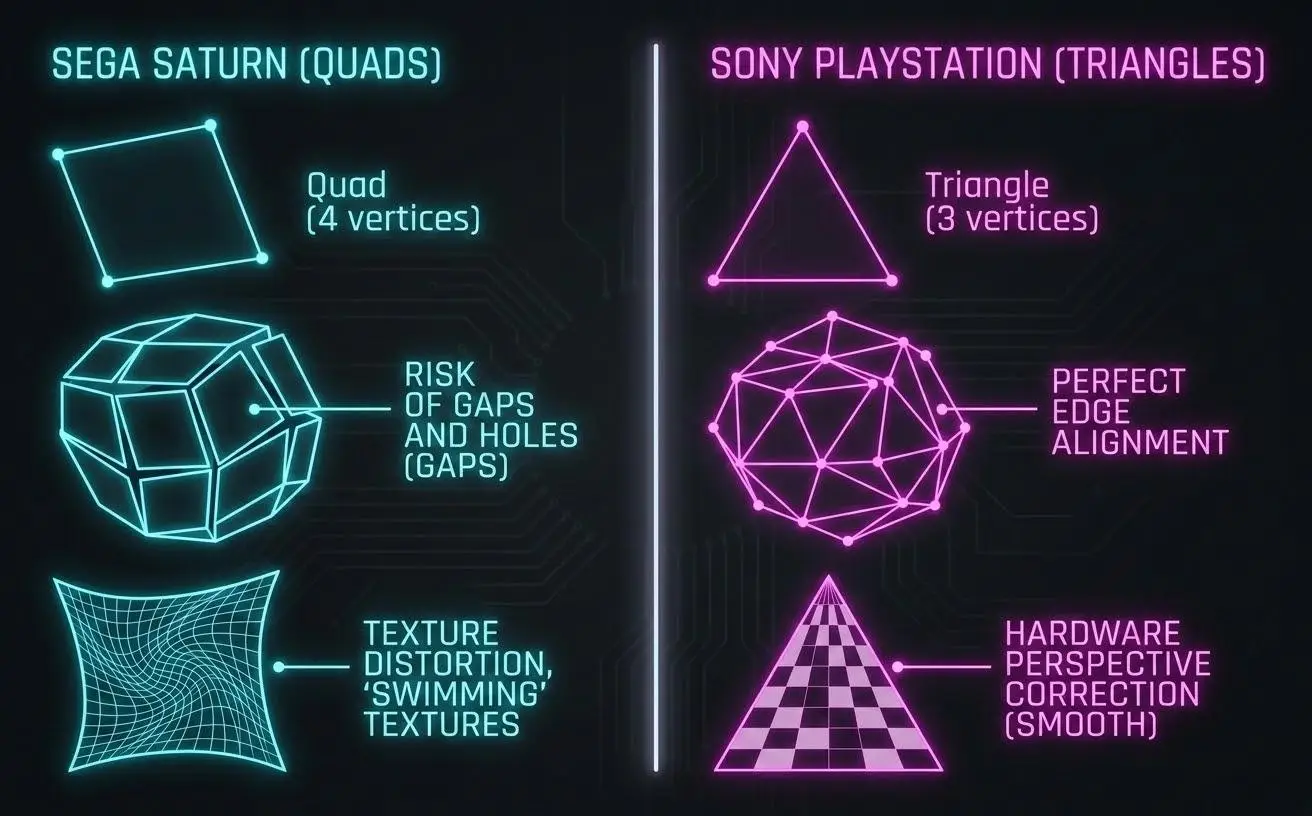
Rendering Parameter
Sony PlayStation (Triangles)
Sega Saturn (Quads)
Base Primitive
Triangle (3 vertices)
Quadrilateral / Quad (4 vertices)
Polygon Stitching
Exact edge alignment
Risk of gaps and holes formation
Perspective Correction
Hardware affine texture mapping
Sprite deformation across 4 points
Alien Format Emulation
Native industry standard
Requires "degenerate" quads (2 overlapping points)
Multiplatform Porting Issues:
• Lack of Hardware Stitching (Gaps & Overlapping): When attempting to build a complex 3D model out of quads, rotating the camera inevitably caused quad vertices to separate, forming visible gaps and holes through which the background peeked.
• Zero Coordinates: To draw a triangle on the Saturn, programmers had to define a quadrilateral where two vertices overlapped at the same point. VDP1 wasted resources processing the degenerate edge, lowering rendering performance.
• Texture Distortion: Trying to wrap a 2D texture onto a deformed quad without perspective correction resulted in warped, "wobbly" textures.
• Engine Rewriting: Major publishers (including EA, Capcom, and Konami) refused to rewrite their game geometry for quads. Simple ports from PlayStation to Saturn shipped with terrible frame rates, missing effects, and graphical glitches.
04. Yu Suzuki and Shenmue: How to Squeeze the Impossible from Saturn
Despite the architectural hell, Sega's internal AM2 team under the leadership of legendary game designer and engineer Yu Suzuki performed true technological miracles.
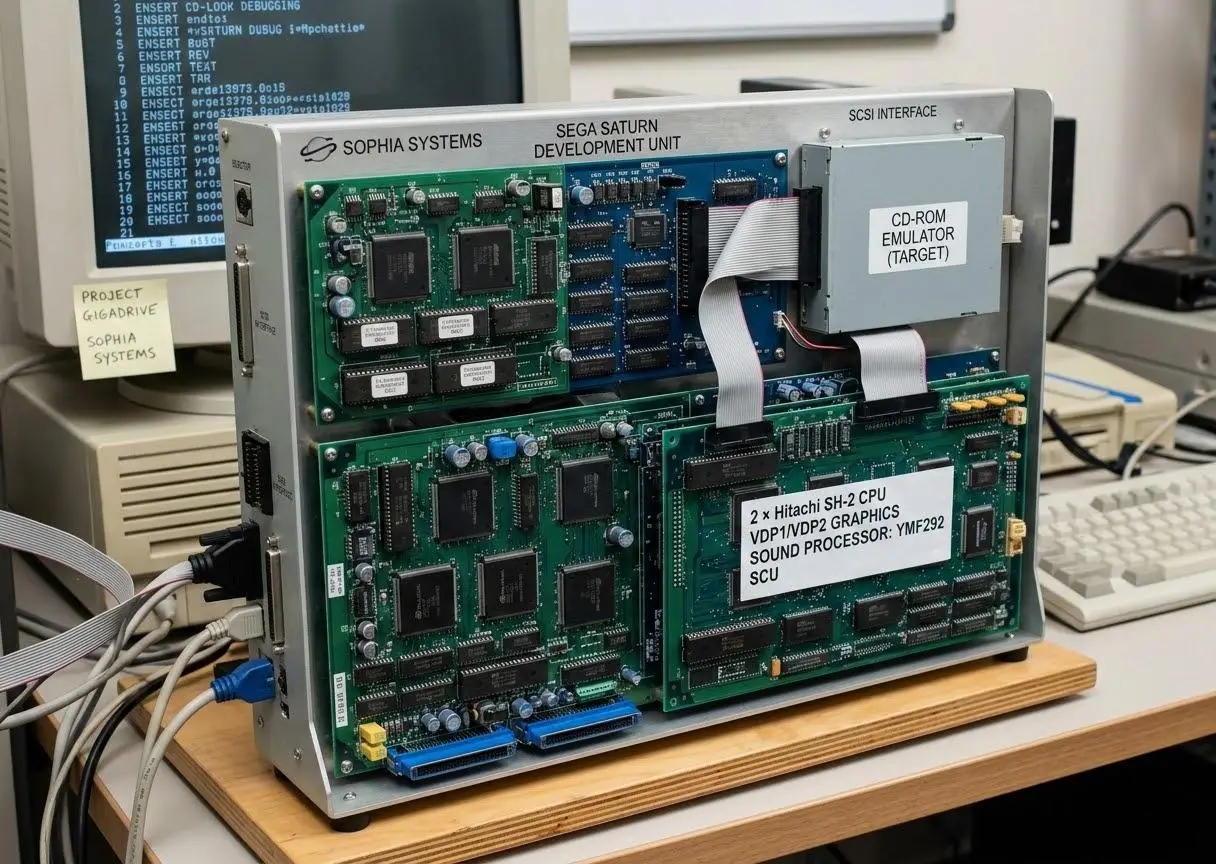
Suzuki and his team wrote code directly in assembly, bypassing Sega's imperfect compilers. They learned to manually distribute tasks between the two SH-2 chips: one processor was dedicated entirely to geometry and collision calculations, while the other handled animation, input, and AI logic.
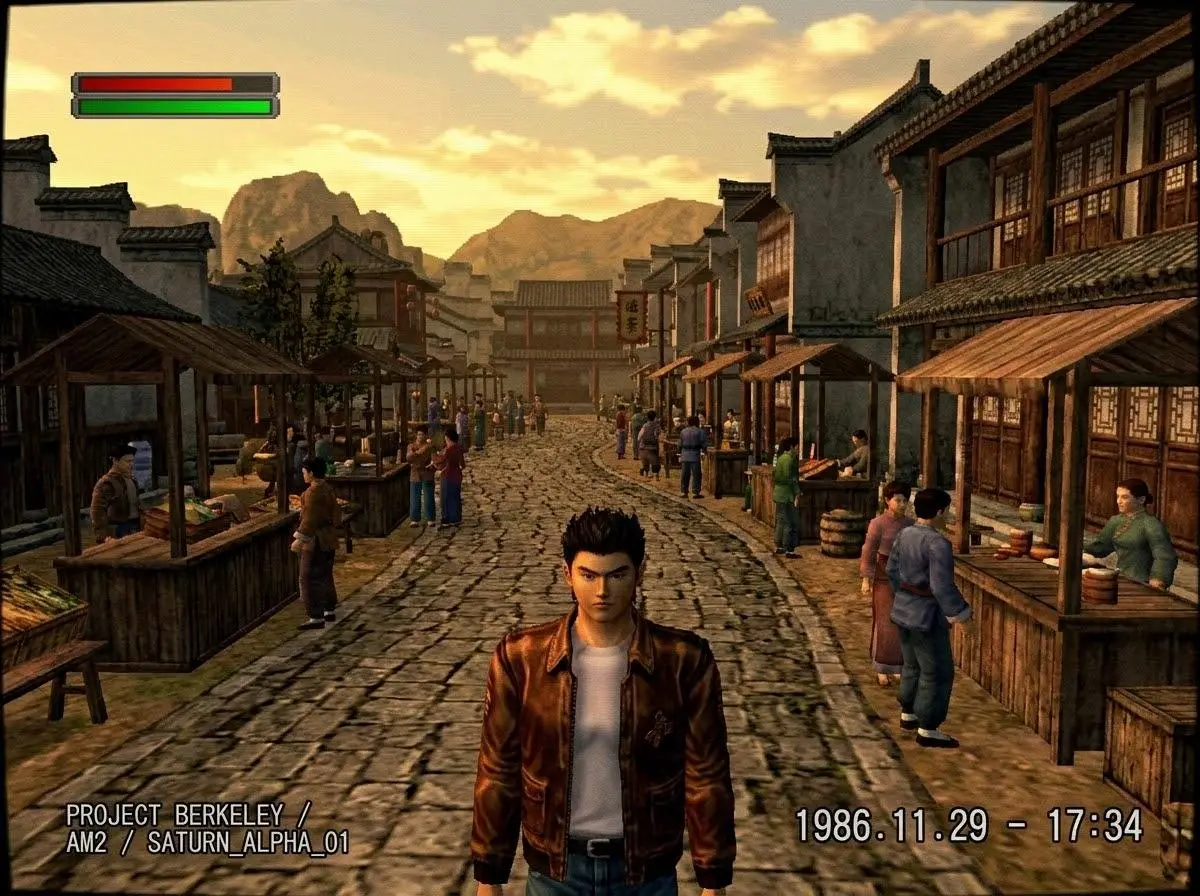
The Legend of Saturn Shenmue (Project Berkeley)
The most ambitious project for the Saturn was the development of Shenmue (then known under the codename Project Berkeley). AM2 created a fully working 3D open-world RPG featuring a day-night cycle, hundreds of unique NPCs, and a detailed ancient China.
When footage of the Sega Saturn Shenmue prototype surfaced years later, the public was stunned: a platform deemed unsuited for true 3D delivered a graphical level comparable to early Dreamcast and PlayStation 2 games! However, the price of this success was too high: creating such an engine took years and millions of dollars, available only to Sega's premier studio.
Final Verdict
The Sega Saturn remains in history as a majestic and tragic monument to engineering thought. The console was ahead of its time regarding multi-core processing, but proved far too complex for an era when development toolchains were in their infancy. Unjustly forgotten by the general public, the Saturn gifted the world timeless masterpieces and taught the entire gaming industry a crucial lesson: balance and ease of development are always more important than raw, non-orthogonal power.