Ralph Baer's Brown Box: Turning the Television Interactive
In 1966, Sanders Associates defense engineer Ralph Baer posed a radical question: why should millions of living room television sets remain passive broadcast receivers rather than interactive digital playfields?
Collaborating with Bill Harrison and Bill Rusch, Baer developed the 'Brown Box.' Constructed entirely from discrete transistors and diodes without a central processor, it relied on transparent printed vinyl plastic overlays clinging to the CRT screen by static electricity.
The moment we managed to manipulate a glowing dot across a common television screen with a potentiometer knob, an entirely new industry was born.
Ralph Baer, father of video games
Nolan Bushnell, Allan Alcorn & the Overflowing Coin Cup
In late 1972, Atari co-founder Nolan Bushnell tasked young recruit Allan Alcorn with a hardware warm-up exercise: design a coin-operated electronic table tennis game with sharp deflection physics and realistic audio bleeps.
They field-tested the prototype at Andy Capp's Tavern in Sunnyvale, California. Within two weeks, the bar owner called complaining the cabinet had broken down. Alcorn arrived to discover the mechanism was fine—the milk carton collecting 25-cent quarters had overflowed and shorted the coin switch.
The Licensing Feud & the Home Pong Microchip
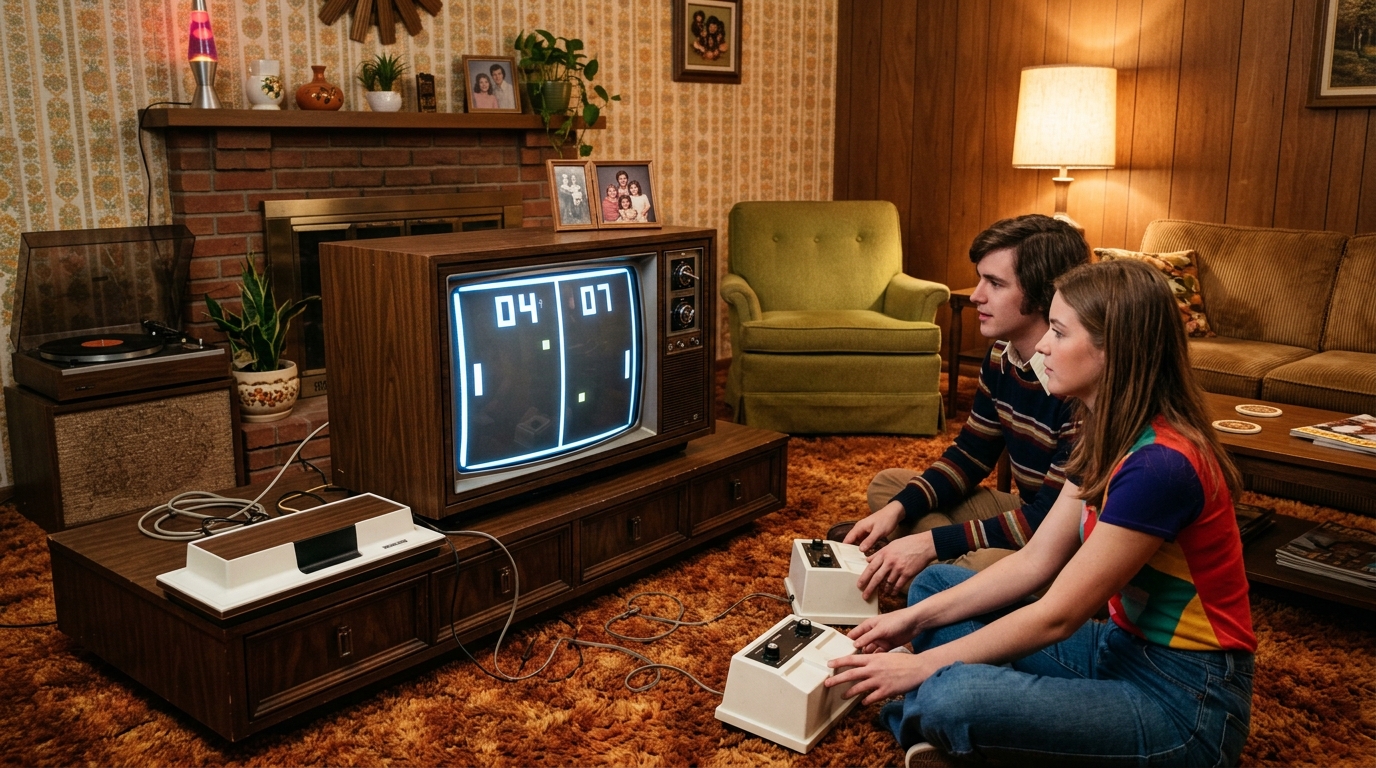
Faced with a patent infringement lawsuit from Magnavox, Bushnell prudently settled for a $700,000 paid-up license, granting Atari free rein to miniaturize the circuitry into an integrated CMOS microchip: Home Pong.
Sears department stores ordered 150,000 units for Christmas 1975, establishing video gaming as a permanent fixture of living room entertainment.