Nintendo 64 and the Cartridge Curse
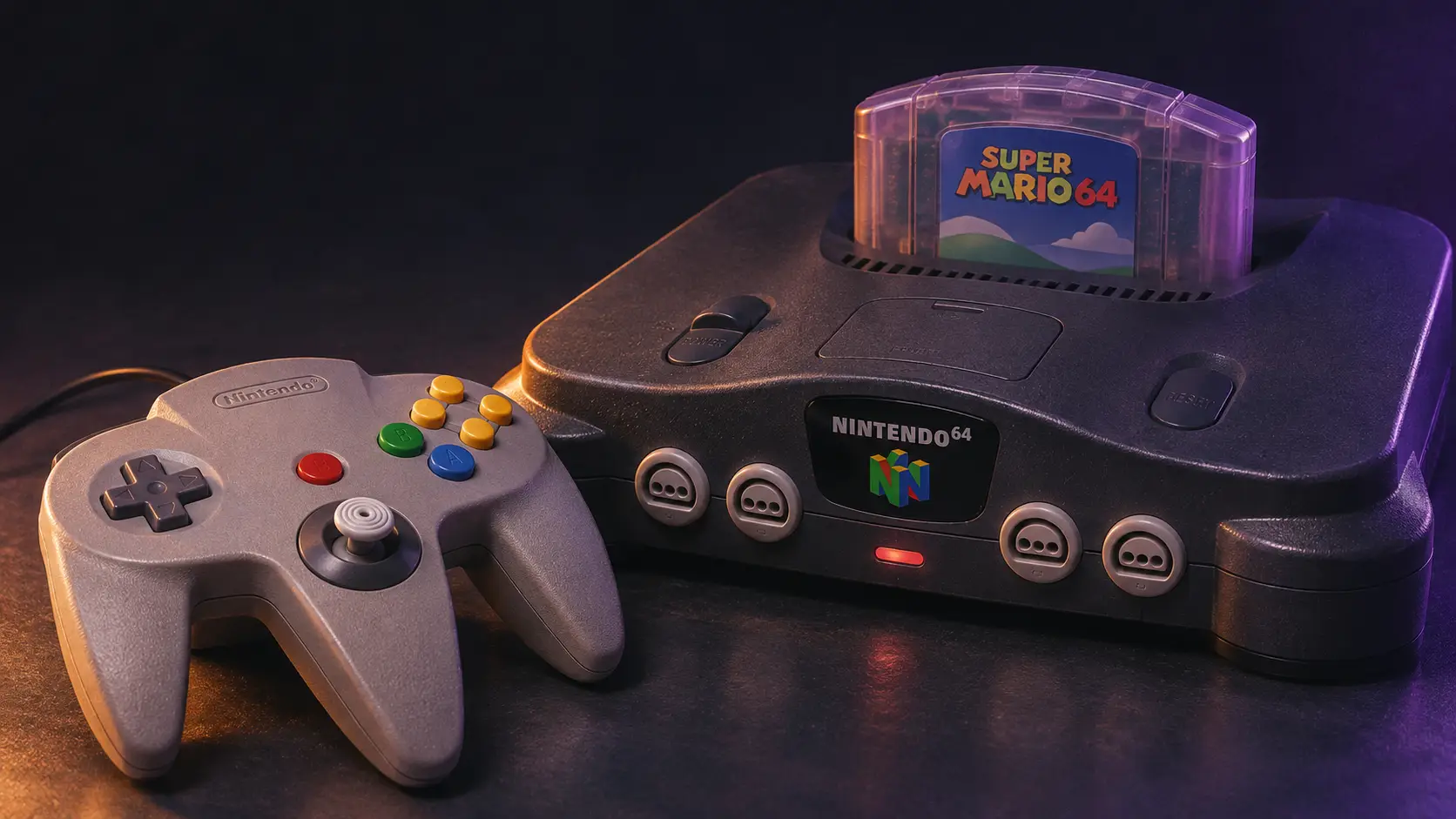
Built with the Silicon Graphics Reality Coprocessor, the Nintendo 64 brought cutting-edge 3D graphics techniques into the living room. But a texture cache of just 4 KB, the cost of ROM chips, and the choice of cartridge shaped the N64’s distinctive visual style—and helped push Square and Final Fantasy VII toward PlayStation.
CONTENTS
01 Project Reality: The secret alliance between Hiroshi Yamauchi and Silicon Graphics
02 RCP architecture: RSP, RDP, and trilinear filtering
03 The 4 KB bottleneck: where the signature blur came from
04 64 MB versus 650 MB: why Square chose PlayStation
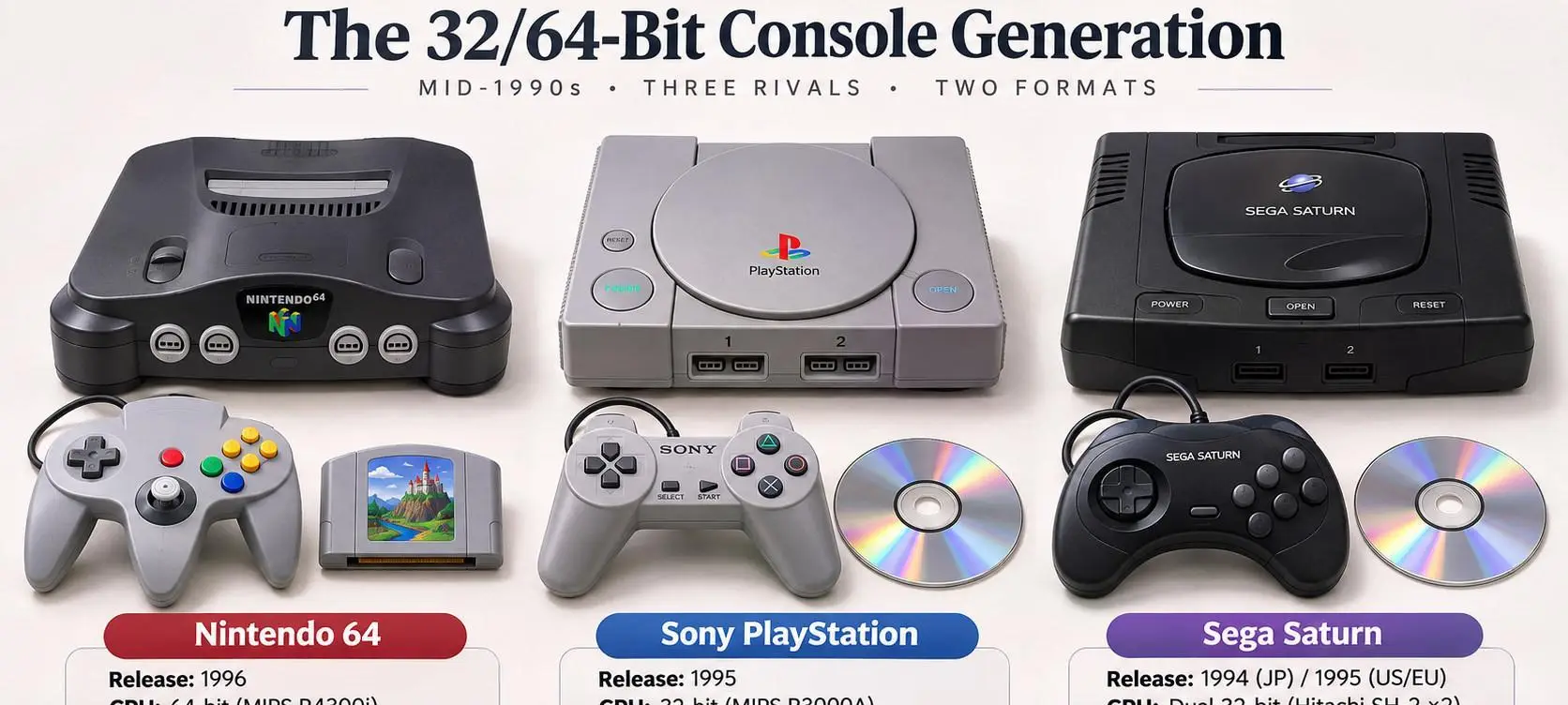
In the summer of 1996, Nintendo launched a console that, on paper, looked like a machine from the future. A 64-bit processor, a graphics system developed with Silicon Graphics, hardware z-buffering, antialiasing, perspective-correct texturing, and a controller with an analog stick promised an entirely different kind of video game. Super Mario 64 immediately explained why all this mattered: the camera moved in three dimensions, space became a playground for experimentation, and the hero’s movement stopped being a set of discrete commands.
But the Nintendo 64 developed a strange visual signature: walls and ground looked soft, details dissolved into the distance, and against the PlayStation’s sharp pixels many surfaces looked as if they had been smeared with Vaseline. At the same time, major publishers increasingly chose optical discs. To understand this contradiction, it is not enough to blame one weak chip or one stubborn management decision. Memory physics, chip costs, graphics algorithms, and Nintendo’s business model all collided here.
That is what makes the N64’s story more interesting than a simple “cartridge versus CD” debate. Its developers achieved something that, not long before, had required an expensive graphics workstation. Yet the engineering victory in processing triangles did not eliminate the need to store textures, music, videos, and vast worlds—and pay for every additional megabyte. [1–4]
N64 / TECHNICAL SPECIFICATIONS
| CPU | NEC VR4300 (64-бит RISC) / 93,75 МГц |
| RCP | SGI Reality Coprocessor / 62,5 МГц |
| RSP | 4 КБ IMEM + 4 КБ DMEM (отдельно от TMEM) |
| TMEM | 4 КБ быстрой текстурной памяти RDP |
| RAM | 4 МБ RDRAM / 8 МБ с Expansion Pak |
| Носитель | ROM до 64 МБ (512 Мбит); CD-ROM около 650 МБ |
Clock speeds, memory capacities, and maximum cartridge size are based on Nintendo documentation and technical archives; 64 MB refers to later large cartridges, not a typical 1996 release. [3, 9, 10]
01 Project Reality: The secret alliance between Hiroshi Yamauchi and Silicon Graphics
On August 23, 1993, Nintendo and Silicon Graphics announced their joint Project Reality. The archived press release discussed not a finished console, but licensing 64-bit MIPS technology and SGI graphics developments for a mass-market game system. The release promised a home launch by the end of 1995; the actual Nintendo 64 appeared in Japan only on June 23, 1996. This discrepancy alone is a reminder: the press conference announced an ambition, not a final specification. [1, 2]
The idea emerged at an unusual intersection of industries. SGI designed workstations for scientific visualization, engineering modeling, and computer graphics. Nintendo, which had built an empire on the Famicom and Super Famicom, was looking for a way to turn those techniques into a device that could be sold to families, not laboratories. The key figure on Nintendo’s side was president Hiroshi Yamauchi: he agreed to invest in a long-term partnership and gain access to specialized technology unavailable to competitors on the same terms. [1, 5]
In 1993, company representatives demonstrated the potential of the future platform on SGI machines: the press described a flight on a pterodactyl through an interactive three-dimensional world. It was an impressive demonstration of computational principles, but not footage from a working N64. In early announcements, even the media format—disc or cartridge—remained undecided. The choice of ROM came later, and it would set limits on future games. [2]
The context matters, too. Silicon Graphics had previously presented its gaming idea to Sega, but no agreement followed. For Nintendo, the partnership meant access to MIPS technology and engineers accustomed to thinking in terms of a pipeline transforming geometry, textures, and frame buffers. For SGI, it offered a chance to sell its architecture to millions, rather than to hundreds of customers buying expensive workstations. Workstations were later used as game-development tools, but the marketing phrase “SGI-level graphics” did not mean a home console matched a real Onyx in processing power or memory capacity. [5]
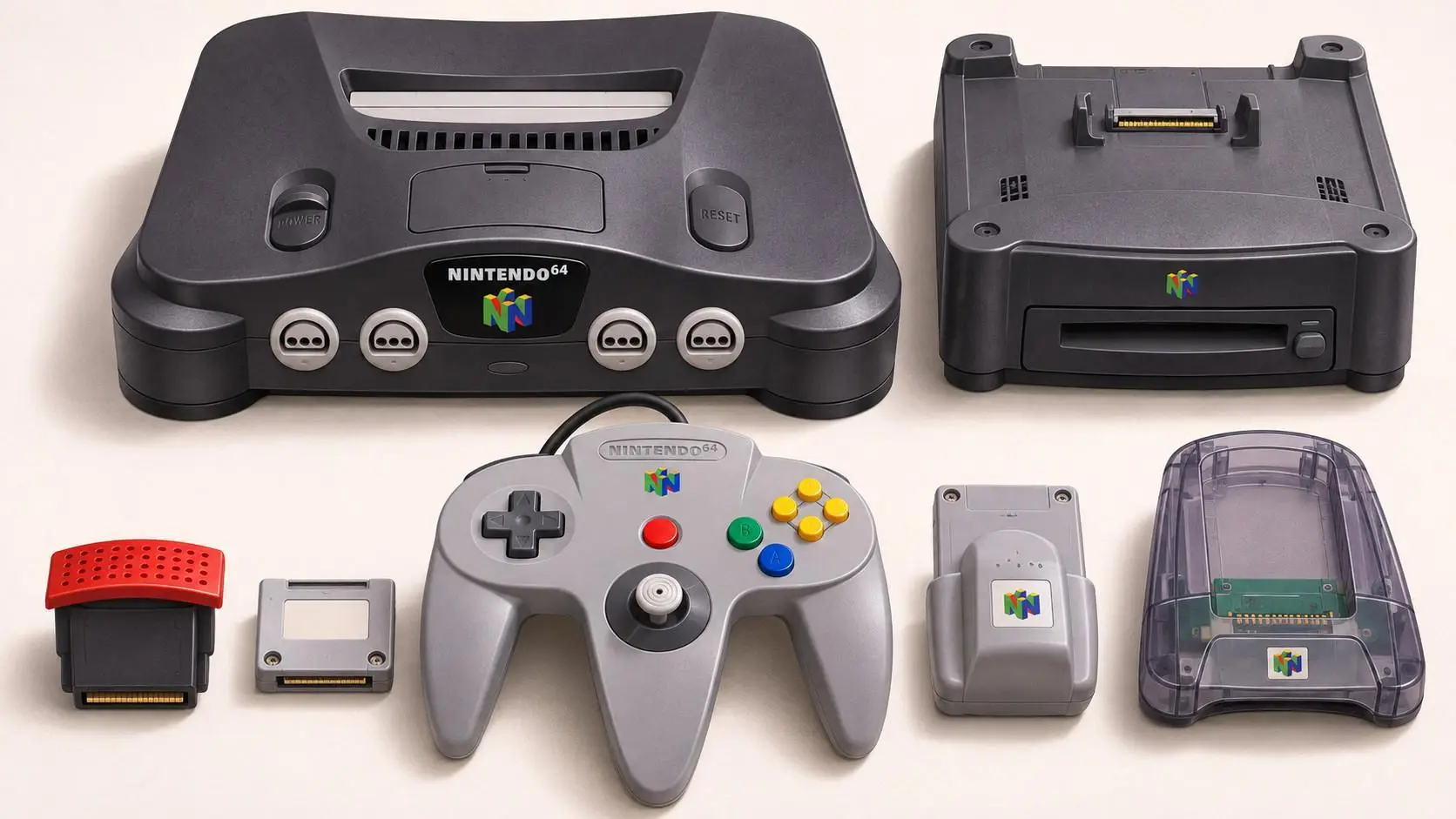
Turning bold promises into a production device required three steps:
“The same principles that help scientists and engineers see complex data will change home entertainment.”
— James Clark, chairman of Silicon Graphics, press release, August 23, 1993 [1]; editorial translation
• Compress a graphics workstation’s capabilities into an inexpensive set of ASICs and a MIPS-compatible processor.
• Move the complex part of the 3D pipeline into specialized hardware so the CPU would not spend every clock cycle drawing.
• Create an SDK and microcode that would let game studios manage the new architecture within a real frame-time budget.
As a result, “Reality” stopped being a scientific demonstration and became a set of strict constraints: clock speeds, memory buses, limited RAM, and precise mathematical limits on the graphics pipeline’s internal memory. Nintendo did get a distinctive platform on which camera, scene depth, and analog control were designed as a unified whole. This was a fundamental breakthrough in game design, even if the marketing promises of 1993 did not bear literal interpretation.
02 RCP architecture: RSP, RDP, and trilinear filtering
Two key processing units worked inside the Nintendo 64. The NEC VR4300—a 93.75 MHz, 64-bit RISC processor based on MIPS—handled the main game logic. The SGI Reality Coprocessor, or RCP, ran at 62.5 MHz and combined the graphics pipeline with memory and input/output interfaces. These figures do not translate directly into “polygons per second”: a game might be limited not by the CPU, but by command preparation, texture reads, pixel blending, or access to RDRAM. [3, 5, 9]
The RCP was not a single all-purpose “GPU” in today’s sense. Its programmable Reality Signal Processor (RSP) processed vertex data, lighting, transformations, and, in other tasks, audio. It contained separate 4 KB regions: IMEM for microcode instructions and DMEM for data. The data then passed to the Reality Display Processor (RDP), a specialized rasterizer that converted primitives into pixels, applied textures, handled depth, and performed blending operations. The IMEM/DMEM regions should not be confused with the separate 4 KB texture memory, TMEM, located in the RDP pipeline. [3, 5]
A typical frame began with the CPU assembling a display list—a sequence of commands describing objects and rendering modes. The RSP interpreted those commands using loaded microcode and passed prepared triangles to the RDP. This approach allowed some work to run in parallel and reduced the load on the central processor. The price of flexibility was the need to understand the cost of individual modes. An expensive effect could consume more time than several additional geometric objects.
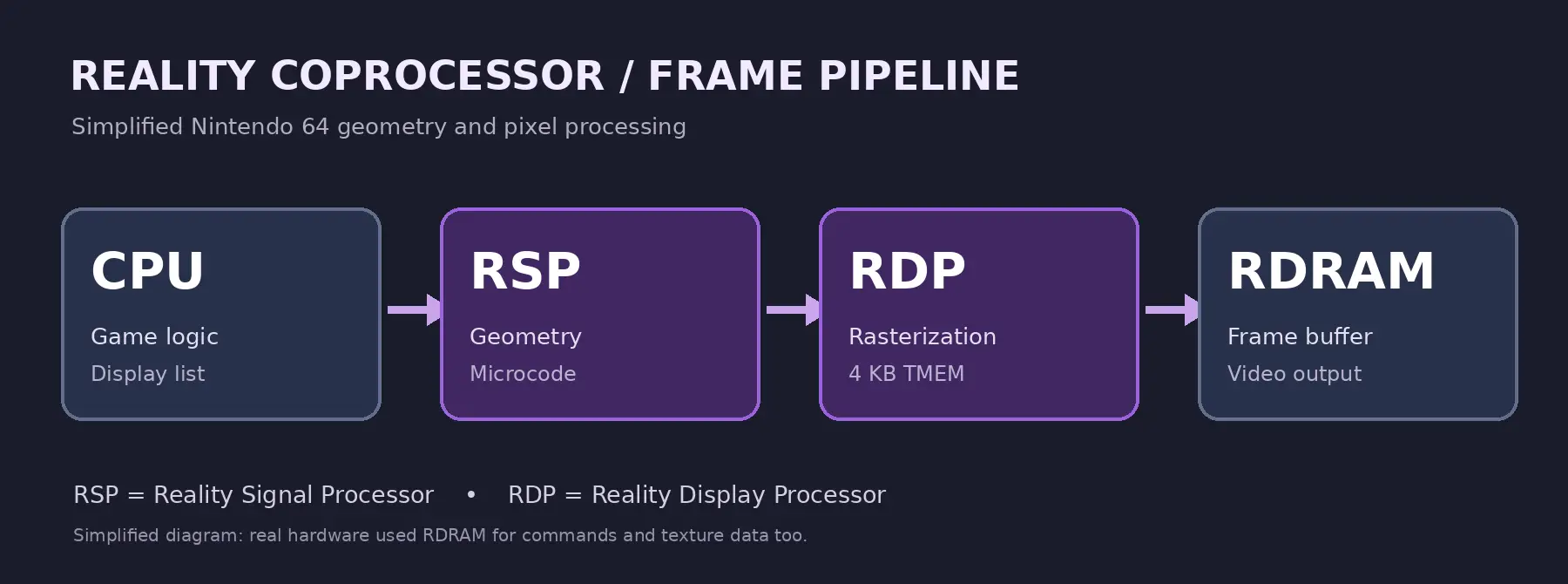
The key difference between N64 and PlayStation was not some magical “64 bits.” Nintendo provided hardware texture perspective correction, a z-buffer, and filtering: images suffered less from the “swimming” textures on sloped surfaces and polygon-ordering problems common in many early 3D games. But these improvements were not free; their speed depended on RDP modes, memory bandwidth, and the number of passes. [3, 9]
The word “trilinear” also needs some care. According to Nintendo’s official manual, the standard G_TF_BILERP mode used not classic interpolation across four neighboring texels, but a simplified three-point filter: a circuit-design trade-off produced mild diagonal anisotropy. True trilinear mipmapping was supported by the RDP: two levels of detail were read in a two-cycle mode, then their results were blended according to the LOD factor. A separate section of the manual confirms this. However, a capability in the hardware does not mean it was used freely and universally in games. [4]
A practical SDK snippet shows how a developer enabled texture filtering; it is not a complete, ready-to-run renderer:
| /* RGBA16: 32 x 32 x 2 = 2048 bytes in TMEM */gSPTexture(glistp++, 0x8000, 0x8000, G_TX_RENDERTILE, G_ON);gDPSetTexturePersp(glistp++, G_TP_PERSP);gDPSetTextureFilter(glistp++, G_TF_BILERP);gDPLoadTextureBlock(glistp++, texture, G_IM_FMT_RGBA, G_IM_SIZ_16b, 32, 32, 0, G_TX_WRAP, G_TX_WRAP, 5, 5, G_TX_NOLOD, G_TX_NOLOD);gSPDisplayList(glistp++, geometry); |
Adapted example from the Nintendo SDK: G_TF_BILERP sets three-point filtering; gDPLoadTextureBlock transfers 2 KB of RGBA16 from RAM into TMEM, after which geometry is drawn. [4, 11]
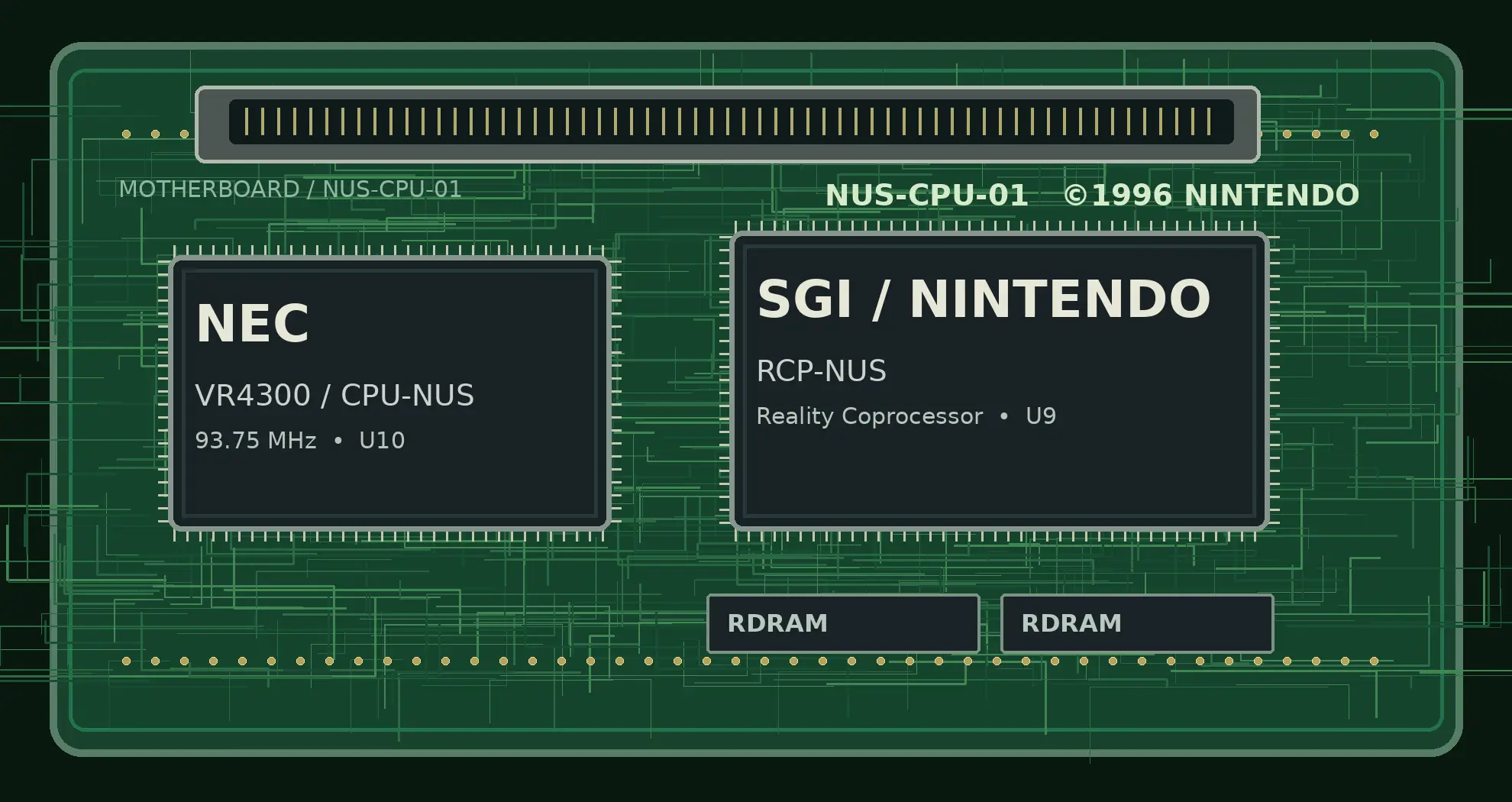
The processor handled logic, the RSP prepared data, and the RDP colored the screen—but the whole chain’s visual quality depended on how skillfully a developer allocated resources. Unlike with a familiar modern GPU, on the N64 “organizing memory correctly” was often more important than simply drawing another thousand triangles. [3, 4]
03 The 4 KB bottleneck: where the signature blur came from
The console’s external RDRAM had a capacity of 4 MB in the base configuration (8 MB with the Expansion Pak), but the graphics unit could not freely read a huge texture every time it needed a pixel. Nintendo’s documentation explains that random access to DRAM had too unpredictable a latency. So each primitive received data from fast internal TMEM—just 4096 bytes. The necessary “tile” of a texture was transferred here in advance from system memory, after which the RDP used it for rasterization. [3, 4]
The scale is easy to grasp without complicated formulas. A 32 × 32 square in RGBA16 requires 2048 bytes. The same area in RGBA32 takes all 4096 bytes. A 64 × 64 texture in RGBA16 takes 8192 bytes—twice TMEM’s capacity. So larger images had to be split into fragments, use palette-based or lower-bit formats, or sacrifice detail. Palette use and multiple mipmap levels introduced further restrictions. [3]
The documentation recommended loading a tile, setting its properties, and drawing as many primitives as possible before changing the contents of TMEM. This led to a workflow like packing a suitcase: the artist reduced or repeated textures; the programmer sorted geometry to avoid unnecessary loads; the designer adjusted the scene to fit the memory budget. If materials were switched constantly, the gains from the fast internal cache disappeared in data exchanges.
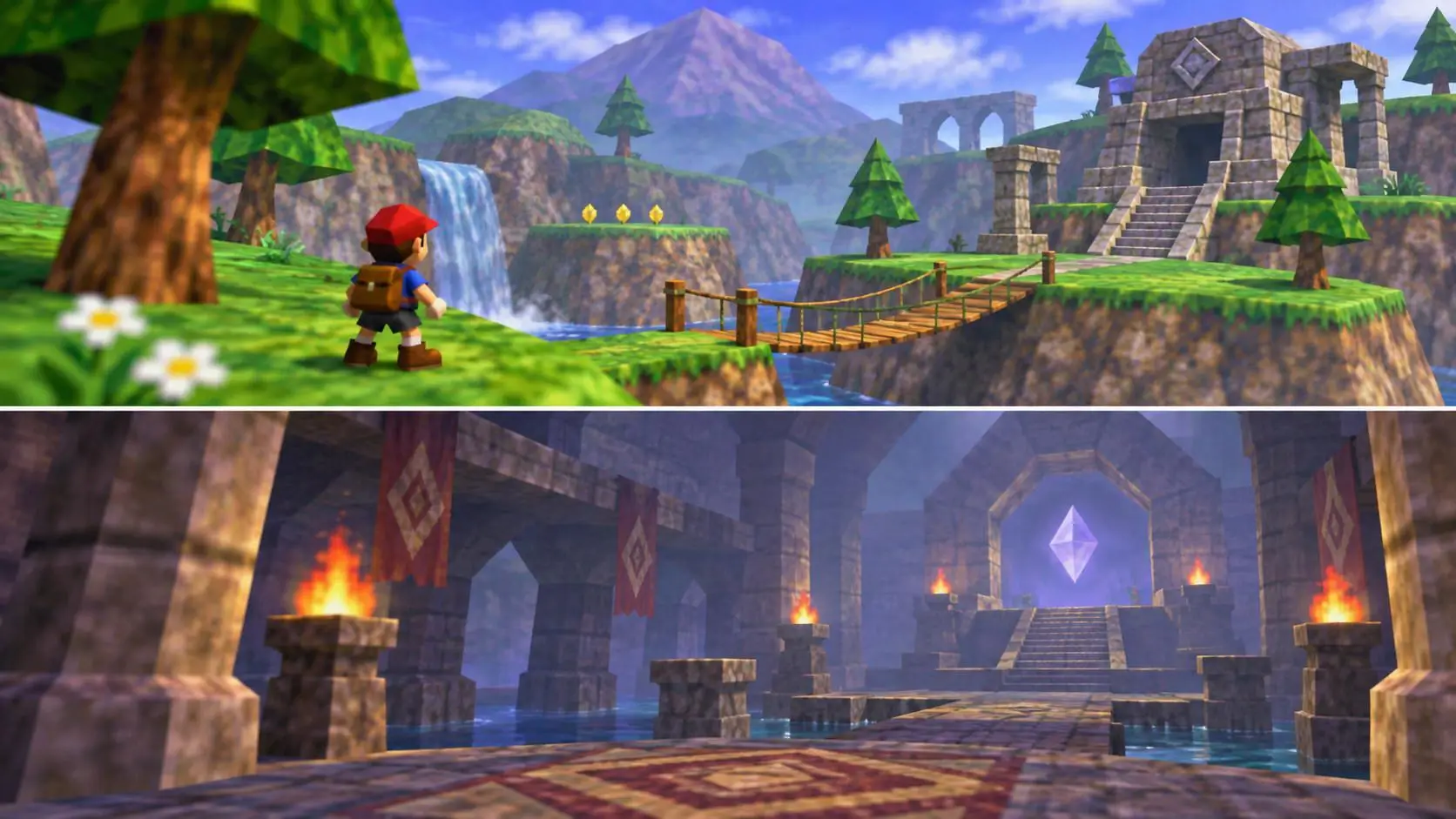
This limitation did not “force” the RDP to blur every image automatically. The famous softness came from several choices working together. First, source tiles were often small and had to be stretched. Second, the standard three-point filter smoothed boundaries between large texels instead of displaying sharp squares. Third, hardware edge antialiasing, low internal resolutions, and video-output stages added a characteristic softness to the overall image. Finally, artists deliberately chose a visual style that better concealed the lack of detail. [3, 4, 9]
Consider a stone wall in Ocarina of Time. A developer did not need to store a photograph of every slab. They could use a small repeating pattern, combine it with vertex lighting and fog, and design the surroundings so the player read the shape and scale rather than inspecting every pixel. In such a scene, filtering looks like an artistic virtue. But move the camera close to a flat surface, and the shortage of original resolution becomes obvious.
“From a programmer’s perspective, TMEM really should be thought of as a cache.”
— Nintendo 64 Programming Manual, Texture Memory section [3]; editorial translation
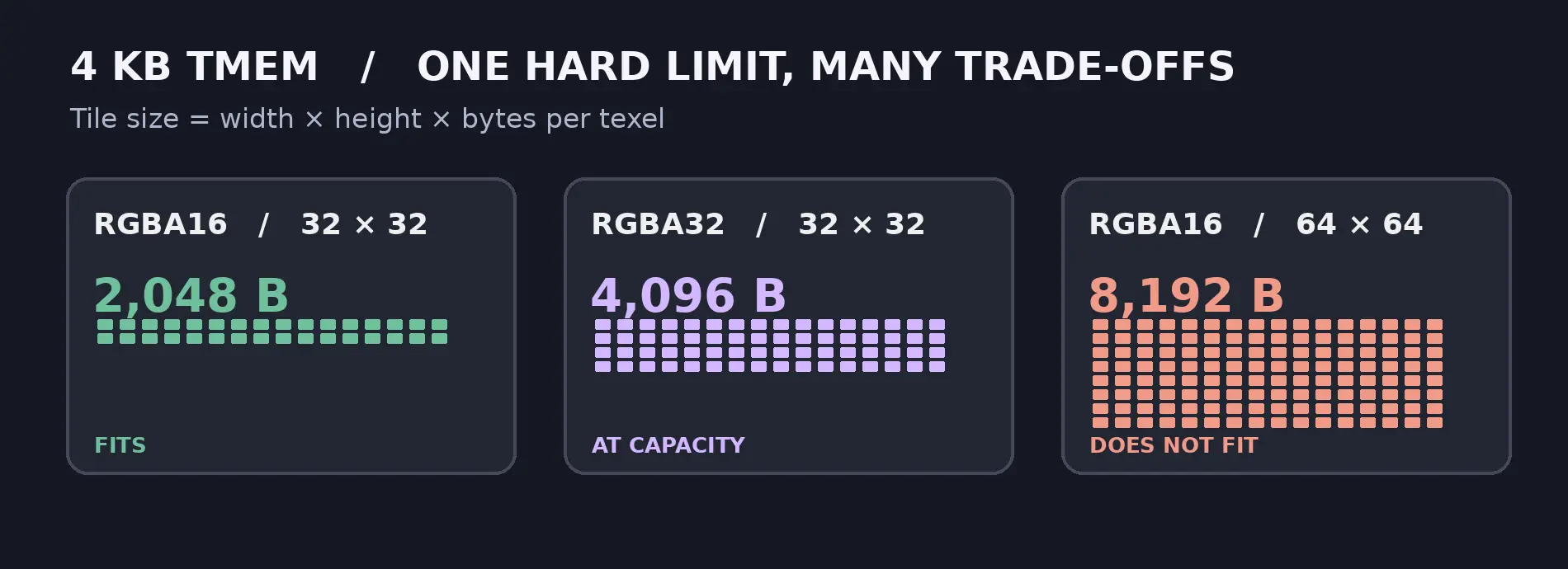
Possible engineering responses to the 4 KB ceiling were quite concrete:
• Split large textures into small tiles; reduce the number of TMEM switches while drawing.
• Use 4- and 8-bit formats, palettes, and repeating textures to save space.
• Move detail into geometry, vertex colors, lighting, fog, and environmental design.
• Drop some expensive effects in scenes where performance matters more than perfect image quality.
A comparison with PlayStation calls for honesty. The original PlayStation had different visual problems: no hardware z-buffer, rougher handling of perspective textures under typical conditions, geometry jitter, and noticeable pixels. Its frame was not “better” on every measure. Developers there could simply strike a different balance: sharp textures without the N64’s characteristic smoothing, a different approach to rendering, and a much roomier medium for source data. The difference between the consoles became a difference in aesthetics, not just a difference between specification tables.
04 64 MB versus 650 MB: why Square chose PlayStation
The main drama of the Nintendo 64 unfolded not in silicon, but in the cartridge slot. ROM started almost without mechanical delays, offered predictable access, and was Nintendo’s familiar way of controlling production and licensing. CD-ROM, by contrast, required the disc to spin and the laser head to move, which meant loading pauses. For a platformer like Super Mario 64, a fast cartridge was a huge convenience. But the format quickly became a financial and creative ceiling. [5, 6]
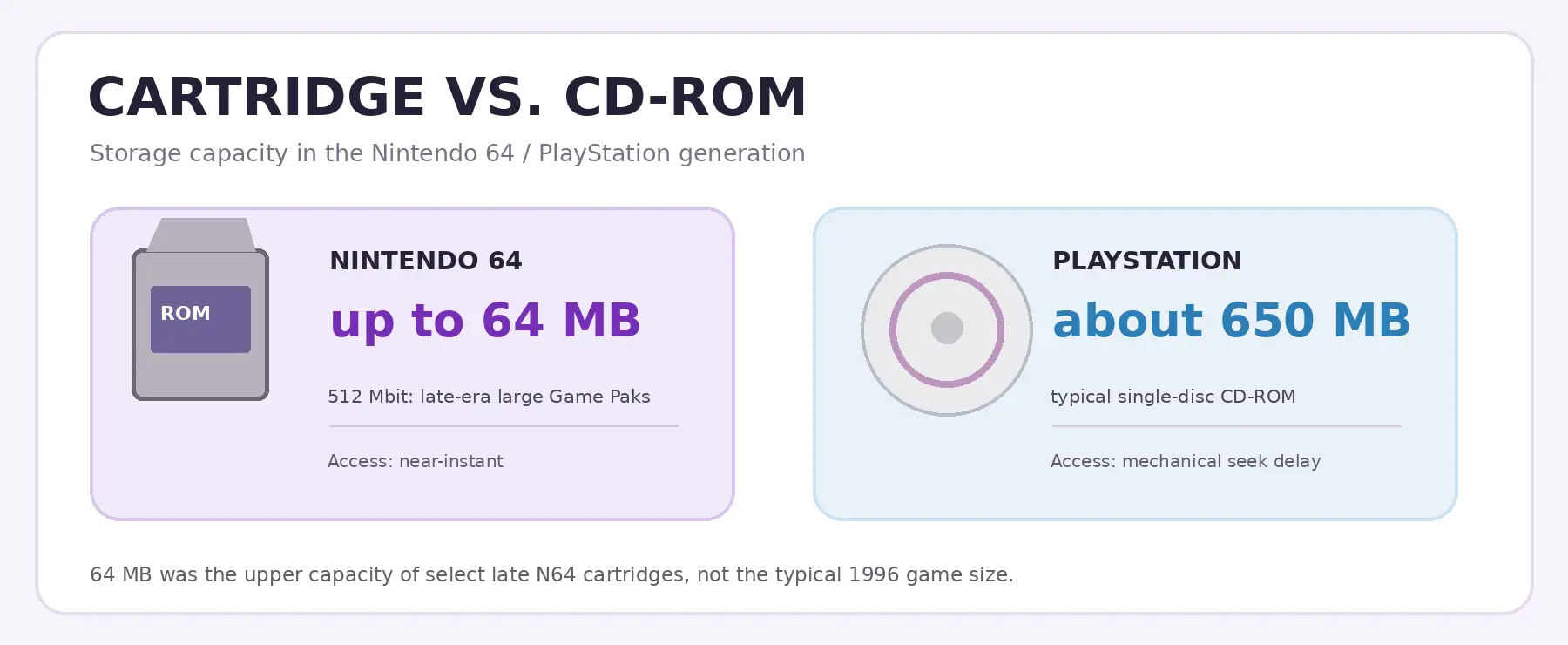
The maximum capacity of later commercial N64 cartridges reached 512 megabits, or 64 MB. That was the upper limit for individual games, not the size of a standard 1996 cartridge. A typical CD-ROM of the era held about 650 MB of user data—more than ten times the largest cartridge. And, crucially, additional discs could be produced much more cheaply than increasing the capacity of expensive ROM chips. In comparisons, decimal megabytes, megabits, and the actual capacity of a recorded CD should be distinguished; these details do not change the fundamental gap. [6, 7, 10]
Square had a project that needed not so much new mathematical instructions as capacity. Final Fantasy VII combined pre-rendered backgrounds, 3D characters, lengthy FMV sequences, and rich storytelling. Fitting this media collection onto a single 64-megabyte chip would have been extremely expensive or would have required a radically different artistic concept. The game was released on PlayStation in 1997 across three CDs. Not all the disc space held unique data: some resources could be duplicated to make switching between discs more convenient. But the format removed the biggest constraint on designing long cinematics and a large number of backgrounds. [6, 7]
It is important not to turn Square’s decision into a one-dimensional legend. In Polygon’s extensive oral history, developers also recalled the efficiency of a particular graphics pipeline, disagreements with Nintendo, and the risks of production decisions. However, series creator Hironobu Sakaguchi called the CD a key factor, while Square president Tomoyuki Takechi emphasized the lower cost of the medium. Their accounts complement each other: artists wanted freedom, while the finance department wanted a controllable production cost. [6]
“The CD for PlayStation games was the main factor in our decision.”
— Hironobu Sakaguchi, Polygon interview, 2017 [6]; editorial translation
The scale of Square’s investment is also visible in its tools. According to Shinjiro Kajitani’s recollection in the same interview, Square acquired hundreds of SGI Indigo2 workstations and servers to create graphics. The result was almost paradoxical: SGI technology played a role both in the creation of the Nintendo 64 and in producing the flagship project that moved to its rival, PlayStation. The reason for the switch was not “dislike of 64 bits,” but the incompatibility of an ambitious, cinematic RPG with the available medium and business terms. [6]
“CDs cost less than cartridges and let us give players more without raising the price.”
— Tomoyuki Takechi, Polygon, 2017 [6]; editorial translation
The cartridge path nevertheless produced unique games. Ocarina of Time, GoldenEye 007, Banjo-Kazooie, and Perfect Dark showed how talented teams built complex systems within limited memory. Nintendo prevailed in access speed, control, image stability, and its understanding of 3D space; Sony prevailed in capacity, the lower cost of manufacturing copies, and appeal to third-party publishers. There was no universally correct engineering solution: the same architecture could be ideal for a platformer and cramped for a cinematic RPG.
The N64’s legacy is a lesson in system-design constraints. Silicon can outpace its time, but the impression a game makes is determined by an entire chain: from the artist’s workstation and texture bytes to the price of the medium on the shelf. The Nintendo 64 became great not in spite of its compromises, but because its best developers learned to turn them into a game form. And for part of the industry, the cartridge itself became the door they had to leave through.
SOURCES AND ARCHIVAL MATERIAL
[1] Silicon Graphics / MIPS, original Project Reality announcement (August 23, 1993)
[2] UPI, Nintendo and Silicon Graphics team up (August 23, 1993)
[3] Nintendo 64 Programming Manual, Texture Memory (TMEM)
[4] Nintendo 64 Programming Manual: RDP texture filtering and trilinear mip mapping
[5] Jon Peddie, Nintendo 64: Breakthrough Design, Genuine Disruption (2020)
[6] Polygon, Final Fantasy 7: An Oral History (2017), interviews with Square developers
[7] AUTOMATON WEST, Hironobu Sakaguchi’s comments on FFVII media (2024)
[8] Wikimedia Commons, photograph of an actual NUS-CPU-01 board, by Yaca2671, CC BY-SA 3.0
[9] Rodrigo Copetti, Nintendo 64 Architecture (technical analysis)
[10] Nintendo64EVER, technical specifications and cartridge capacities
[11] Nintendo Ultra64 SDK Functions Reference: gDPLoadTextureBlock