Source Engine, Havok & the Gravity Gun: Weaponizing Physics
Costing over $40 million across six grueling years, Half-Life 2 redefined the boundaries of real-time simulation. Rejecting licensed middleware, Gabe Newell funded the in-house development of the Source Engine, deeply intertwined with the Havok physics API.
The crowning jewel was the Zero Point Energy Field Manipulator—the Gravity Gun. Everyday detritus—circular saw blades, cinderblocks, gas canisters—became lethal ballistic projectiles, enabling the unforgettable ammunition-free survival sequence through the zombie-infested alleys of Ravenholm.
We realized physics shouldn't just be an aesthetic parlor trick for toppling crates. Physics had to become the foundational verb in the player's vocabulary.
Gabe Newell, co-founder of Valve
City 17: Viktor Antonov's Dystopia & Facial Animation
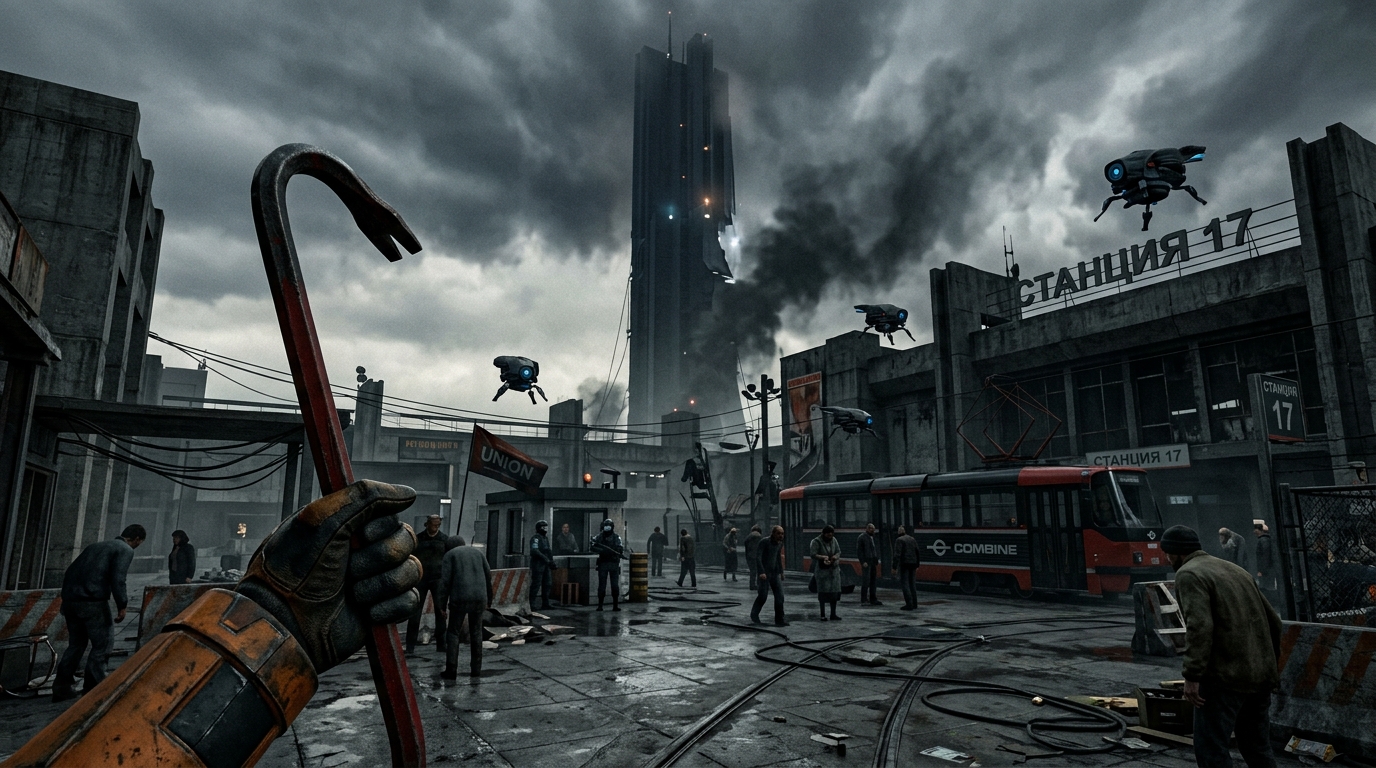
Architectural visionary Viktor Antonov fused Eastern European neoclassical grandeur with the alien brutalism of the Combine Citadel, establishing City 17 as an environmental narrative tour de force.
Valve's proprietary muscle-driven Facial Animation System delivered uncanny emotional authenticity to companions Alyx Vance, Dr. Kleiner, and Eli Vance, dispensing entirely with jarring third-person cinematics.
The Steam Gamble: Dawn of Digital Distribution
Half-Life 2's November 16, 2004 launch provoked intense controversy: for the first time, a packaged retail disc mandated broadband online authentication through Valve's fledgling client, Steam.
Authentication servers choked under dial-up traffic and retail cartels threatened boycotts. Yet Newell's gambit succeeded decisively, dismantling physical distributor margins, establishing a digital haven for independent creators, and cementing Steam as the definitive bedrock of modern PC gaming.