Yamauchi's Mandate: Outpacing Rivals for Three Years
In late 1981, Nintendo president Hiroshi Yamauchi issued an uncompromising ultimatum to R&D2 chief Masayuki Uemura: engineer a home video game console priced under 10,000 yen with visual capabilities no rival could replicate for three years.
Rejecting the expensive Motorola 68000, Uemura struck an ambitious silicon fabrication partnership with Ricoh. Together, they modified the dependable 8-bit MOS 6502 core with an integrated 5-channel audio synthesizer and devised a dedicated co-processor: the Picture Processing Unit.
Yamauchi told me: 'Make something that will not be obsolete before the decade ends.' We designed Famicom not as a plastic toy, but as a relentless arcade station for the living room.
Masayuki Uemura, lead architect of Famicom & NES
The PPU & 2A03: Hardware Smooth Scrolling and Chiptune Mastery
The architectural masterpiece of the Famicom was its Picture Processing Unit (Ricoh 2C02 PPU). Capable of rendering 64 simultaneous hardware sprites and buttery-smooth single-pixel background scrolling, the PPU liberated game directors from static single-screen arenas.
It was this fluid parallax capability that empowered Shigeru Miyamoto and Takashi Tezuka to architect the sprawling kinetic expanses of Super Mario Bros., backed by Koji Kondo's timeless 5-channel musical polyphony.
The NES Disguise, 10NES Lockout & the Seal of Quality
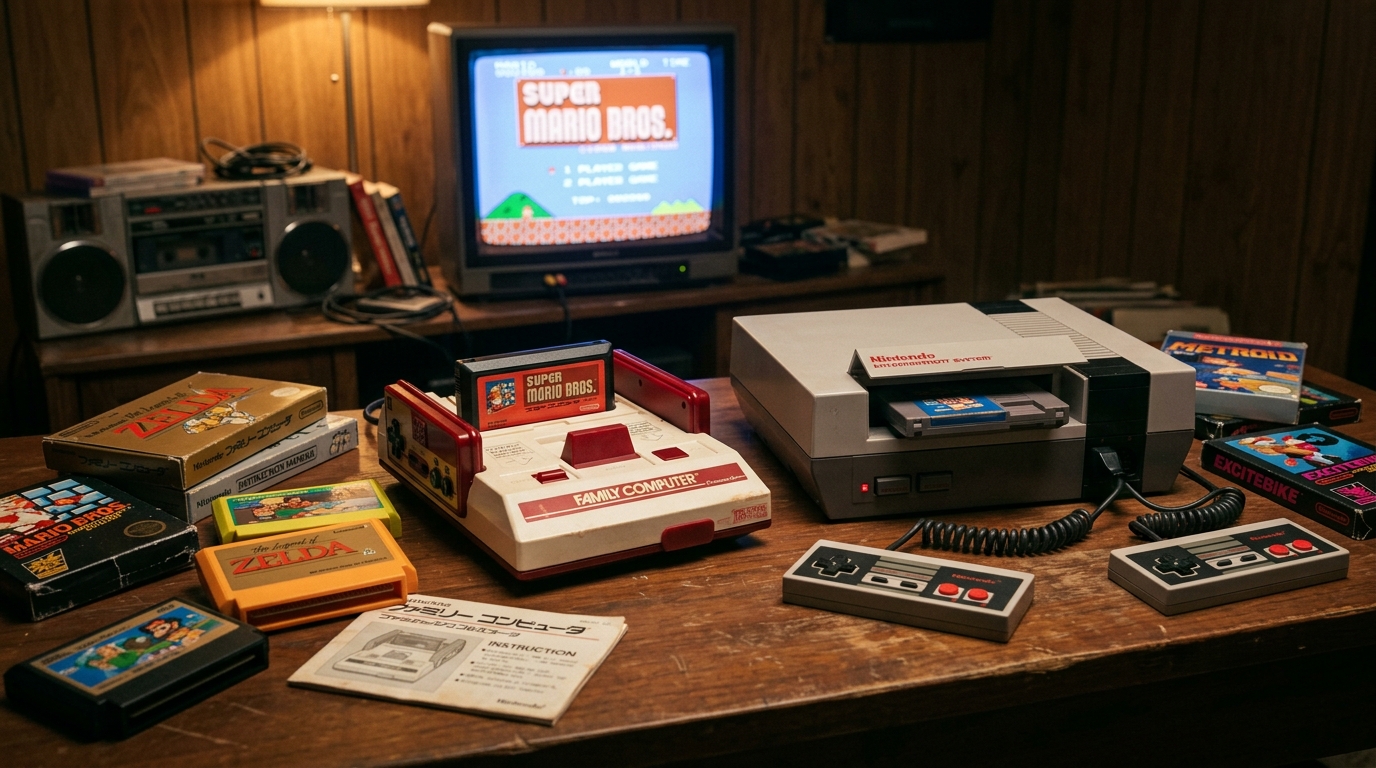
When Nintendo approached American retailers post-1983 crash, merchants vehemently refused to stock 'video games.' Nintendo responded with brilliant industrial camouflage: reshaping the machine into the front-loading 'Nintendo Entertainment System' resembling a VCR, bundled with the robotic toy R.O.B. and the Zapper light gun.
To permanently prevent the shovelware catastrophe that destroyed Atari, Nintendo embedded the proprietary 10NES security lockout chip and enforced ironclad publishing contracts capped at five titles per licensee per year under the golden 'Nintendo Seal of Quality.' The strategy single-handedly resurrected the global home video game industry.