Warren Spector's Manifesto: Never Tell the Player 'No'
By 1997, Looking Glass and Origin veteran Warren Spector had grown frustrated by linear corridor shooters that treated the player like an actor reading a fixed script. Establishing Ion Storm Austin, Spector and lead designer Harvey Smith codified a design manifesto predicated on maximal emergent agency.
Deus Ex melded first-person tactical shooting, systemic stealth, and granular RPG progression. Players shaped nano-augmented UNATCO agent JC Denton to their personal philosophy: a non-lethal ghost slipping through ventilation ducts, a persuasive diplomat, or an armored assault operative breaching blast doors with heavy ordnance.
In a truly great simulation, designers do not solve puzzles for the player. Designers craft consistent systemic rules and step out of the way.
Warren Spector, director of Deus Ex
Emergent Design on Liberty Island
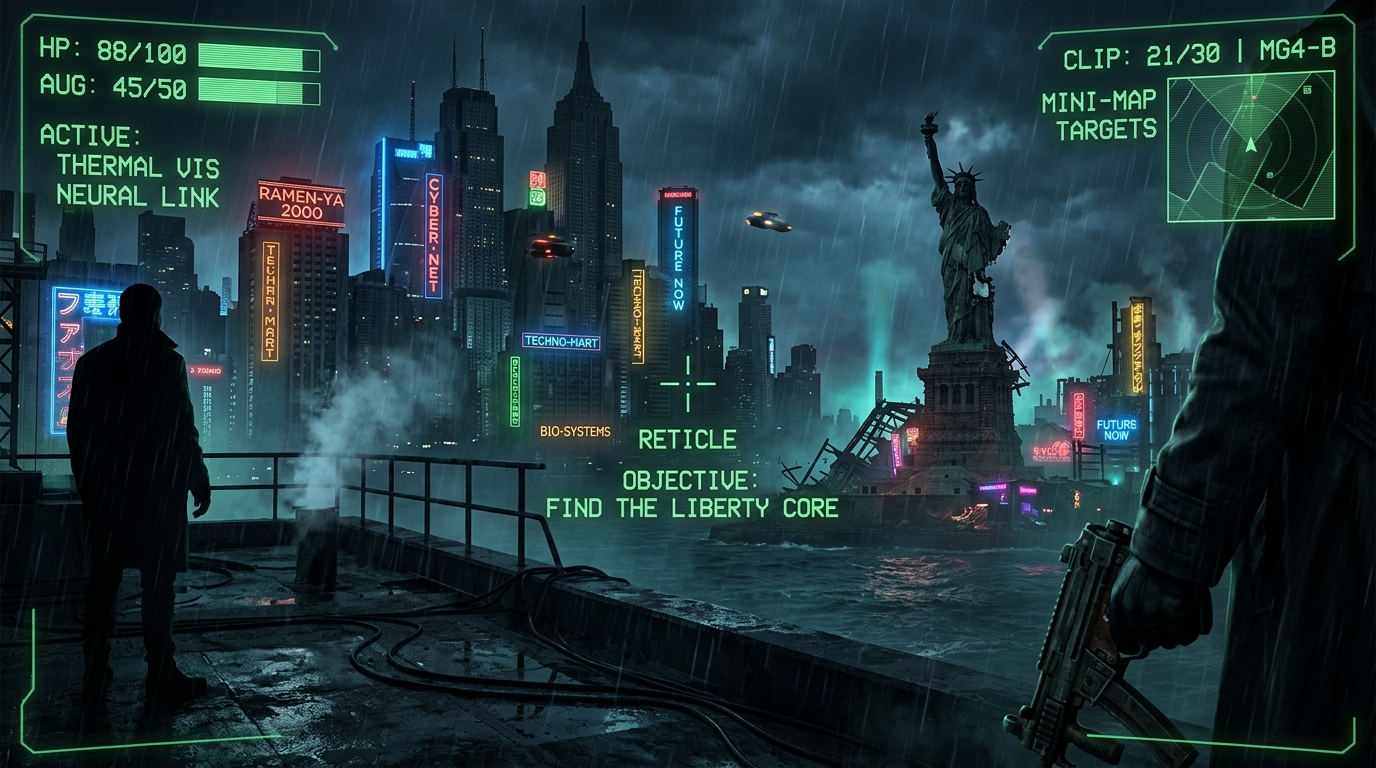
The opening infiltration of Liberty Island beneath the decapitated Statue of Liberty remains a masterclass in level architecture. Every locked security bulkhead possessed at least four systemic solutions: lockpicking the tumblers, hacking security terminals, finding an access pocket secretary on a guard, or stacking wooden crates to reach an unmapped roof intake.
Real-time nano-augmentations—from sub-dermal ballistic armor and thermoptic cloaking to speed enhancement—fluidly transformed every hostile encounter into an improvisational playground.
Philosophical Conspiracy & Three Destinies
Deus Ex wove every turn-of-the-millennium conspiracy theory—the Illuminati, MJ-12, the Gray Death nanovirus, Area 51, and rogue synthetic intelligence—into an intoxicating sociopolitical tapestry.
Crucially, the climax avoided an arbitrary bullet-sponge boss fight. Inside the subterranean reactors of Area 51, Denton confronts three profound ideological forks: plunge humanity into a dark-age decentralization, empower a clandestine benevolent oligarchy, or merge consciousness with the AI Helios to govern as an omnipresent digital deity.