Life Before Accelerators: Software Rendering and Jagged Pixels
In the mid-1990s, three-dimensional computing on the PC was bottlenecked by the CPU. The host Intel Pentium was forced to compute polygon geometry, perspective division, and rasterization simultaneously, restricting games to a pixelated 320×200 canvas.
Early 2D/3D combi-chips like the S3 ViRGE were notoriously sluggish, earning the derisive moniker '3D Decelerator'. The PC ecosystem desperately required dedicated silicon purpose-built to offload 3D rasterization.
«Running software 3D pegged the host processor at 100%, producing a sea of swimming pixels. Dedicated silicon was our singular salvation». (Scott Sellers, Co-Founder of 3dfx Interactive)
The SST-1 Architecture: Why a Dedicated Add-In Card Redefined Gaming
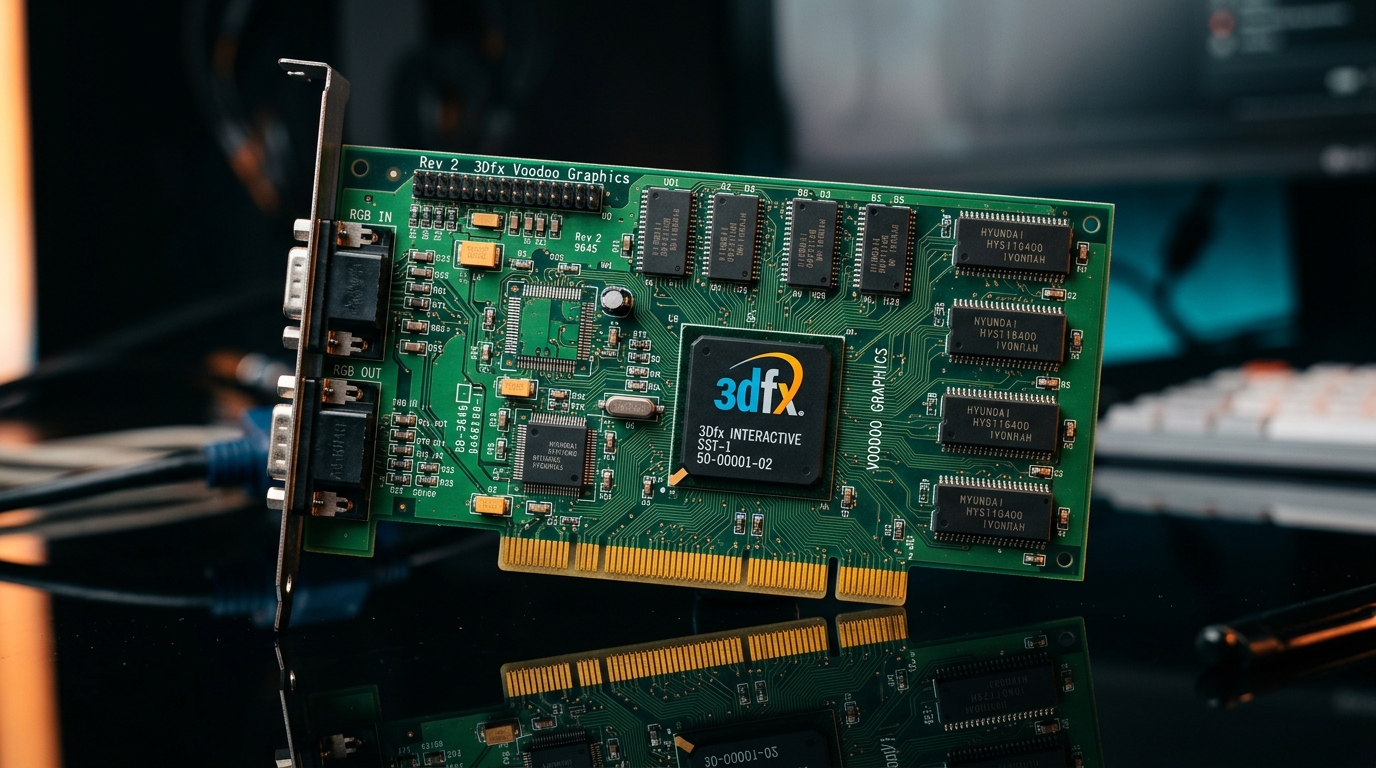
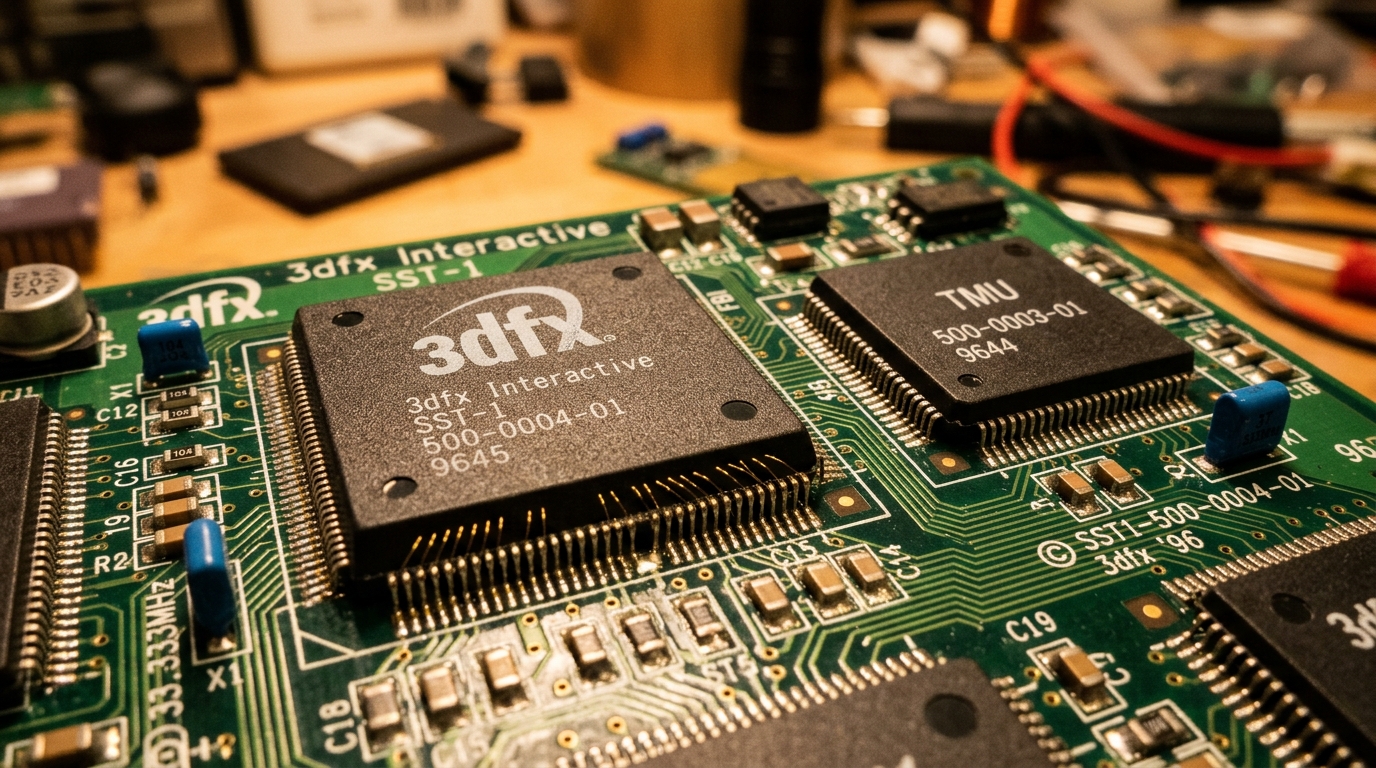
Silicon Graphics veterans Scott Sellers, Gary Tarolli, and Ross Smith chose not to compete in the crowded Windows 2D GUI market. Instead, they engineered a dedicated 3D-only PCI accelerator card powered by the dual-chip SST-1: the PixelFX framebuffer processor and the TexelFX texture management unit.
Requiring a short external pass-through cable connected to a primary 2D VGA card, the Voodoo signaled its activation with an unforgettable mechanical relay click. Instantly, muddy pixels vanished beneath hardware bilinear filtering, real-time alpha blending, and 16-bit Z-buffering.
The Magic of Glide API: John Carmack and the GLQuake Watershed
3dfx's secret weapon was Glide—a streamlined, close-to-the-metal API derived from OpenGL that bypassed cumbersome operating system driver overhead and spoke directly to SST-1 hardware registers.
In January 1997, John Carmack unleashed GLQuake. Running on 3dfx hardware, Quake rendered fluid 60 frames per second at 640×480 with dynamic colored rocket flares, delivering an interactive watershed moment that instantly obsolete CPU software rasterization.
«The moment GLQuake ran fluidly on Voodoo via Glide, the era of CPU software rendering ceased to exist». (John Carmack, Lead Programmer id Software)
Fatal Hubris: The STB Acquisition and the Nvidia GeForce Juggernaut
Riding high with an 85% market share, 3dfx executives made a catastrophic strategic blunder. In late 1998, they ceased selling silicon chips to board partners like Diamond and Creative, acquiring factory manufacturer STB Systems for $141 million to build complete graphics cards in-house.
Alienated partners fled en masse into the arms of Nvidia. In autumn 1999, Nvidia delivered the mortal blow with the GeForce 256 featuring hardware Transform & Lighting (T&L). Trapped in corporate debt, 3dfx went bankrupt in late 2000, its assets absorbed by Nvidia.