Super Breakout, the sequel to the original arcade block breaker, had me guiding a stick at the bottom of the screen to deflect a bouncing ball up into the cascading brick wall above. People give the Atari 2600 covers grief for not representing their games well, but the artwork depicting two space astronauts playing space badminton against a rainbow wall was dead on. I had lots of fun with the game, and control was smooth and precise with the paddle controllers, letting me guide my spaceman stick with complete accuracy.
The Evolution of Paddle Control
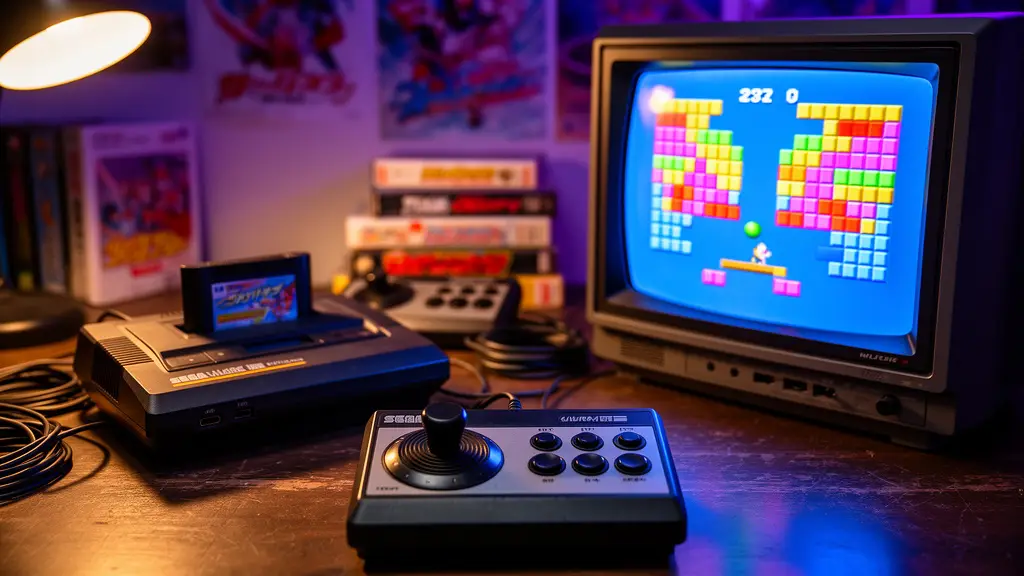
Developer Taito would take that Breakout concept and fashion its own arcade title in Arkanoid, expanding upon the formula with a variety of new brick types and added enemies and power-ups. Released for the Mark III as the final Sega My Card for the system, Woody Pop: Shinjinrui no Block Kuzugi would see itself bundled with a paddle controller just as Taito had done before with Arkanoid. In fact, Sega released two distinct paddle controller packages in 1987 with either of two games: Woody Pop on a card or Alex Kidd BMX Trial on a 1Mb Gold Cartridge.
Woody Pop is playable but never reaches the point of being something you’d go out of your way to play.
While Arkanoid is a very sleek if sterile looking game with 3-D modeled elements, Sega gave its clone more personality. Woody the Wood Spirit ventures through the Bizarre Mansion in order to rescue his friend, Gumball, and he does that by smashing all of the breakable bricks in each room.
Gameplay Flaws and Frustrations
Unfortunately, a color mod would not be enough, because the level design needs work as well. Arkanoid was developed for a vertical display, but Woody Pop uses a shorter and wider playfield being a console game drawn to 4:3 scale. This means your paddle has to cover a lot more ground, which would be OK, except that the rapid increase in speed makes it too difficult to be enjoyable.
• Branching paths offering different room choices.
• Power-ups obtained by catching bubbles from crystal bricks.
• Annoying toy box blocks that endlessly spawn enemies.
Accompanying the aggravation is a soundtrack, which I can best describe is like listening to someone playing a different Master System game from across the room. Sega made a tepid attempt to advance the genre with Woody Pop, but none of the additions are implemented well enough to overcome the game’s flaws.
SCORE: 4 out of 10
Source: Sega-16