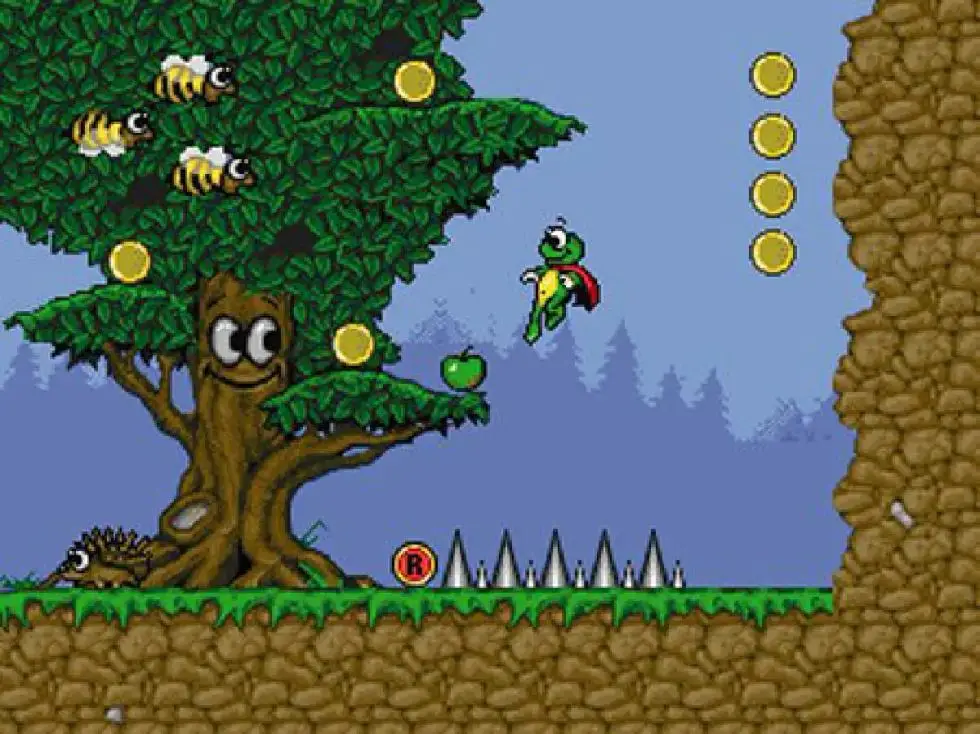
Superfrog had all the makings of an Amiga mascot: a caped frog, a vivid presentation and Team17’s stamp of polish. It looked like the colourful platform hero Commodore players had been waiting for. But the game beneath that image is more modest than its reputation suggests.
That does not make Superfrog a bad game. It remains a well-made, enjoyable platformer, with smooth animation, readable visuals and professional presentation. The mismatch lies between the solid game on screen and the larger claim that it was the Amiga’s answer to Mario and Sonic.
Superfrog is a good Amiga platformer—not the definitive one its mythology sometimes promised.
Team17’s immaculate presentation
Team17 knew how to give its games a distinctive identity. Superfrog’s bright, cartoon-like introduction and colourful world immediately sell the adventure. For a moment, it feels as though the Amiga has found a character ready to stand proudly beside the console greats.
In play, the same care is evident. Scrolling is smooth, the screen is easy to read and the controls generally respond well. Yet technical competence is not the same as a hardware showcase. The visuals are orderly rather than spectacular: there is no parallax scrolling, and the small hero and enemies rarely make the screen feel especially alive.
Other Amiga platformers made a stronger impression in different ways. Ruff ’n’ Tumble brought a larger protagonist and a harder arcade punch; Kid Chaos chased speed; Fire & Ice had more atmosphere. Superfrog is clean and polished, but it does not astonish.
Good movement, restrained momentum
The bigger limitation is the rhythm. Superfrog starts briskly, then settles into a predictable pattern: run, jump, collect items and find the exit. Its large levels contain coins, bonuses and passages to explore, but they rarely build much tension or change the pace in a memorable way.
The game feels as if it is always about to open up. Instead, it stays linear and composed. Enemies—including bees, snails and hedgehogs—fill the stages without becoming distinctive personalities, while the small, relatively inexpressive hero struggles to command the screen as a mascot.
There are few dramatic peaks to break up the routine. The near-absence of end-of-level bosses means there are fewer memorable encounters to close out an area or give progression a sense of occasion. Superfrog rarely goes wrong; it also rarely takes off.
At a glance
• Strengths: colourful, readable visuals; smooth animation; polished presentation.
• Weaknesses: predictable level design; limited character and enemy personality; a structure that can feel repetitive.
Sound and the console comparison
Allister Brimble’s music suits the game’s cheerful, fairy-tale tone and is professionally made. It supports the action without becoming one of the soundtrack’s defining features. As with the presentation, the result is refined, but not especially memorable.
By 1993, platform games were being shaped by the distinctive pace and control of console hits. Sonic the Hedgehog on Mega Drive made speed part of its identity, while Super Mario World on Super Nintendo set a high bar for control, level design and characterisation. Superfrog could look the part, but it did not match those games’ rhythm, precision or personality.
That comparison does not diminish the Amiga’s broader strengths. It does help explain why the expectation placed on Superfrog was so heavy: players wanted a presentable mascot for a machine whose identity was not built around console-style platformers.
A game carrying a bigger expectation
Contemporary opinion was not unanimous. Amiga Computing awarded Superfrog 93%, praising its graphics, sound and playability. Amiga Power was more reserved, giving it 78% in its 1993 review. Those scores capture a tension that still shapes the game’s reputation: it was a strong release, but not everyone saw it as a genre-defining one.
Superfrog mattered partly because of what it represented. It gave Amiga players a colourful, recognisable character at a time when console platformers dominated the conversation. The game was good enough to fill that symbolic role, even if it did not fully deliver on the promise.
Its presentation is stronger than its lasting impact: Superfrog is polished, pleasant and respectable, but not unforgettable.
Verdict and ratings
Played today, Superfrog remains a decent Team17 production. The visuals are clear, the movement is smooth and the presentation still has charm. But linear levels, a measured pace, forgettable enemies and a lack of major set pieces keep it from the top tier.
The final score is 7.5/10. Superfrog is not a failure, nor is it the Amiga masterpiece that its most enthusiastic admirers hoped for. It is a good platformer with a reputation that grew larger than the game itself.
• Graphics: 7.5/10
• Sound: 7.0/10
• Gameplay: 7.5/10
• Longevity: 7.0/10
• Total: 7.5/10
Source: Retro-Gamers.it