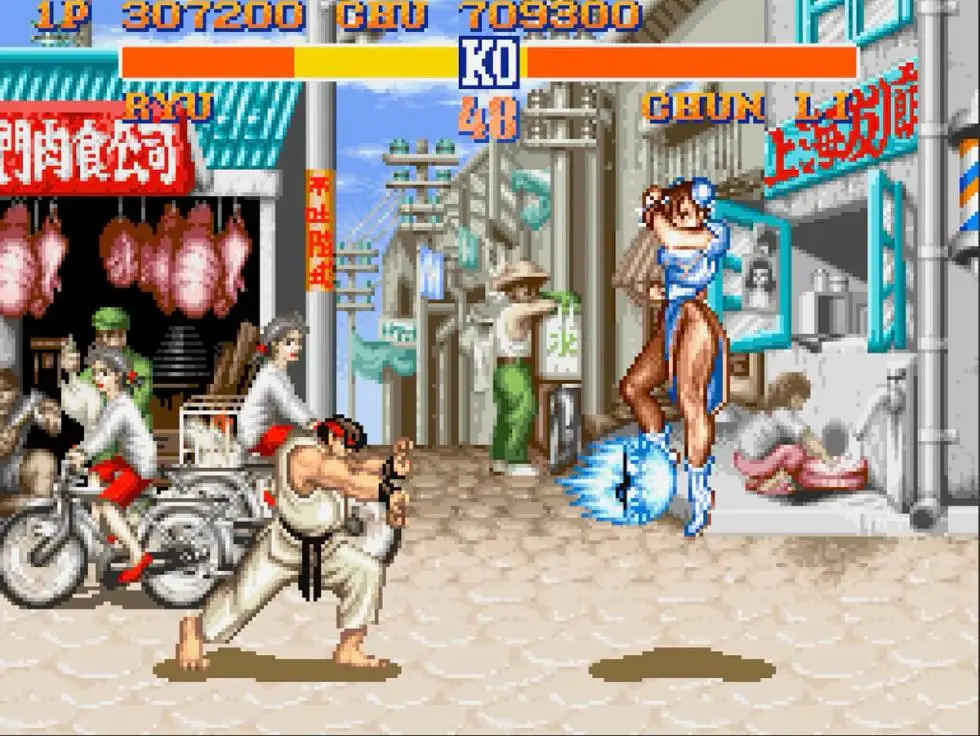
In 1992, Street Fighter II was more than a hit game. In arcades, bars and shopping centres, it had become a shared ritual: players queued coins on cabinets to claim the next match, crowds watched from behind, and arguments raged over whether Ryu, Ken, Guile or Chun-Li had the edge.
Capcom had helped turn fighting games into a contest of technique, reflexes and reading an opponent. Bringing Street Fighter II: The World Warrior to the Super Nintendo brought that contest into the living room—and made the console’s ambitions unmistakable.
It wasn’t a perfect arcade replica. It was close enough to change what players expected from a home console.
A conversion that felt like a statement
The release arrived during a decisive stretch of the console rivalry. The Mega Drive projected speed and an arcade-minded image; Nintendo needed to show that the Super Nintendo could deliver more than bright colours, Mode 7 and mascots. A home version of Capcom’s phenomenon made that case forcefully.
The conversion makes visible compromises. Character sprites are smaller than in the arcade, some background details are simplified, and the action loses some of the cabinet’s visual punch. Still, the fighters remain well defined, key animations are smooth, and the stages retain their character. Most importantly, this version feels like Street Fighter II in its timing, moves, spacing and match tension.
Eight fighters, eight approaches
The game’s appeal rests on more than its graphics or arcade roots. Its eight selectable fighters each bring a different rhythm and way to control a match:
• Ryu and Ken: technical all-rounders and a foundation for learning the game.
• Chun-Li: fast and unpredictable.
• Guile: defensive, with lethal counterattacks.
• Blanka: irregular and hard to read.
• Dhalsim: a specialist in controlling distance.
• Zangief: heavy and devastating in skilled hands.
• E. Honda: powerful and difficult to contain.
Learning a fighter meant learning a new mentality, not just memorising special moves. The game rewarded players who watched, waited, drew out mistakes and knew when to take a risk. Its apparent simplicity concealed a system deep enough to grow with its audience.
From arcade controls to the SNES pad
The Super Nintendo controller was no arcade stick, but its six face buttons and shoulder inputs offered a credible way to play. After a few matches, the Hadoken, Shoryuken and Sonic Boom began to feel natural. The essential sensation of combat survived the move home.
Every match could teach you something—and every defeat made “one more round” tempting.
Not perfect, but remarkably close
Measured against the arcade cabinet, the home version has clear limitations. The original has larger sprites, fuller sound and a more imposing physical presence. Some voices are compressed, effects have less weight, and background details are missing. The first SNES release also leaves the four final bosses unplayable, a restriction later editions would address.
But the conversion’s importance lies in what it preserved: the match structure, balance, pace and tension of versus play. The music is less powerful than the arcade soundtrack, yet the character themes remain instantly recognisable and work well in a home setting.
Why two-player mode endured
Two-player mode was the heart of the cartridge. This wasn’t a game to finish and put away; it could stay in the console for weeks, months or years. Two controllers and a friend were enough to turn a living room into a small arcade, complete with rivalries over Guile, Blanka, Zangief and the timing of a Shoryuken.
Its longevity came not from levels or secrets but from the depth of the fights. Every character had room for improvement, and no two matches had to unfold the same way. That natural competitiveness helped Street Fighter II leave a lasting mark on the genre and on home multiplayer.
A pillar of the 16-bit generation
The SNES release was more than a successful port: it was an event. The cartridge helped sell consoles, filled afternoons with rivalries and showed how commercially powerful a fighting game could be. After its arrival, console conversions of arcade fighters had a new standard to meet.
Later releases would expand and refine the formula: Street Fighter II Turbo sped things up, while Super Street Fighter II enlarged the roster. Yet the original SNES conversion remains the one with the greatest historical impact—the game that brought an arcade phenomenon home without stripping away its identity.
Final verdict
Today, this is not the definitive version of Street Fighter II. It is, however, one of the most important cartridges of the 16-bit era: a conversion that kept the rhythm, reads, spacing, special moves and memorable duels that made the arcade game special.
Overall score: 9.5/10. The arcade cabinet still has the technical edge, but the heart of the game is here—and the living room became a battleground.
• Graphics: 9.0/10
• Sound: 8.5/10
• Gameplay: 10/10
• Longevity: 10/10
Strengths and limitations
• Strengths: brings the heart of the arcade experience home; precise, readable and remarkably deep gameplay; memorable roster with strong variety.
• Limitations: smaller sprites and simplified backgrounds; some arcade audiovisual detail is missing; the final bosses are not playable in this first SNES version.
Source: Retro-Gamers.it