The return of Star Fox on Nintendo Switch 2 raises a familiar question: why does this instalment remain the series’ defining reference point? The original Star Fox on Super Nintendo mattered, but its reputation is inseparable from the technical novelty of the Super FX chip. Star Fox Zero, meanwhile, was a divisive attempt to restart the franchise on Wii U.
Instead, players’ memories keep circling back to 1997, the Nintendo 64, Fox McCloud, Falco, Peppy, Slippy, Andross and that unforgettable instruction: “Do a barrel roll”.
In 1997, Nintendo needed games that could make the new generation’s appeal immediately clear. Super Mario 64 had already reshaped 3D platforming, while Mario Kart 64 had taken local multiplayer somewhere new. The console still needed a game built around action that was fast, pure, spectacular and cinematic. Lylat Wars—called Star Fox 64 in Japan and North America—filled that role.
It took the concept of Super Nintendo’s Star Fox and made it smoother, more legible and more ambitious. The first game was a technical marvel for its day thanks to the Super FX chip, but its rough edges were hard to avoid. Lylat Wars put Fox McCloud and his Star Fox squad into a much sturdier form of 3D, adding livelier missions, more assured direction, voice acting, alternate routes and a wealth of scenes that stick in the mind.
The European release bore a different name for legal reasons, yet for many players on the continent, that cartridge was Star Fox’s true arrival in the modern gaming imagination. It was far more than “the one with the spaceships”: it became one of the most recognizable action games on the whole Nintendo 64.
An arcade-style war among the stars
The premise is straightforward and gets the job done. The villainous Andross, banished to Venom, puts the Lylat system under threat. General Pepper summons the Star Fox crew—Fox McCloud, Falco Lombardi, Peppy Hare and Slippy Toad—to halt the invasion and reach the centre of the conflict. There is no sprawling or intricate plot, but the story moves with exactly the right rhythm for an arcade game.
Every mission plays like a compact chapter in a space war. The action shifts from mountain passages to orbital engagements, enemy strongholds to asteroid belts, and from underwater worlds to cities under siege. On-rails sequences, in the mould of a traditional shooter, alternate with stretches in all-range mode, where the arena opens up and movement is free across a three-dimensional space.
That change of pace is among the game’s greatest assets. Lylat Wars always keeps the action under control: even when it offers room to roam, the goals remain obvious, enemies easy to read and momentum brisk. It feels like an interactive action movie shaped by arcade priorities—little downtime, plenty of intensity and an unbroken push forward.
Steering through space on Nintendo 64
The Arwing sits at the centre of the experience. Fox’s craft handles with precision, with acceleration and braking alongside sharp turns, loops, flips and the iconic barrel roll. The controls make strong use of the Nintendo 64 pad: the analogue stick offers a fluidity earlier consoles struggled to provide, while the buttons make firing lasers, dropping bombs, locking on and dodging feel intuitive.
Lylat Wars is easy to pick up, but there is real depth behind that accessibility. Clearing a mission is one challenge; mastering it is another. Scores, medals, keeping your squad alive, alternate paths and secrets all give players reasons to return. Each stage can be completed with greater skill and accuracy by learning where enemies appear, how they move, when to use bombs and which hidden requirements alter the route on the Lylat system map.
That is the key to what the game really is. Taken as a linear adventure, Lylat Wars is brief. Viewed as a highly replayable arcade shooter, it is substantial. The campaign itself is short, but successive runs can differ, and the branching map invites players to tackle tougher routes, alternate bosses and secret missions.
Your squadmates do more than talk over the radio
A particularly clever feature is the way the Star Fox team functions. Falco, Peppy and Slippy are not merely there to decorate the story. They join the action, call for help, react to events, warn of danger, unlock routes and affect the battle’s pace. Protecting them is practical as well as principled: a wingmate who gets shot down sits out the next mission while their ship is repaired, leaving the player without their assistance.
The result is a more lively fight. The now-famous radio exchanges create a sense of teamwork that many much bigger games have struggled to capture. Peppy offers guidance, Falco needles the player, Slippy lands in trouble, General Pepper steps in, and Wolf and Star Wolf make their entrances. Each element makes the conflict feel more personal and changeable.
The voice performances made a major impression. Some lines can seem repetitive or innocent now, but they are inseparable from the game’s character. In Lylat Wars, dialogue lingers in the memory alongside its stages and bosses. “Do a barrel roll” became a meme for good reason: it captures a game that keeps talking directly to the player.
The Rumble Pak’s generation-defining impact
Lylat Wars also arrived alongside the launch of the Rumble Pak, an accessory that would change how controllers communicated with players through physical feedback. Vibration is commonplace now, but in 1997, feeling the pad respond to explosions, hits and collisions was a striking new sensation.
This was more than a novelty. In a shooter focused on speed, impacts, lasers and evasive flying, tactile feedback made the action more absorbing. The Nintendo 64 translated on-screen events into little jolts in the player’s hands, lending each battle extra weight. Lylat Wars was not just an excellent game; it also showed how the controller could become part of the experience.
That helped give the game such a strong “next gen” quality. The effect came from more than 3D graphics or spoken dialogue: analogue movement, directional control, voices, vibration and branching stages worked together to signal a new generation.
Clear visual direction, confidently delivered
Lylat Wars makes no attempt at visual realism. Its models are simple, textures spare and geometry unmistakably shaped by the Nintendo 64 era. It succeeds because its direction is exceptionally clear. Enemies are easy to distinguish, blasts feel satisfying, settings vary, and bosses are large and recognizable. Every mission has its own visual and mechanical character.
Corneria launches the conflict with a flourish: the city is under attack, and the flight beneath its arches is unforgettable. Sector Y expands the scale of the battle. Aquas shifts the pace completely with the Blue-Marine, while Zoness introduces a grimier, darker mood. Macbeth, Solar, Titania, Area 6 and Venom each bring something new. The game’s age shows in places, but its direction remains assured and energetic.
Memorable set pieces are everywhere: the first encounter with Star Wolf, the train on Macbeth, all-range fights, bosses that unfold in multiple phases and the final dash towards Venom. It may be a short game, but it is packed with moments.
Music, dialogue and a distinct personality
Sound is central to the experience. Synthetic orchestral music carries the action with martial, adventurous themes that suit an arcade space opera. The score may not have the complexity of Nintendo’s most melodic work, but it supports the missions’ pacing remarkably well and gives the game an instantly heroic feel.
The voices are the most distinctive part of the soundscape. Lylat Wars is always speaking: squadmates react, foes issue threats, bosses taunt, and radio calls help shape the action. This creates a cinematic flow without taking control away from the player. Speech is used smartly—not as a substitute for gameplay, but as its companion.
Many European players also remember the game for its localized voice acting, which gave the experience extra personality. It may sound naive today, but at the time, hearing so much spoken dialogue in a Nintendo game made a real impression. It was part of the cartridge’s magic.
A quick finish, with plenty left to master
The most obvious weakness is the game’s length. A full run can be completed quickly, and anyone expecting a long space epic in 1997 might have been surprised by how compact it is. But measuring Lylat Wars on length alone misses the point of its design.
It is made to be played again. The route chosen across the map changes the challenge, and some missions depend on meeting precise conditions. Medals reward strong performance rather than mere survival. Multiplayer offers another dose of local fun, although it is not the experience’s centrepiece. It lacks the campaign’s depth, but lets players take the Arwing and Landmaster into battles with friends as a satisfying arcade bonus.
How long it lasts depends greatly on the player. Go straight for the ending and Lylat Wars is brief. Pursue the best route, top scores, mastery of every mission and all the map’s branches, and it becomes a cartridge worth revisiting regularly.
The Nintendo 64 classic that belongs in the lineup
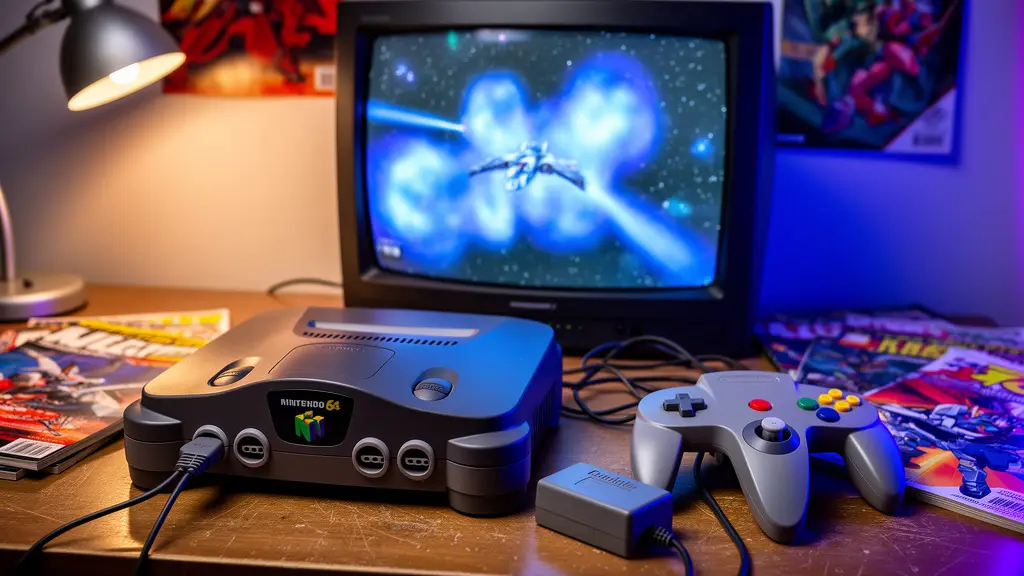
Lylat Wars is one of the games that most clearly represents the Nintendo 64. It is not necessarily the biggest or most groundbreaking game in absolute terms; its strength is how much of the console’s character it brings together: analogue controls, readable 3D action, personality, physical accessories, local multiplayer, arcade immediacy and a flair for spectacle.
It is a huge advance on the first Star Fox. Against many shooters of its era, it stands out for its clarity and economy. It is spectacular without becoming muddled, approachable without feeling simplistic, and short without feeling meagre. Above all, it has a quality shared by Nintendo’s finest games: after only a few minutes, everything feels natural, as though it could never have worked any other way.
Today, Lylat Wars remains an excellent way into the Nintendo 64 library. It takes no hours to get going, needs no complicated explanation and does not depend on nostalgia to succeed. Launch from Corneria, hear the first radio calls, dodge incoming fire, and the danger facing the Lylat system is clear.
Fox, Falco, Peppy and Slippy have never had a more balanced, iconic or immediate adventure. The Nintendo 64 is often remembered through a small group of all-time greats, and Lylat Wars deserves a permanent place among them.
Ratings
• Graphics: 9.0
• Sound: 9.0
• Gameplay: 9.5
• Longevity: 9.0
• Total: 9.5
Star Fox 64 / Lylat Wars shows how brilliantly the Nintendo 64 could turn arcade action into a home spectacle. It is brief if played casually, yet remarkably rich in replay value, alternate routes and score-chasing, and remains an elegant, precise and memorable shooter. The Rumble Pak, voice acting, radio chatter and mission direction give it a strong cinematic identity, while the gameplay retains impressive clarity.
It is more than the ideal sequel to Star Fox: it is one of the most representative cartridges in the Nintendo 64 library.
Source: Retro-Gamers.it