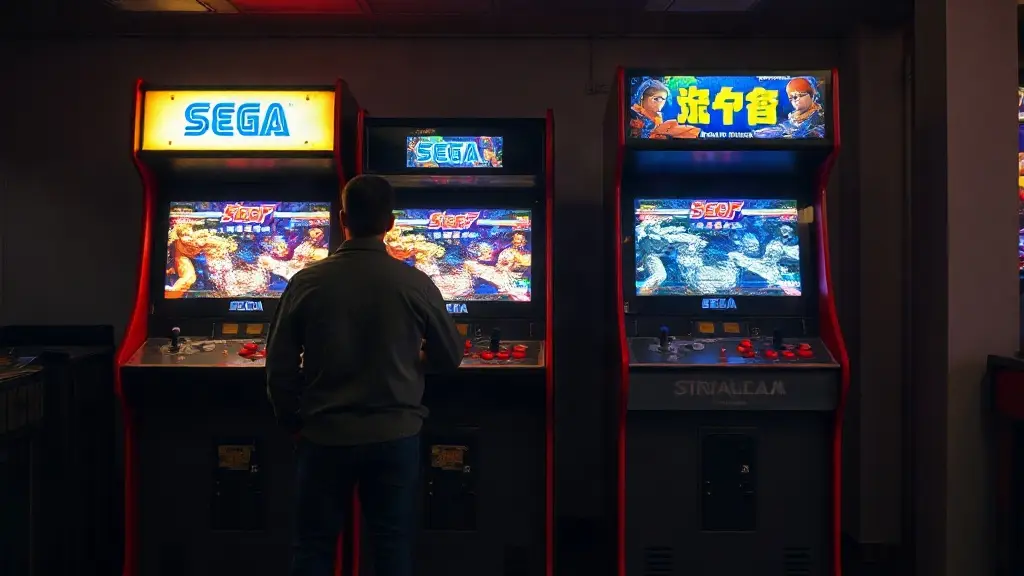
Sega built its reputation with side-scrolling brawlers such as Golden Axe and Streets of Rage. As the company moved into 3D, it also created original arcade fighters including Spikeout—a mechanically demanding beat-’em-up that found a devoted following in Japanese arcades—and its fantasy-themed successor, Slashout.
In Spikeout, players choose one of four fighters and battle the Inferno gang across Dieseltown. Each area requires clearing a set number of enemies before a boss appears; defeating the boss opens the way to the next stage. A map tracks both the layout and enemy positions, useful information when attackers can swarm from any direction.
Stages can branch, and some routes lead to different areas. Each credit gives the player a single life, although enemies sometimes drop health restoratives. The timer keeps ticking throughout the lengthy encounters, adding pressure to an already unforgiving fight.
Spikeout turns the brawler into a 3D crowd-control test
Its combat has quick “beat” attacks and stronger “charge” attacks. Holding the charge button builds more powerful moves, from attacks that briefly stun enemies to blows that send them flying. The charge can also be prepared during other actions, making it useful as a combo finisher, but it expires if held at maximum too long.
Jumping attacks, sweeps and grapples add further options. Pressing attack and jump together triggers a crowd-clearing Super Attack, limited by lightning charges. A fourth button, Shift, locks the character’s facing direction while moving and slightly increases speed—a vital way to create space, since there is no dodge or parry.
• Use charged attacks to interrupt or knock back groups.
• Use Shift to reposition and avoid incoming attacks.
• Pick up weapons including tire irons, basketballs and flamethrowers.
• Link up to four arcade cabinets for multiplayer.
Unlike Dynamite Deka, which used 3D graphics but retained a largely 2D feel, Spikeout gives players full 3D movement and a camera focused on their character. Enemies approach from all directions, so success depends on reading their movement, managing the crowd and juggling opponents for damage—not simply mashing buttons.
In Spikeout, the key is controlling the crowd before it controls you.
Arcade hardware note
Spikeout ran on Sega’s Model 3 arcade hardware. Its character-focused camera and one-player-per-cabinet setup meant that multiplayer required linking separate machines rather than sharing a single cabinet.
Final Edition stretches the challenge
The original arcade release was called Spikeout: Digital Battle Edition. Sega later revised it as Final Edition, adjusting balance and changing boss encounters: bosses gained flashing invincible attacks that players must evade, while their health was reduced slightly.
The revision also added two stages: Spiker’s Camp, a gentler opening, and the optional Shipyard, which can replace Astro Mall. A standard run lasts at least four stages in Final Edition, and secret routing can extend it to five. The long stages make a full playthrough last well over an hour.
Some of the later locations stand out from the otherwise drab urban settings. Astro Mall contains a Sega museum room featuring a huge Sonic statue and artifacts from Space Harrier, Fantasy Zone and Tetris. The final stage moves from a hedge maze to an opera house, then into themed “Hell” and “Heaven” rooms.
Produced by Toshihiro Nagoshi, Spikeout also points toward later Sega action games. Nagoshi’s team carried its brawling ideas into the Yakuza series, while the fighting engine was reused for battle sections in the Dreamcast version of Rent-A-Hero No. 1. Final Edition eventually reached home audiences as part of Like a Dragon: Infinite Wealth in 2024. The 2005 Xbox game Spikeout: Battle Street, despite presenting itself as a sequel, is more accurately an expanded remake.
Slashout trades fists for fantasy weapons
Released for Sega’s Naomi arcade hardware in 2000, Slashout follows a similar structure but shifts the action to swords, axes, daggers and magic. Its four heroes are Slash, an all-round sword user; Axle, who wields an axe; Luna, a dagger fighter; and Kamui, a ninja.
Players clear each arena to summon Gatekeepers, then defeat the level boss and break through the exit gate. Routes are shorter than in Spikeout, though alternate stages require meeting time limits. A standard run has six stages; finding hidden areas can bring the total to eight—and another hour-plus of fighting.
The weapons make attacks faster and give them slightly more reach, but the basic three-hit combo does not reliably knock enemies back. Charged moves use elemental magic, while jumping attacks and Super Attacks help keep groups at bay. A special berserk mode is triggered by rotating the control 270 degrees and pressing the two attack buttons plus jump.
• Collect dropped gems to level up, restore health and improve abilities.
• Hold orbs to boost strength, magic, defense or speed.
• Explore arenas for breakable objects that may reveal power-ups.
• Use Shift to avoid being surrounded by fast, aggressive enemies.
The grappling system is gone, and the new magic does not erase the series’ central problem: enemies remain relentless. Slashout adds larger mythical bosses, including a two-headed lion, a genie and a dragon, with weak points highlighted on screen. Some weak points are difficult to reach, and Gatekeepers’ invincible attacks can be especially hard to dodge.
Slashout has the speed and style of a standout arcade brawler, but its relentless enemies make every mistake costly.
From Naomi arcade to a later home appearance
Naomi shared much of its technology with the Dreamcast, making a home conversion seem plausible, but Slashout never arrived on the console. Its camera and demanding combat would likely have needed adjustment for a home audience. The game finally appeared outside arcades in Yakuza Kiwami 3 in 2026, as an arcade game within the larger title.
Visually, Slashout is a striking showcase for Naomi, moving from a cathedral exterior to a spooky castle and machinery-filled stages. Composer Hidenori Shoji’s upbeat rock and electronic soundtrack adds momentum. The fast, responsive fighting is compelling—when the surrounding enemies give players room to enjoy it.
Source: Hardcore Gaming 101