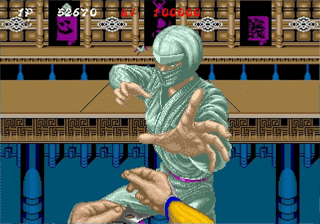
Genre: Action Developer: Sega R&D 1 Publisher: Sega Ent. Players: 1–2 Released: 1987
Ninjas were everywhere in 1980s pop culture, and arcades were no exception. Sega entered the crowded field with Shinobi, a game that makes an immediate impression: the action is quick and satisfying, but its punishing difficulty can turn every continue into a hard-won lesson.
Conceived by Yutaka Sugano after his work on the arcade version of Alex Kidd: The Lost Stars, Shinobi stands apart from brighter Sega contemporaries such as Action Fighter and Fantasy Zone. Its mood is darker, its combat direct. Despite the ninja theme, there’s little stealth involved. The rule is simple: take down everything that moves.
Shinobi is fast, forceful arcade action—and beating it takes practice, not luck.
Joe Musashi’s mission
Players control ninja master Joe Musashi, fighting through a terrorist network called Zeed to rescue kidnapped children. The game spans five missions, with stages set against backdrops ranging from city streets to enemy hideouts. Each mission ends with a boss encounter, and the opposition escalates from heavily armored fighters to helicopters unleashing waves of enemy ninjas.
Survival depends on learning enemy patterns and building muscle memory. Even the first boss can drain a stack of quarters, making victory feel earned in the same way it does in other famously demanding arcade games.
Ninjutsu and a little extra firepower
Musashi’s basic arsenal includes punches, kicks and shurikens, but a third button unleashes ninjutsu. These screen-clearing spells can also deal substantial damage to bosses, and each is available once per stage:
• Doppelganger clones
• Lightning bolts
• Tornado whirlwinds
Saving the spell earns a stage-completion bonus, but using it can be the difference between pressing on and getting overwhelmed. A POW icon provides another boost, upgrading shurikens to a gun and Musashi’s martial arts to a katana.
Vertical stages, sharp challenge
One of the game’s notable mechanics is its vertical movement. Musashi can leap to areas above and below, a useful skill when searching for hostages and power-ups. Some stages require backtracking to find a hostage before the exit becomes available.
Between missions, first-person bonus rounds ask players to hit advancing ninjas with shurikens and award an extra life for success. They offer a change of perspective, but the approaching enemies make these brief interludes tense rather than restful.
A darker look and memorable sound
Shinobi uses earthier colors and more restrained scenery than many Sega arcade games of the period. Its static backgrounds lack the parallax scrolling some players might expect, though the level design helps keep the stages engaging. A soundtrack with Eastern-inspired motifs, along with expressive sound effects and voice samples, strengthens the game’s martial-arts atmosphere.
The visuals have aged less gracefully than the combat, but the tight stage design and vivid audio still give Shinobi its character.
From conversion kit to Sega staple
The original arcade release was distributed as a conversion kit, a cheaper and easier-to-install alternative to a dedicated cabinet. Sega had already seen strong sales with its Choplifter kit; the accessible format helped Shinobi reach arcades around the world. Sega claimed it was the best-selling kit since Universal’s 1982 hit Mr. Do!.
Hardware note: Sega System 16A
The arcade game ran on Sega’s System 16A board. Its conversion-kit release meant operators could adapt existing cabinets rather than install a complete new machine—a practical approach that helped popular games spread through arcades.
The Master System version and final verdict
The Master System adaptation introduced a health meter, giving players more room to survive than in the arcade version’s often unforgiving encounters. Directed by Katsuhiro Hasegawa, it likely helped shape ideas used in the later Genesis sequel, The Revenge of Shinobi. The adaptation remains difficult, though, and cheat codes can still be tempting.
Shinobi remains a bracing example of classic Sega coin-op action. Its combat, stage design and ninjutsu are a potent combination, even if the static scenery shows its age. Joe Musashi’s first arcade outing launched a lasting series—and still feels great when a well-timed spell clears the screen.
Score: 9 out of 10
Source: Sega-16