Before football games chased television realism, Sensible World of Soccer made its case with a pitch seen from above, tiny players and a ball that never quite stayed where you expected. It was not trying to reproduce a broadcast. It captured the rhythm, instinct and geometry of football—and made every mistake feel like your own.
Released in 1994, the game took the fast, one-button foundation of 1992’s Sensible Soccer and expanded it into a whole football universe. Leagues, cups, national teams, clubs, transfers and player-manager careers gave each match a larger purpose, while the action remained immediate.
SWOS adds depth without losing arcade speed. It is a very rare balance.
Easy to start, difficult to master
Sensible World of Soccer’s controls are spare: move in eight directions, pass, shoot, tackle and put spin on the ball. But the ball is not glued to a player’s feet. Every touch needs to be guided, and a shot depends on angle, timing, momentum and body position. A small change in approach can turn an attempt into a low drive, a chip or a curling finish.
The top-down camera is a design choice, not a compromise. It makes space, passing lanes and player movement easy to read. Rather than using visual spectacle to draw you into a match, SWOS does it through control: you learn the timing, develop reflexes and take responsibility when a pass or shot goes wrong.
From Sensible Soccer to SWOS
The original Sensible Soccer distilled football into fast matches and sharp arcade play. SWOS preserved that formula but wrapped it in a larger structure, turning a quick game into a season, a career and, often, a personal story.
That difference shapes the choice between them:
• Sensible Soccer: concise, immediate matches suited to a quick tournament.
• Sensible World of Soccer: the same brisk football, expanded with careers, transfers and competitions.
A world packed onto a floppy disk
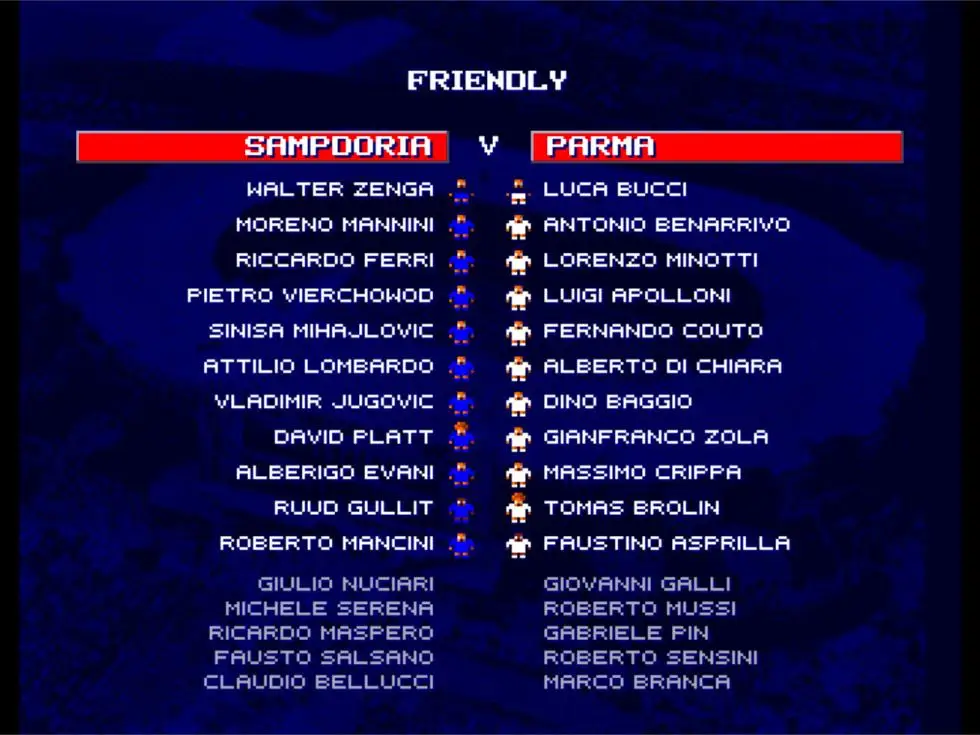
The “World” in the title was no empty flourish. The game brought together teams, nations and competitions on a remarkable scale. Historical sources commonly cite around 1,500 teams and 27,000 players—an extraordinary amount of football for a compact game.
SWOS is not a management simulator in disguise. You can take a modest club, play its matches yourself, enter the transfer market and build a campaign over multiple seasons. The database gives the arcade action somewhere to go: a wider, branching football world in which promotion, relegation and squad choices matter.
Where FIFA was beginning to pursue licensed teams and the look of televised football, SWOS went the other way. It stripped away the presentation and gave the player direct control. Its graphics are abstract, but its match rhythm feels alive: you quickly sense whether a striker has the right touch or a midfield can withstand pressure.
Why the Amiga version stands out
This review focuses on Amiga, where the relationship between graphics, speed, joystick response and screen clarity feels especially natural. The pitch is a tactical map, the players are moving icons and the goals become emotional magnets. Dry sound effects and unobtrusive music leave room for the action.
On Amiga, every successful shot feels earned through a learned gesture. A mistimed button press or misplaced spin can cost you, and the game rarely seems unfair. That combination of readable play and unforgiving control is a major part of its appeal.
A brief musical cue
Before kick-off, SWOS set its tone with “Goal Scoring Superstar Hero,” written by Jon Hare and Richard Joseph and performed by Jackie Read. The song’s exaggerated, immediate energy fits a game built around quick decisions and memorable moments.
Different editions, different feel
For many fans, Sensible World of Soccer 96/97 is the definitive edition. It updated squads and the database, bringing the formula to a mature, polished point. The 1992 Sensible Soccer remains a classic in its own right, but SWOS offers the longer arc of a season and career.
PC editions and later conversions brought the game to other platforms, but the feel could change with the controller, speed and response. Because SWOS depends so heavily on control, even a small difference can alter the match. The Amiga version retains a particular naturalness that suits its design.
It does not ask you to watch a match. It asks you to understand it.
A classic that is still being played
SWOS has outlasted its original era through tournaments, online matches, leagues and seasonal updates. In 2026, a community-made SWOS 25/26 update for Amiga was published, initially as a WHDLoad version, curated by Playaveli and collaborators. The community’s work keeps squads and competitions current for players using real or emulated Amiga hardware.
That continuity is unusual for a sports game from the 1990s. Rather than being replaced by the next annual entry, SWOS has remained a platform for new seasons and community play. Its appeal is not simply nostalgia: the underlying idea still works.
Final verdict
Sensible World of Soccer is football reduced to its purest form and expanded into an entire universe. On Amiga, its blend of immediacy, depth and speed reaches an ideal balance. The game can be cruel when a mistake costs you, and exhilarating when every touch falls into place.
Final score: 9.5/10. Graphics: 8.5/10. Sound: 8.0/10. Gameplay: 10/10. Longevity: 10/10.
An absolute classic: not just remembered, but still alive.
Rating breakdown
• Graphics: 8.5/10
• Sound: 8.0/10
• Gameplay: 10/10
• Longevity: 10/10
• Total: 9.5/10
Source: Retro-Gamers.it