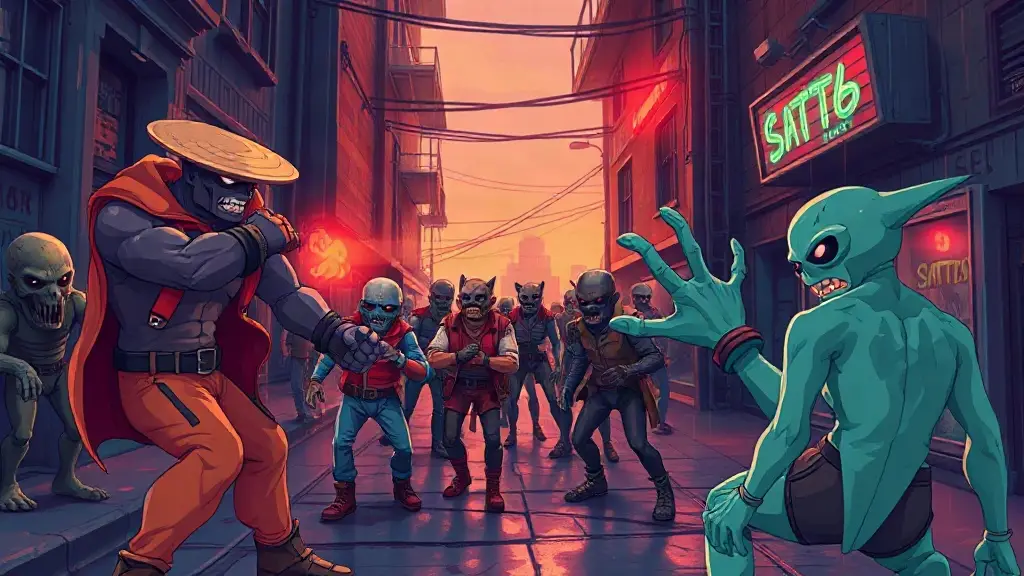
With series such as Streets of Rage and Double Dragon enjoying multiple 21st-century revivals, a return for Rushing Beat felt like a natural next step. Japanese publisher City Connection owns Jaleco’s properties and has kept them in circulation, making this fourth entry a matter of time. Rushing Beat X is an interquel set between Brawl Brothers and The Peace Keepers. Its “Return of Brawl Brothers” subtitle also tries to bring American and Japanese naming conventions together, though the wording still feels silly when two of the team members are women.
The story introduces Kahlua, a tanned, blonde teenage girl who has lost her memory and starts training at Rick Norton’s gym. Her opponent is Edgar Dieter, brother of Brawl Brothers villain Iceman. Edgar puts his scientific genius to work building an army of zombies, clones, and other mutations, all in a bid to take over Neo-Cisco.
Building a team and a combo game
Kahlua, Rick, and Bild are available from the start. The remaining fighters become playable over the first few levels, among them Lord J, Wendy, and Kazan. Four difficulty settings are available, with Shura—the expert option—offering the toughest test. Free Play strips away the story and instead sets challenges to complete in each area.
Combat takes the Final Fight-inspired foundations of the 16-bit games and pushes them toward speed and combo play. Fighters have several standard strings, along with heavier moves such as uppercuts. The juggling and combo mechanics are remarkably adaptable: jump or dash to cancel out of an attack, then keep a long sequence going. The six main characters cover a satisfying range from “strong but slow” to “fast but weak,” though even the heavier fighters move with a pleasing snap.
Cancel attacks with a jump or dash, and the flexible combo system lets you keep the hits coming.
One particularly striking move sends an enemy airborne before driving them headfirst into the floor. They end up sticking straight up like a plank, leaving room for a few more hits.
A Rage Gauge fills as you take damage. Spend a third of it on a Beat Blow to knock enemies back; it does little damage, in a fashion reminiscent of the Guilty Gear games. Once the gauge fills, Rage Burst activates automatically and boosts your strength. While Rage Burst is running, you can also unleash Rush Finish, your character’s most powerful super combo.
Weapons, food, and a colorful presentation
Weapons fall into two categories. Big finds such as steel beams and flamethrowers replace your regular attacks and vanish after a handful of uses, much like weapons in other beat-’em-ups. Smaller items—including tire irons and grenades—go into your inventory, so you can pull them out whenever you like, but their uses are limited too.
Food has its own unusual system. Most food pickups are stored for later use, but a food truck appears regularly, letting you turn those items into ingredients for combo meals and cut their prices dramatically. Weapons are also for sale there. Cash is hard to come by, however, so spending it on food is usually the better choice.
Instead of the SNES games’ 2D look, Rushing Beat X uses cartoon-shaded 3D models, with a style reminiscent of Marvel vs. Capcom 3. The shadows can be a little heavy-handed, but the approach suits a game that clearly wasn’t made with a large budget. WASi303 composed the guitar-led soundtrack, although it rarely leaves much of an impression.
Jaleco callbacks and comic detours
The game treats its lore earnestly. Comic-book-style scenes between stages spell out Dieter’s schemes and include small snapshots from the SNES games to refresh your memory about past events. The plot itself is as generic as beat-’em-up stories come: fight through several parts of a city, then break into a secret base. You can skip the scenes, and it is difficult to imagine many players are deeply invested in Brawl Brothers continuity.
Fortunately, the humor is more memorable. During a park concert, zombies break into a dance lifted from Michael Jackson’s “Thriller,” and characters even comment on its questionable legality. The food truck also becomes a recurring gag, thanks to the absurd ways it manages to meet you halfway through a level for item refills.
Jaleco references are everywhere. An evil pharmaceutical company is called Jecoal—an anagram of Jaleco—and there are nods to Ninja Jajamaru-kun. The truck bears the name “Tough Enough,” the correct spelling of the SNES fighting game Tuff E Nuff, while Rival Turf appears as graffiti. The game even invokes 64th Street, folding Jaleco’s arcade brawler into the Rushing Beat family tree.
Strong fighting, stretched stages
The brawling is solid, but Rushing Beat X runs long: a complete playthrough takes around two hours. Length alone would not be a problem, especially since progress saves between levels. The bigger issue is that all nine stages are lengthy, with areas repeated well past the point where they have worn out their welcome. Enemies are recycled frequently, the roster of enemy types is small, and boss variety is sorely lacking.
Edgar’s experiments do at least provide an excuse to fight assorted “zombie” and “dark” versions of characters, including members of the Rushing Beat team. Julia, Edgar’s personal maid and a killing machine, also returns as a regular opponent. She and Kahlua are the game’s coolest new characters. Julia becomes playable after you finish the game, but only in her battle-swimsuit look, rather than her more distinctive maid outfit.
You have just one life, but unlimited credits, a setup that rather undercuts the food system. A one-credit clear is possible, though attempting it over a two-hour run can become exasperating. Streets of Rage 4 handled this problem better: it restored lives at the start of each stage but made you restart that level if you ran out, maintaining tension without unlimited credits. It is disappointing that City Connection did not use a similar solution here.
Enemy behavior swings between two extremes. Literal, mindless zombies wander aimlessly and serve mostly as fodder; tougher foes, by contrast, can lock you in place with stun attacks and strip away half your life meter with ease.
A very good brawler—and a clear step up from its 16-bit predecessors—but one that still cannot quite escape its “second tier Final Fight clone” reputation.
Even so, Rushing Beat X is a decent revival and comfortably outdoes its 16-bit predecessors. Its mechanics and graphics also come out ahead of Double Dragon Revive, another retro beat-’em-up revival released a few months earlier. The old “second tier Final Fight clone” label still clings to the series despite its best efforts, but Rushing Beat X is very good at being the kind of game it is.
Source: Hardcore Gaming 101