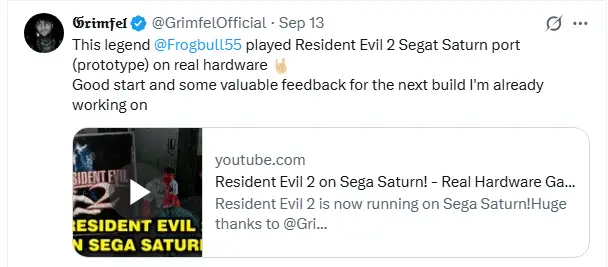
Developer Grimfel has shared a major update to an in-progress project rebuilding Resident Evil 2 for the Sega Saturn. The game was running on real Saturn hardware within days of its announcement, and prototype v1.1 now incorporates community feedback and a range of technical changes.
This is not a native conversion of the original game’s source code. Grimfel says assets were extracted from the commercial game and manually integrated into a new build using JoEngine. AI tools were used for data extraction and debugging, but not to generate assets from scratch.
A fast-moving work in progress
The project moved quickly from its September 7 announcement to testing on real hardware by September 13. Early milestones included getting basic game data and logic running, then adding cinematics, audio, collision, player systems and level progression.
After feedback from Saturn developers, Grimfel made further changes for v1.1. The update includes rendering and animation optimizations, revised memory handling, and expanded support for game content and interactions.
• Rendering and animation optimizations.
• Smarter shadow caching to reduce repeated memory reads.
• Camera loading and RPD cutscene improvements.
• More room music and revised dialogue streaming.
• Changes to door animations and movie playback.
• Weapon reactions to walls and additional gameplay work.
• Optional 4 MB expansion support and menu memory fixes.
“There’s progress here, but please expect an unfinished, messy prototype.”
The developer warns that crowded scenes can slow down, audio and movies may glitch, and interactions or progression can break. Reliable playback and consistent 30 frames per second across Saturn hardware, optical-disc emulators and Saroo remain goals, not guarantees.
A Saturn sequel that never was
Capcom’s first Resident Evil did receive a Saturn version, developed by NexTech. The studio also planned a Saturn release of the sequel, reportedly intending to use the console’s 4 MB RAM expansion, but abandoned the effort in 1998 as Capcom shifted its attention to Code Veronica for Dreamcast.
Grimfel’s project takes a different route: it uses extracted assets from the released game to create a new Saturn build in another engine. The source article describes the current v1.1 build as a prototype available for download, not a finished release.
Brief technical note
The optional 4 MB RAM expansion adds memory beyond the Saturn’s base configuration. It was used by some games and could help with the demands of a project like this, but the prototype’s support remains optional and does not mean performance is fully solved.
AI tools and the homebrew debate
The project has also prompted debate about using AI in retro development. Critics argue that relying on AI-assisted code may produce inefficient results and take away from the painstaking hardware-specific work associated with Saturn homebrew. Supporters see tools for extraction and debugging as a way to lower barriers for independent developers.
Whatever view fans take on that discussion, the build is still experimental. Its progress is notable, but it should be approached as an unfinished prototype with substantial technical limitations.
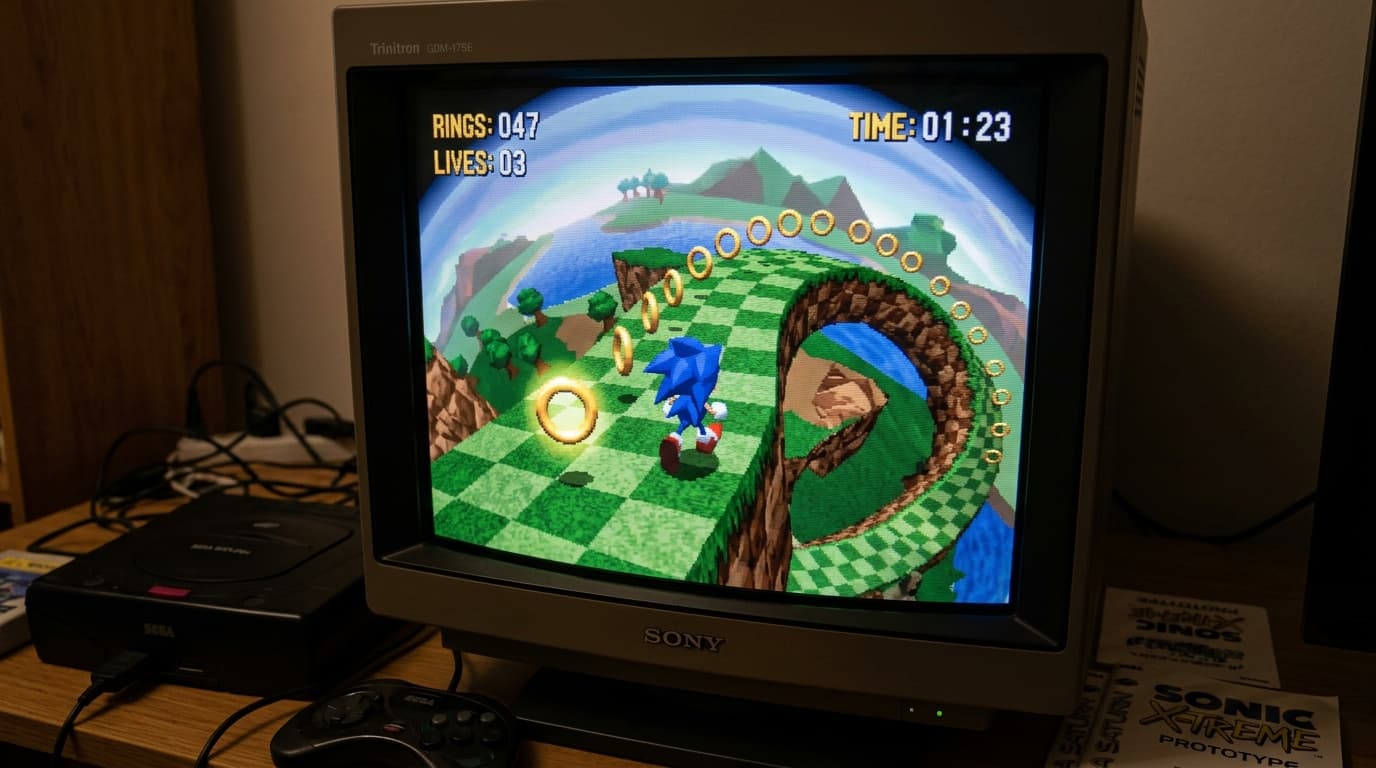
Gameplay demonstration: v1.1 running on real Saturn hardware via Saroo and a CRT.
Source: SEGA SATURN, SHIRO!