In 1996, Sega Saturn was struggling to define itself beside the PlayStation. Sonic Team answered not with a conventional platformer or a bid for cinematic realism, but with NiGHTS into Dreams…: a bright, musical game built around flight, movement and the pursuit of a better score.
Its premise is simple and fairy-tale-like. Children Claris Sinclair and Elliot Edwards enter Nightopia in their dreams, where they meet NiGHTS, a theatrical flying being who rebels against the evil Wizeman. The story gives the game an emotional undertone without interrupting its focus on play.
NiGHTS does not try to beat the PlayStation at its own game. It makes flight, colour and scoring its own language.
Learning to fly
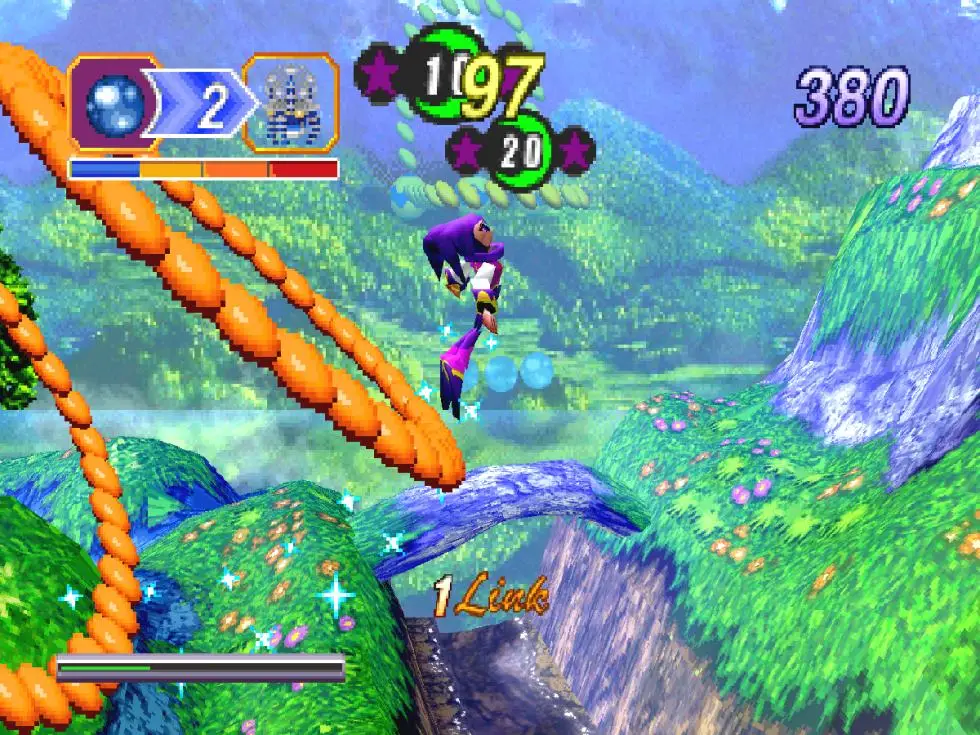
Each stage begins with Claris or Elliot on foot. The central experience starts when they merge with NiGHTS and take to the air, following three-dimensional courses shaped around a constrained path. The control scheme feels unusual at first, then quickly becomes intuitive.
NiGHTS loops through rings, gathers spheres and chains manoeuvres together. A signature move, the paraloop, draws a circle through the air to capture whatever falls inside it. The immediate objective is to recover stolen Ideya and return before time runs out, but completing a course is only the beginning.
The deeper appeal lies in score attack. Every route invites another attempt: find a cleaner line, string together more pickups or keep the flight going at just the right moment. The game rewards elegance as much as speed, and its compact stages gain depth through repetition.
A Saturn game with its own identity
NiGHTS is one of the Saturn’s most distinctive technical showcases—not because it pushes the most complex geometry, but because Sonic Team gives the hardware a vivid, coherent style. The dream worlds are full of curves, suspended scenery and bold colours. Some geometry is simple, and the visuals cannot match the polish of later 3D games, but the art direction makes those limitations feel secondary.
Stages such as Spring Valley, Splash Garden, Mystic Forest and Soft Museum each have their own rhythm and palette. Flight makes them feel less like backdrops than paths to be performed. NiGHTS itself is an equally memorable creation: an androgynous, light-footed figure designed to move rather than fit a familiar hero mould.
Hardware note: The Saturn 3D Control Pad launched alongside NiGHTS into Dreams…. Its analog stick makes steering, curves and trajectory adjustments feel more fluid than with the standard controller, strengthening the game’s central sensation of drawing lines through space.
Music in motion
The soundtrack is among the game’s strongest elements. Airy melodies and gentle rhythms define the mood of each level, while sound effects give collecting and chaining actions an immediate, almost musical pulse. The signature song Dreams Dreams captures the game’s warmth and wistful optimism.
There is a trade-off: this is a short game, with a compact set of stages rather than a sprawling adventure. Players seeking long levels, conventional jumping challenges and a linear campaign may find its structure elusive. But its grades, scores, alternate routes and demand for mastery give repeat sessions a clear purpose.
Verdict: a dream worth revisiting
NiGHTS into Dreams… remains one of the Sega Saturn’s most representative and singular games. It is arcade-minded in structure, experimental in control, colourful in presentation and guided by music rather than realism. Sonic Team turns the dream itself into a mechanic, creating a game that grows more rewarding as its flight system clicks.
Strange, luminous and unlike anything else, NiGHTS into Dreams… is a 9.0-rated Sega experience that still feels unmistakably its own.
Ratings
• Graphics: 9.0
• Sound: 9.5
• Gameplay: 9.0
• Longevity: 8.5
• Total: 9.0
Source: Retro-Gamers.it