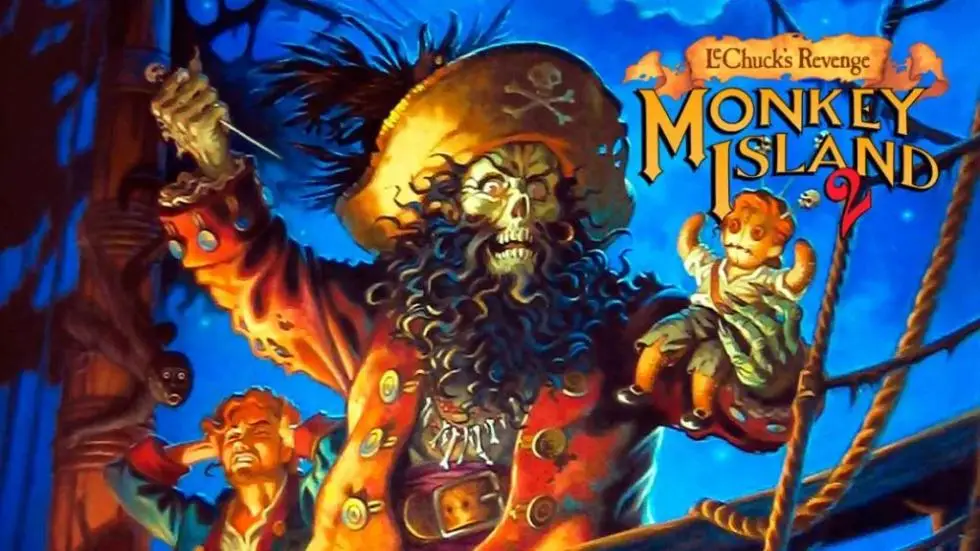
Guybrush Threepwood is dangling above a huge pit when Elaine Marley arrives to rescue him. Before she helps, she wants to hear how he got into trouble this time. It is a fitting opening for Monkey Island 2: LeChuck’s Revenge, a sequel that somehow improves on a first game already close to perfect.
After a brief, charming introduction, Guybrush recounts his supposed victory over ghost pirate LeChuck to two pirates around a campfire. He then heads to Scabb Island, where the bad-tempered Largo LaGrande has imposed an embargo. Largo robs Guybrush of everything he owns—and, after Guybrush foolishly shows him LeChuck’s living beard, uses it in a voodoo ritual to bring the pirate back.
Guybrush’s goal is to find the legendary treasure of Big Whoop. His confidence and naïveté, meanwhile, keep turning the search into a string of disasters. The premise gives the game room to mix absurd situations with mystery and, beneath the jokes, a touch of melancholy.
A world built to stay with you
Scabb Island and the other locations are packed with character. Returning figures such as the Voodoo Lady and Stan share the stage with newcomers including the unfortunate Wally, Captain Dread and Phatt Island’s thoroughly unpleasant librarian. The writing is sharp, the cast is unforgettable, and the pirate atmosphere comes through in every corner.
The puzzles are a major part of the appeal: brilliantly comic, often absurd, but usually grounded in their own peculiar logic. A few demand patience and a mindset shaped by early-1990s adventures, yet the detours and discoveries make the world feel richer rather than merely larger.
More ambitious, richer and more unpredictable than the first game, Monkey Island 2 remains one of the finest point-and-click adventures ever made.
Versions and technical trade-offs
The 256-colour VGA version is a delight to look at, while the Amiga conversion makes an impressive showing despite its 32 colours on screen. Some background animation and parallax effects did not survive the conversion, and the Amiga’s loading times and general slowness can disrupt the pace—particularly without a hard disk. An Amiga 1200 makes the experience noticeably smoother.
Sound offers another point of comparison. The Amiga has plenty of character, but the MS-DOS version’s iMUSE system gives locations their own musical accompaniment and adds sound effects absent from the Commodore version. For the fullest experience, MS-DOS is the clear choice; Amiga players should be prepared for disk swapping and compromises.
A brief technical note: iMUSE
LucasArts’ iMUSE system coordinated music with the action, allowing cues to shift as players moved between places and events. In Monkey Island 2, that approach helps make the score feel closely tied to the adventure’s locations.
A defining chapter in the series
Ron Gilbert’s departure from LucasArts marked a turning point for Monkey Island. Later entries had their supporters, including Telltale’s Tales of Monkey Island, but this review judges the subsequent sequels a step back in story and atmosphere—especially the fourth game. The first two adventures remain the essential heart of the series.
Final verdict: 10/10. Graphics: 10/10. Sound: 10/10. Gameplay: 10/10. Longevity: 9/10. Monkey Island 2 is LucasArts at its most creatively confident: a masterpiece of comic writing, memorable puzzles and richly imagined adventure that is still difficult to surpass.
• Pros: Some of the best comic writing in graphic adventures; brilliant, absurd but usually logical puzzles; an irresistible pirate atmosphere.
• Cons: Heavy loading and disk swapping on Amiga without a hard disk; some lost animations and details compared with MS-DOS; puzzles that can demand patience.
Source: Retro-Gamers.it