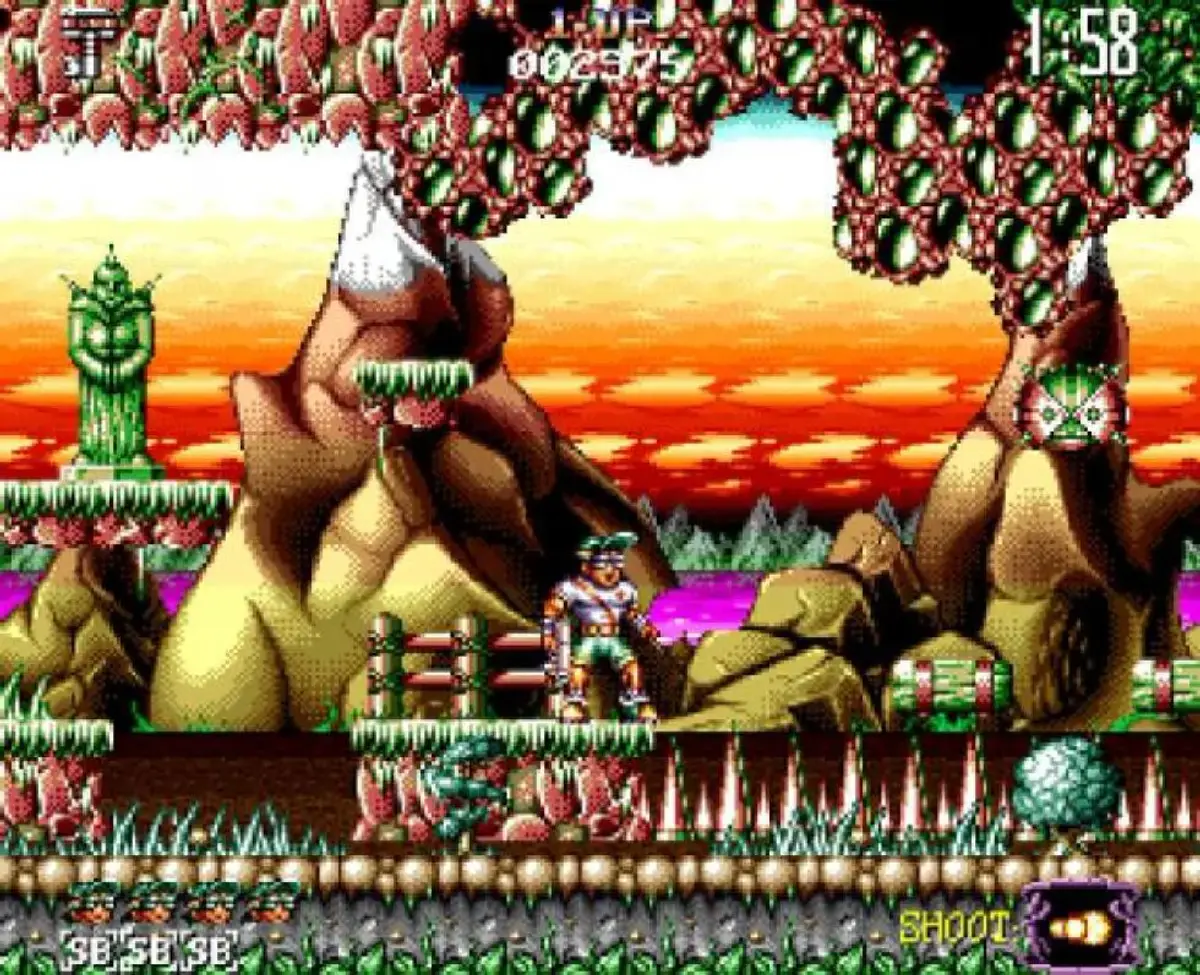
Some Amiga games seem determined to prove what the machine can do. Jim Power in Mutant Planet is one of them: a 1992 release from publisher Loriciel and developer Digital Concept that meets the rising visual ambitions of the Mega Drive and Super Nintendo with vivid colours, layered scrolling and relentless action.
Its ambition is clear, but so are its rough edges. The game is harsh and frequently punishing, yet its graphics, movement and music make an impression almost immediately. Jim Power is less a polished showcase than a memorable one: spectacular, demanding and unmistakably European in character.
A hybrid built for impact
Calling Jim Power simply a platformer misses much of its shape. The game moves between side-scrolling action, top-down sections and horizontal shoot ’em up passages, switching perspective as it sends its hero across a hostile alien world. The story is little more than a pretext for fighting mutants, dodging traps and pushing forward.
That variety keeps the game restless, though not always cohesive. Some sequences land better than others, and the constant changes in style can feel like a bid to do everything at once. When its ideas click, the result is striking; when tight level design and unforgiving hazards take over, frustration arrives fast.
An Amiga game with visual muscle
The Amiga version has a distinctive identity. Bright colours, detailed backgrounds, a clearly defined hero and sustained parallax give the action a console-like look. Yet the experience remains rougher and more technically showy than the clean, immediately readable platformers it seems to glance toward.
Its busy screens are both a strength and a weakness. Parallax adds depth and motion, but backgrounds can compete with platforms and threats for the player’s attention. Even so, the visual ambition is hard to miss: Jim Power wants every screen to feel full, alive and in motion.
More fascinating than balanced, Jim Power is an imperfect classic that captures the Amiga’s appetite for spectacle.
That personality sets it apart. It does not match the balance of a Nintendo classic or the instinctive precision of a great SEGA title. Instead, it offers a muscular, showy take on console-style action through an unmistakably European lens.
Chris Hülsbeck turns up the volume
The soundtrack by Chris Hülsbeck is one of the game’s defining strengths. Powerful melodies and full arrangements give each level a larger-than-life feel, sustaining momentum when the gameplay gets rough. Hülsbeck’s signature is familiar from Turrican, but Jim Power shows how effectively he could give another game its own musical identity.
Here, the music does more than accompany the action: it amplifies it. Against punishing sections and uneven pacing, the score keeps pushing forward, adding a heroic scale that makes the world feel bigger than the action on screen.
A note on the soundtrack
Chris Hülsbeck is best known for his work on Turrican. In Jim Power, his music again turns sprites, tiles and scrolling into something grander, helping an imperfect game leave a lasting impression.
Demanding play, uneven rewards
Jim Power’s main limitation is its difficulty. The controls respond reasonably well, but the game offers little room for error. Enemy and obstacle placement can be merciless, and success often depends on remembering a level as much as reacting to it.
Once players learn the patterns and accept the game’s severity, getting through a difficult stretch can be satisfying. But Jim Power is not accommodating: it expects patience, repetition and a tolerance for sections that feel more punitive than carefully balanced.
Other versions, different directions
Jim Power later appeared as Jim Power: The Lost Dimension in 3-D on Super Nintendo and MS-DOS, taking a different visual direction. The SNES release used the Pulfrich effect, a technique intended to create a three-dimensional impression with special glasses.
A Mega Drive / Genesis version was developed but not released at the time, later becoming a recovered piece of the game’s history. These versions explored visual depth in different ways, while the 1992 Amiga original made its impact through colour, scrolling, rhythm and music.
Verdict: a rough-edged classic
Jim Power in Mutant Planet is not a model of balance, clarity or precision. Its difficulty is severe, the screen can be hard to read, and its different gameplay sections do not all work equally well. But its audiovisual ambition remains compelling, and Hülsbeck’s soundtrack is a major part of its enduring appeal.
For players seeking the fairest or most refined Amiga platformer, this is a difficult recommendation. For anyone curious about how the Amiga pursued console-style spectacle without losing its own character, Jim Power is a vivid example: an imperfect classic that is hard to forget.
Review score
• Graphics: 9.0
• Sound: 9.5
• Gameplay: 7.5
• Longevity: 7.0
• Total: 8.0
What works and what doesn’t
• Pros: Striking audiovisual impact on Amiga; ambitious parallax, colour and movement; powerful Chris Hülsbeck soundtrack.
• Cons: High, often punishing difficulty; sometimes unclear action amid rich backgrounds; uneven sections.
Source: Retro-Gamers.it