By the mid-2010s, games such as Puppet Combo’s Babysitter Bloodbath and Back In 1995 had brought the low-polygon look of PlayStation- and Sega Saturn-era survival horror back into fashion. CRT filters and scanlines completed the nostalgic package. For some players, the appeal was clear: staying up late with a 32-bit console, bracing for jump scares and hunting down a strangely shaped key to open the next door. This return to basics also spoke to fans who preferred the original Resident Evil games’ fundamentals to the series’ more recent action-movie direction.
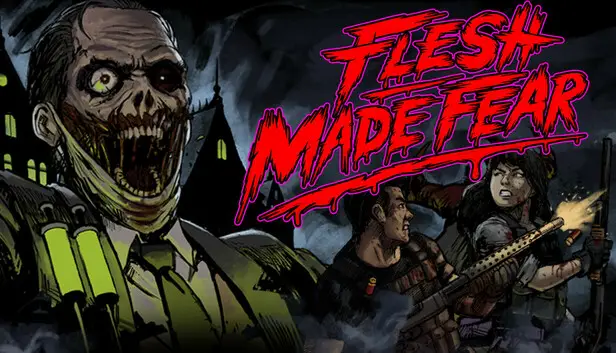
Tainted Pact Games released Flesh Made Fear on Steam on Halloween 2025. The independent studio is led by Michael Cosio, who is also credited with much of the game’s creation. Its work so far has focused entirely on retro horror and low-polygon aesthetics. Apart from the 2D, 16-bit-styled Terror At Oakheart, the studio has favored first-person games made in Unreal Engine. For Flesh Made Fear, the influence of Resident Evil prompted a move to third-person play and the fixed camera angles associated with the series’ earlier entries.
Familiar faces in the town of Rotwood
Players pick one of two agents from Reaper Intervention Platoon (R.I.P.), a special task force sent to eliminate Victor “The Dripper” Ripper. A former CIA agent, Ripper has turned the small town of Rotwood into a setting for his twisted experiments. His mad-scientist manner and fondness for neon-green injectables evoke Herbert West from the Re-Animator films.
The playable agents, Jack Richards and Natalie Lewis, are clear counterparts to Chris and Jill from Resident Evil. Their alternate outfits come remarkably close to the originals, while differences in health and inventory capacity underline the homage. The developers aren’t hiding the inspiration; they’re leaning into it. Ripper even makes a joke about the resemblance in his introductory speech in the post-game trophy area. Other R.I.P. squad members also look and function much like S.T.A.R.S. personnel. Depending on whether you play as Jack or Natalie, you’ll be joined by a companion who fills a role similar to Rebecca Chambers or Carlos Oliveira.
Other hallmarks of Resident Evil-style horror are everywhere. Journal entries and notes build the backstory and give more depth to the victims of Ripper’s creations. They also provide combinations for nearby lockers and other useful clues. Safe rooms let you save and reach your item boxes, while crafting materials can produce ammunition for your pistol, shotgun, assault rifle or grenade launcher. The launcher has just one type of round.
Tank controls, fixed cameras and pure terror are the promise—but Flesh Made Fear makes its old-school framework surprisingly welcoming.
Monsters, oddities and varied streets
That arsenal can take on a roster of familiar enemy types—or its ammunition can be saved for the bosses. Rotwood’s streets crawl with slow zombies that pose little danger, alongside faster, low-crawling creatures reminiscent of the Resident Evil series’ Lickers and zombies that burst into poisonous gas. A school patrolled by zombie children is especially unsettling. A teacher’s note explaining that she still thought of them as her students makes the scene more tragic.
Outside a few encounters, basic zombies rarely justify spending ammunition and can often be lured out of the way. At one point, you can draw them away from a door and into an actual corral, like the leader of an undead conga line. Both characters’ default knives are useful, too: they can shove enemies back or chip away at bosses after they’ve been stunned.
Flesh Made Fear is more than another corpse brought back to life. It uses familiar survival-horror conventions to help players settle in, then adds its own turns. Instead of beginning in a Spencer Mansion stand-in, the R.I.P. agents travel through Rotwood’s outskirts and central streets before confronting the Dripper at his large estate. The locations are varied enough to feel like distinct spaces within a much larger world, rather than one repetitive complex.
Video stores, movie theaters, trailer parks, gas stations and sewers keep the journey moving through different environments. Jack and Natalie also each get a location of their own: a radio station for one and a butcher shop for the other.
Keys, clues and a generous control scheme
Healing doesn’t involve herbs. Bandages handle minor injuries, while blood bags restore full health without requiring any combination. Contorted-face trees offer a mini-game for players willing to reach inside and pull out what’s hidden there. The reward is usually a journal entry, so missing it won’t seriously hinder anyone who would rather not investigate.
A later sequence raises the stakes as you try to free two captured squad members. An eyeless orb is waiting to tear off your arm if you fail. The soundtrack, meanwhile, is a standout: its original dark-synth tracks should appeal to modern horror fans steeped in John Carpenter, as well as anyone who remembers VHS slashers fondly.
Getting from one point to another is rarely straightforward. Some routes are blocked by doors that need unique medallions, complete with rotating shape-matching puzzles. Others require special objects such as crow- or skull-shaped staffs. There are also multi-item scavenger puzzles and sequences to solve by entering codes suggested by nearby riddles written in blood.
These challenges seldom stall the action or make backtracking and inventory management feel burdensome, since an item box is usually close at hand. Early on, for instance, you collect the ingredients for an explosive to clear a tunnel. The box is right there in the room where you put the mixture together.
The game’s tagline proudly announces “Tank controls. Fixed cameras. Pure Terror.” That shouldn’t put players off. The camera and movement draw on classic survival horror, but the execution feels more generous and in tune with modern expectations. A shoulder-button dodge makes it easy to escape trouble, and a dedicated 180-degree turn button helps the controls feel natural to genre veterans.
Running requires holding a button, which is a nuisance in a game with plenty of open areas where sprinting feels like the obvious choice. Fixed angles occasionally cause confusion, and some doors are easy to miss. Still, wide Dutch-angle shots and red outlines around entrances make those moments brief.
Difficulty, endings and Kickstarter rewards
Normal difficulty is not especially tough; it seems designed to keep players moving toward the next monster or location and enjoying the ride. The low-polygon models have a rich, high-contrast, comic-book look that signals a tone closer to a Sam Raimi film than a more serious or emotional horror story. Standard difficulty should suit speedrunners: on a first playthrough, you’ll likely finish with plenty of unused healing blood bags in your item box.
Each character has several possible endings, depending on whether you save your teammates, giving the game substantial replay value. Hardcore mode offers a stronger challenge. Earn its best ending and you’ll unlock a weapon capable of delivering the sort of gross laugh that will satisfy players who enjoy that kind of payoff.
Flesh Made Fear was crowdfunded on Kickstarter and hit its goal within 48 hours. The game acknowledges that history through Easter eggs, including gravestones bearing backers’ names and searchable corpses modeled after real people. Backers at the “Left In The Mud” tier received this perk, and the corresponding bodies generally provide players with paraffin wax, which acts as the game’s equivalent of Resident Evil’s Ink Ribbons for saving.
Alongside the Steam release, the game came to PlayStation 5 in June 2026. Kickstarter stretch goals targeted Xbox Series X/S and Switch 1 and 2 versions, but those goals were not met. As of this writing, releases on those consoles have not been announced.
A sincere tribute with its own bite
Survival-horror fans looking for familiar pleasures delivered with some of the old genre’s rough edges addressed should find plenty to enjoy in this heartfelt tribute to Resident Evil. Even without the nostalgia, it’s worth considering as an approachable introduction to 32-bit survival horror.
Horror cinema thrives on imitators who bring a few ideas of their own, and Flesh Made Fear wears its influences openly—right down to the blood pouring from an amputated arm.
Interview:
Source: hardcoregaming101.net