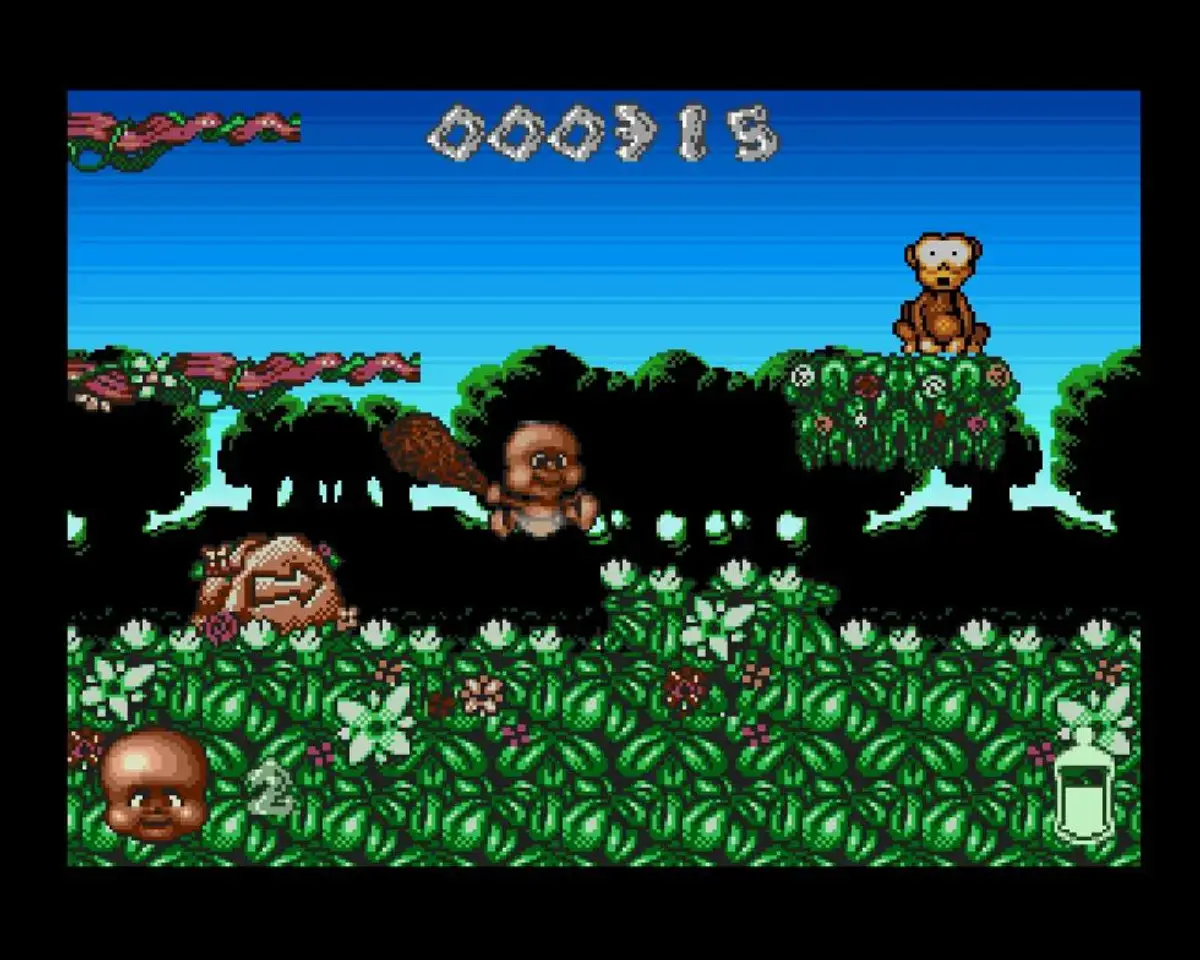
Core Design returned to its prehistoric comedy world in 1993 with Chuck Rock II: Son of Chuck. This time Chuck’s son, Chuck Junior, takes the lead: smaller, livelier and armed with a club. When Chuck is kidnapped, Junior must cross dinosaur-filled stages to rescue him.
This review focuses on the Amiga version. Its large sprites, busy backgrounds and slapstick tone give it the feel of an early-1990s European platformer with a personality all its own. Chuck Rock II also appeared on Amiga CD32, Mega Drive/Genesis, Sega CD, Master System and Game Gear.
A lighter, more agile sequel
Changing the hero changes the feel of the game. Chuck Junior moves with more flexibility than his father, while the club attack and clearly readable jump make the action easy to pick up. It may not have Mario’s precision or Sonic’s speed, but compared with the original, the sequel feels cleaner and less cumbersome.
The familiar side-scrolling structure mixes enemies, platforms and environmental obstacles with a few playful diversions. Junior can ride certain animals to reach places he could not access alone, adding variety to the straightforward platforming.
Chuck Rock II is a good platformer with personality, but it never quite finds the spark that would make it an essential classic.
Its levels rarely stray far from the formula. The design tends to guide rather than deeply challenge, and some difficulty comes from collisions, enemy placement and memorization instead of clever platforming. The result is enjoyable and charming, though more compelling as a distinctive piece of gaming history than as a genre-defining classic.
A distinctive Amiga look and sound
The Amiga version’s strongest asset is its presentation. Chuck Junior’s expressive sprites give the game a cartoon identity, while colorful backgrounds fill the prehistoric world with odd machines and comic details. The style feels distinctly European, with an illustrated quality that separates it from many Japanese console platformers of the same period.
The Amiga handles the artwork and large characters well, though the action does not always feel as smooth as the Mega Drive version can in motion. Some animations are charming; others seem stiff, and the overall pace may feel slow by modern standards.
Sound by Martin Iveson
Martin Iveson’s music supports the game’s comic prehistoric mood without demanding attention. It is upbeat and well made, if not among the era’s most memorable Amiga soundtracks. Simple sound effects underline attacks and comic moments, rounding out a pleasant presentation without elevating the game beyond its solid platforming foundations.
How the other versions compare
The Mega Drive/Genesis edition is the most natural comparison. Published by Virgin Interactive, it retains the game’s core identity while feeling well suited to a living-room console. The Amiga version, by contrast, keeps more of the character of a European home-computer production.
The Amiga CD32 release brought the game to Commodore’s CD console without radically changing the experience. Sega CD/Mega-CD also joined the game’s wider Sega presence, while Master System and Game Gear received more limited 8-bit adaptations. Those handheld and 8-bit editions are interesting curiosities, but the main comparison remains Amiga versus Mega Drive.
Verdict
Chuck Rock II: Son of Chuck remains enjoyable when approached with the right expectations. It is accessible, colorful and well made, but neither the deepest Amiga platformer nor the most technically refined. Its linear structure and occasional rough edges are more noticeable today, while the crowded platform-game field of 1993 made it harder to stand out.
Still, it is a worthwhile stop in Core Design’s pre-Tomb Raider history: a glimpse of a studio rooted in the European home-computer scene, already capable of building memorable characters and a strong visual identity.
Final score: 8.0/10. Recommended for fans of 1990s European platformers and anyone curious about Core Design before Tomb Raider.
Ratings
• Graphics: 8.5
• Sound: 8.0
• Gameplay: 8.0
• Longevity: 7.5
• Total: 8.0
What works and what does not
• Pros: Colorful, distinctive visuals; Chuck Junior feels lighter and more agile; good pacing for a European Amiga platformer.
• Cons: Level design is enjoyable but not memorable; the structure is rather linear; some collisions and situations feel dated.
Source: Retro-Gamers.it